

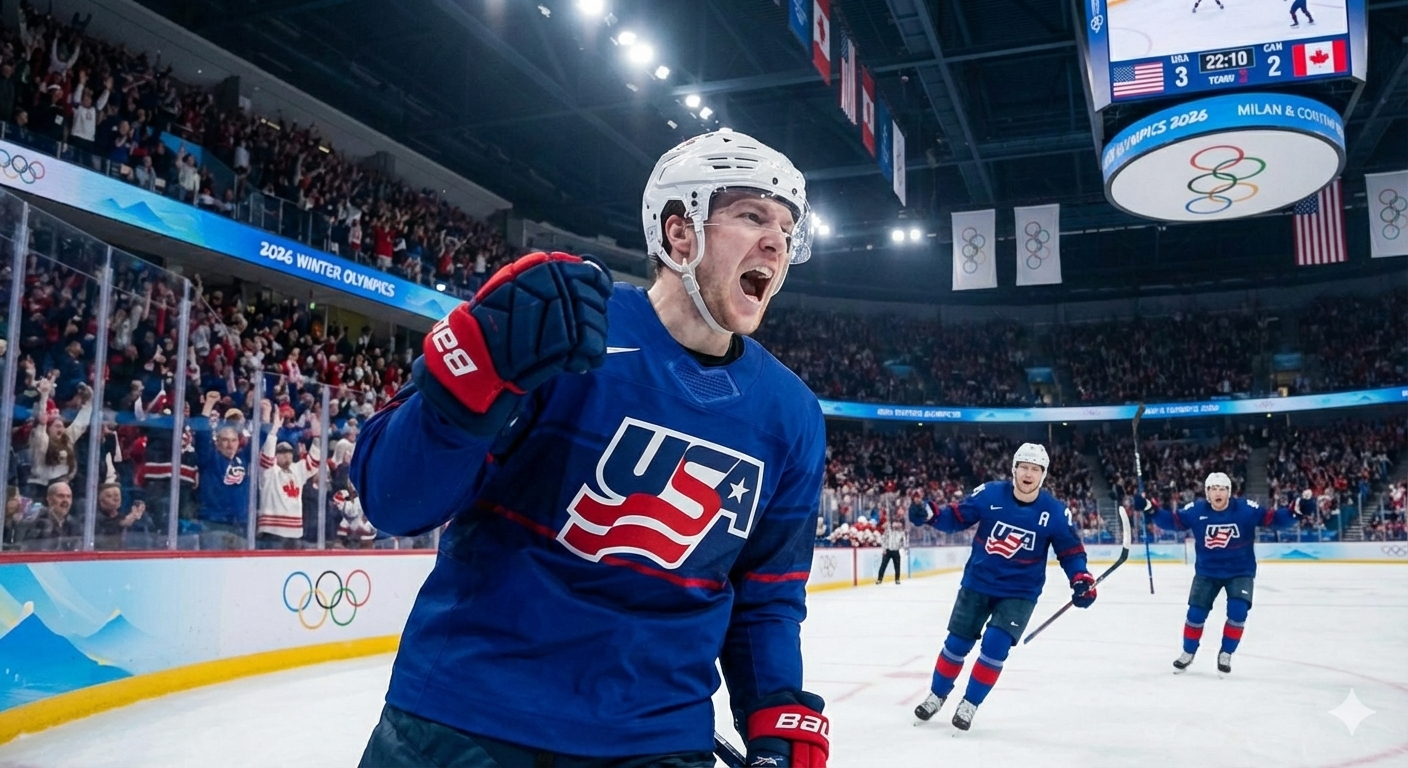
2026 Winter Olympics: Team USA Men’s Hockey Schedule and Results as Americans Chase First Gold Medal Since 1980 Miracle on Ice
As the 2026 Winter Olympics kick off in Italy, Team USA men’s hockey enters the tournament with its most talented roster in history and legitimate aspirations to end a 46-year gold medal drought that dates back to the legendary “Miracle on Ice” at Lake Placid in 1980.
The United States men’s hockey team arrives in Milan-Cortina d’Ampezzo carrying the weight of nearly five decades without Olympic gold, but also armed with perhaps the most formidable lineup ever assembled wearing the red, white, and blue. With NHL superstars headlining every position and momentum from recent international success, American hockey fans have legitimate reason to believe this could finally be the year their team returns to the top of the Olympic podium.
The tournament represents a historic opportunity for American hockey. Not since the amateur college players shocked the world by defeating the Soviet Union and Finland to claim gold in 1980 has the United States captured Olympic hockey’s ultimate prize. That iconic victory—forever known as the Miracle on Ice—remains one of the greatest moments in sports history, but the 46-year wait since then stands as a frustrating reminder of how elusive Olympic gold has proven for subsequent generations of American players.
The Return of NHL Stars Makes All the Difference
For the first time since the 2014 Sochi Olympics, NHL players will be competing at the Winter Games, fundamentally changing the competitive landscape and giving hockey powerhouse nations like the United States, Canada, Sweden, and Finland the opportunity to ice their absolute best players.
The NHL’s participation in the Olympics has been sporadic in recent years. Following disputes over insurance, scheduling, and other logistical concerns, the league declined to send players to the 2018 PyeongChang Games and the 2022 Beijing Olympics. The absence of NHL talent dramatically altered the competitive balance, with the Olympic Athletes from Russia winning gold in 2018 and Finland claiming their first-ever Olympic hockey gold in 2022.
Now, with the NHL back in the Olympic fold, the 2026 tournament promises to showcase hockey at its highest level, featuring the world’s elite players competing for national pride on the sport’s grandest international stage.
Team USA’s Star-Studded Roster

The American roster for the 2026 Olympics reads like an NHL All-Star team, featuring players who have won virtually every individual honor the league offers and who compete for the sport’s most prestigious franchises.
Leadership Core:
Toronto Maple Leafs superstar Auston Matthews has been named Team USA’s captain, a well-deserved honor for one of the game’s premier goal scorers. Matthews, who has won multiple Maurice “Rocket” Richard Trophies as the NHL’s leading goal scorer and captured the Hart Memorial Trophy as league MVP, brings elite offensive talent and veteran international experience to the leadership role.
Serving as alternate captains alongside Matthews are Matthew Tkachuk of the Florida Panthers and Charlie McAvoy of the Boston Bruins. Tkachuk, a power forward known for his physical play and clutch scoring ability, helped lead the Panthers to the Stanley Cup championship and brings a winning pedigree to the American lineup. McAvoy, one of the NHL’s premier two-way defensemen, provides leadership from the blue line and represents the backbone of Team USA’s defensive corps.
Goaltending Excellence:
Between the pipes, the United States boasts Connor Hellebuyck of the Winnipeg Jets, arguably the world’s best goaltender. Hellebuyck has won the Vezina Trophy (awarded to the NHL’s top goaltender) three times and captured the Hart Trophy as league MVP, a rare achievement for a netminder. His ability to steal games and perform under pressure makes him an invaluable asset in tournament play where a single exceptional goaltending performance can determine a team’s fate.
Defensive Depth:
The American blue line features Norris Trophy contenders Quinn Hughes of the Vancouver Canucks and Zach Werenski of the Columbus Blue Jackets. Hughes, known for his exceptional skating ability and offensive creativity from the back end, provides the kind of puck-moving skill that modern hockey demands. Werenski complements Hughes with his powerful shot and two-way reliability, giving Team USA one of the tournament’s most formidable defensive pairings.
The depth throughout the roster extends well beyond these headliners, with NHL stars at every position bringing a combination of skill, speed, and experience that makes the United States a legitimate gold medal threat.
High Expectations and Legitimate Gold Medal Aspirations
Team USA enters the 2026 Olympics as one of the tournament favorites, with oddsmakers and hockey analysts ranking them just behind archrival Canada in the race for gold. This favored status reflects both the exceptional talent on the American roster and the team’s recent success in international competition.
Momentum from 4 Nations Face-Off
The foundation for American optimism was laid at the 4 Nations Face-Off tournament held in early 2025. This event, featuring the United States, Canada, Sweden, and Finland, served as a preview of the Olympic hockey tournament and demonstrated that Team USA could compete with—and defeat—the world’s best.
During the preliminary round of the 4 Nations Face-Off, the Americans scored a significant victory over Canada, their primary rival for Olympic supremacy. The win showcased the American roster’s offensive firepower and proved they could match Canada’s intensity and skill in high-stakes competition.
However, the tournament ultimately ended in heartbreak for Team USA when they faced Canada again in the championship game. In a back-and-forth thriller that exemplified the intense rivalry between North America’s hockey powers, Canada emerged victorious, denying the Americans the tournament title but providing valuable lessons about competing under championship pressure.
That championship game loss, while disappointing, may ultimately benefit Team USA heading into the Olympics. The team now has recent experience in a winner-take-all game against their toughest competition, understanding what worked, what didn’t, and what adjustments they need to make when the stakes are highest.
The North American Rivalry: USA vs. Canada
For American hockey fans, the dream scenario for the 2026 Olympics involves a gold medal game rematch with Canada. The rivalry between these neighboring nations represents one of sports’ greatest competitive relationships, combining geographic proximity, cultural similarities, contrasting hockey philosophies, and genuine mutual respect.
Canada enters the tournament as the slight favorite, boasting its own collection of NHL superstars and a hockey culture that treats Olympic competition with reverence bordering on national obsession. Canadian players grew up dreaming of wearing the maple leaf and representing their country, creating an intensity and commitment that makes Canada perpetually dangerous in tournament hockey.
A potential USA-Canada gold medal game would captivate North American audiences and provide the kind of marquee matchup that defines Olympic hockey. The 4 Nations Face-Off demonstrated that when these teams meet, the result is typically thrilling hockey played at breakneck speed with championship implications hanging in the balance.
However, both teams must navigate through a challenging field before any such dream matchup can materialize.
Formidable International Competition
While much of the North American focus centers on the USA-Canada rivalry, several other nations enter the 2026 Olympics with legitimate aspirations of claiming gold and the talent to support those ambitions.
Sweden: Perennial Contenders
Sweden consistently produces elite hockey talent and boasts a national team program with deep Olympic experience. Swedish players combine exceptional fundamental skills with tactical discipline, making them difficult opponents who rarely beat themselves with mistakes.
The Swedish roster for 2026 features NHL stars across all positions, and their systematic approach to tournament hockey has produced Olympic medals in multiple recent Winter Games. Sweden won gold in 2006, silver in 2014, and bronze in 2018, demonstrating sustained excellence at the Olympic level.
Finland: Defending Champions
Finland enters the 2026 Olympics as the defending gold medalists, having captured their first-ever Olympic hockey championship at the 2022 Beijing Games when NHL players were absent. While that tournament featured different rosters than 2026 will showcase, the Finnish victory demonstrated the strength of their player development system and national team culture.
With NHL players now competing, Finland fields a more talented roster than the team that won in Beijing, potentially making them even more dangerous. Finnish hockey emphasizes defensive responsibility, goaltending excellence, and opportunistic offense—a formula that translates well to tournament play where games are often decided by narrow margins.
Other Medal Hopefuls
Beyond the traditional powers, several nations enter the 2026 Olympics with rosters capable of causing upsets and potentially challenging for medals:
Russia (competing under a neutral designation due to ongoing sanctions) possesses extraordinary talent despite political complications affecting their Olympic participation. Russian players excel in skill-based hockey and have won Olympic gold multiple times historically.
Czech Republic has a proud hockey tradition and periodically assembles rosters capable of defeating anyone on a given night, as evidenced by their gold medal victory at the 1998 Nagano Olympics.
Switzerland and Germany have developed increasingly competitive national programs, with growing numbers of players competing at the NHL level and improved results in international tournaments.
The depth of quality teams makes the Olympic hockey tournament uniquely challenging. Unlike NHL playoffs where series formats allow better teams to prove themselves over multiple games, the Olympic single-elimination knockout rounds mean that one bad period, one unlucky bounce, or one exceptional opposing goaltending performance can end a gold medal dream regardless of overall talent.
Team USA’s Preliminary Round Schedule and Path to Gold
The American journey toward potential Olympic gold begins with three preliminary round games designed to determine seeding for the quarterfinal knockout stage.
Preliminary Round Matchups
Game 1: USA vs. Latvia – Thursday, February 12 at 3:10 PM ET (USA Network)
Team USA opens tournament play against Latvia, a matchup where the Americans will be heavily favored. Latvia qualified for the Olympics through their placement in international rankings but lacks the NHL depth that characterizes the tournament’s elite teams.
For the United States, this opening game serves multiple purposes beyond simply securing a victory. It allows the coaching staff to evaluate line combinations in competitive action, helps players adjust to the Olympic ice surface and officiating tendencies, and provides an opportunity to build confidence and momentum heading into tougher tests.
The key for Team USA will be starting strong, establishing their game early, and avoiding the kind of sluggish performance that allows a significant underdog to gain confidence and potentially pull off a shocking upset. Olympic hockey history includes several stunning results where favored teams overlooked supposedly inferior opponents, and the Americans will want to avoid adding to that list.
Game 2: USA vs. Denmark – Saturday, February 14 at 3:10 PM ET (USA Network)
Denmark represents another opponent where Team USA should be favored, though the Danes have proven themselves capable of competitive hockey at the Olympic level. Denmark qualified for the 2022 Beijing Olympics and has gradually improved their international standing through better player development and increasing numbers of players competing in top European leagues.
While Denmark lacks the NHL star power that Team USA brings, they play a structured, defensively responsible style that can frustrate more talented opponents if those teams become impatient or overly individualistic. The United States will need to maintain discipline, stick to their systems, and use their superior skill to break down Danish resistance.
This game also provides Team USA with an opportunity to fine-tune their approach before facing a more significant preliminary round test in their third and final group stage game.
Game 3: USA vs. Germany – Sunday, February 15 at 3:10 PM ET (USA Network)
Germany presents the stiffest preliminary round challenge for the United States. The Germans have developed into a solid international hockey program, with increasing numbers of players competing in the NHL and top European leagues. Germany won silver at the 2018 PyeongChang Olympics (when NHL players were absent) and has demonstrated the ability to compete with elite teams when playing their best hockey.
This game could have significant implications for playoff seeding. The top teams from each preliminary round group receive favorable quarterfinal matchups, while lower seeds face tougher draws. A strong performance against Germany would position Team USA advantageously heading into the knockout rounds.
Beyond seeding considerations, the Germany game allows Team USA to test themselves against a well-coached, organized opponent that will provide a more realistic preview of the challenges awaiting in the medal rounds.
The Knockout Stage: Single-Elimination Pressure
Following the preliminary round, the Olympics hockey tournament transitions to single-elimination knockout play, where there are no second chances and every game becomes a potential season-ender.
Quarterfinals – Wednesday, February 18 at 3:10 PM ET
The quarterfinal round features the top eight teams from preliminary play, with matchups determined by group standings and seeding. For Team USA, securing a top seed would mean facing a theoretically weaker opponent, though Olympic hockey history shows that “weak” opponents can prove dangerous when facing elimination.
The quarterfinals represent the stage where Olympic dreams often end for talented teams. One bad game, one hot opposing goaltender, or one unfortunate bounce can send favored teams home without medals despite rosters laden with NHL All-Stars.
Semifinals – Friday, February 20 at 3:10 PM ET
Teams surviving the quarterfinals advance to the semifinals, now just one win away from guaranteeing an Olympic medal. The semifinals typically feature the tournament’s four strongest teams (though upsets sometimes disrupt this pattern), creating matchups of extraordinary quality and intensity.
For Team USA, reaching the semifinals would represent a successful Olympics in terms of meeting minimum expectations, but anything short of playing for gold would be considered disappointing given the talent on this roster.
Medal Games – Saturday, February 21 and Sunday, February 22
The Olympic hockey tournament concludes with the bronze medal game on Saturday, February 21 at 2:10 PM ET, followed by the gold medal game on Sunday, February 22 at 8:10 AM ET.
The early morning (U.S. time) gold medal game reflects the European host location, with the timing designed for prime viewing in European markets. American fans will need to set early alarms to watch what could be their team’s first Olympic gold medal game appearance since 2010 (when they lost to Canada in Vancouver) and first gold medal victory since 1980.
Historical Context: The Long Gold Medal Drought
To fully appreciate what an Olympic gold medal would mean for American hockey, it’s essential to understand the 46-year journey since the Miracle on Ice and the near-misses that have defined U.S. Olympic hockey in the intervening decades.
The Miracle on Ice: 1980 Lake Placid
The 1980 Olympic hockey tournament remains the gold standard for American hockey achievement. A team of amateur and college players, coached by Herb Brooks and given virtually no chance of medaling, shocked the world by defeating the seemingly invincible Soviet Union in the semifinals before clinching gold with a victory over Finland.
The semifinal victory over the Soviets—a team that had won gold in six of the previous seven Olympics and had defeated an NHL All-Star team just before the Games—ranks among the greatest upsets in sports history. Al Michaels’ iconic call of “Do you believe in miracles? YES!” as time expired has become permanently woven into American sports culture.
That gold medal represented more than just athletic achievement. Coming during the Cold War and a period of American economic uncertainty, the victory provided a sense of national pride and possibility that transcended sports. The team’s achievement has been commemorated in books, documentaries, and the Hollywood film “Miracle,” ensuring that each new generation of Americans knows the story.
However, that transcendent victory also created an impossibly high bar for subsequent American Olympic teams. Every four years since 1980, new U.S. rosters have carried the weight of those expectations while attempting to write their own golden chapter in American hockey history.
Decades of Near-Misses and Disappointments
The years following the Miracle on Ice have seen American teams achieve success at various levels while consistently falling short of Olympic gold:
1984 Sarajevo Olympics: The defending champions failed to medal, finishing seventh.
1988 Calgary Olympics: Another disappointing result with a seventh-place finish.
1992 Albertville Olympics: The U.S. finished fourth, just missing the podium.
1998 Nagano Olympics: The first Olympics featuring NHL players saw the U.S. finish sixth despite high expectations.
2002 Salt Lake City Olympics: On home ice with a star-studded roster including Brett Hull, Mike Modano, and Chris Chelios, the Americans won silver after losing the gold medal game to Canada. This remains the closest the U.S. has come to gold since 1980.
2006 Turin Olympics: A disappointing eighth-place finish.
2010 Vancouver Olympics: The U.S. won silver after another heartbreaking gold medal game loss to Canada, this time in overtime on Canadian ice. Ryan Miller’s exceptional goaltending throughout the tournament gave the Americans a chance, but Sidney Crosby’s “Golden Goal” extended American frustration.
2014 Sochi Olympics: Team USA finished fourth, losing the bronze medal game to Finland.
2018 PyeongChang Olympics: Without NHL players, the U.S. finished seventh.
2022 Beijing Olympics: Again without NHL players, the Americans failed to medal, finishing a disappointing sixth.
This history demonstrates that American hockey has produced talented teams and memorable moments, but converting that talent into Olympic gold has proven elusive for nearly half a century.
What Makes 2026 Different?
Several factors suggest that the 2026 Olympics represent a genuinely special opportunity for Team USA to end the gold medal drought:
Unprecedented Roster Depth
While previous American Olympic teams have featured NHL stars, the 2026 roster combines elite talent at every position with remarkable depth that allows the team to roll multiple dangerous lines. The gap between the top American players and those filling out the fourth line is smaller than in previous Olympic years, giving the U.S. the ability to match up against any opponent and maintain pressure throughout games.
Recent Success Builds Confidence
The 4 Nations Face-Off victory over Canada demonstrated that this core group of players can defeat their primary rival on a neutral site in meaningful competition. While the championship game loss provided a dose of humility, the overall tournament showed that Team USA belongs in the conversation as a legitimate gold medal contender.
Balanced Team Construction
Previous American Olympic teams sometimes overemphasized offensive firepower while undervaluing defensive responsibility and two-way play. The 2026 roster appears better balanced, with elite defenders like Hughes and Werenski, defensive forwards who can shut down opponents’ top lines, and goaltending excellence from Hellebuyck.
Motivated Leadership
Captain Auston Matthews and the leadership group have experienced frustration in international competition previously. Matthews, despite his NHL success, has yet to capture major international gold as a professional. That hunger to achieve something that has eluded him could drive exceptional performances when the stakes are highest.
Favorable Tournament Location
While Italy represents a neutral site rather than home ice, the European time zones and travel may actually benefit North American teams more than tournaments held in Asia have. The Americans should be well-rested and acclimated, without the jet lag and disrupted circadian rhythms that affected teams in previous Olympics.
Keys to American Success
For Team USA to convert gold medal potential into actual gold medals, several factors will prove critical:
Goaltending Excellence
Olympic hockey tournaments are often decided by goaltending. Connor Hellebuyck gives the Americans arguably the world’s best netminder, but he must perform at his absolute peak when facing elimination games and the world’s elite shooters. One exceptional goaltending performance can steal a game; a series of them can steal a gold medal.
Power Play Efficiency
With the offensive talent Team USA possesses, the power play should be a devastating weapon. Converting man-advantage opportunities often provides the difference in tight games against defensive-minded opponents. The Americans must capitalize on power plays while maintaining discipline to avoid giving opponents the same opportunities.
Defensive Responsibility
In tournament hockey, one defensive breakdown can end a gold medal dream. Team USA must maintain systematic defensive play even when trailing or frustrated, trusting that their offensive talent will eventually create opportunities rather than taking risks that expose them to counterattacks.
Staying Healthy
The single-elimination format means that losing a key player to injury at the wrong time can derail even the most talented team. Managing minutes, avoiding unnecessary physical risks in games that are already decided, and having organizational depth to absorb injuries all matter in tournament success.
Mental Toughness
Olympic hockey inevitably includes adversity—bad bounces, questionable referee calls, momentum swings. Teams that win gold typically demonstrate the mental fortitude to weather difficult moments without panicking or abandoning their systems. For Team USA, maintaining confidence and composure regardless of circumstances will be essential.
The American Hockey Community’s Hope
For the American hockey community—from youth players and their families to college programs, NHL organizations, and longtime fans—the 2026 Olympics represent more than just another tournament. A gold medal would validate decades of player development, organizational growth, and investment in the sport at all levels.
American hockey has grown tremendously since 1980. Youth participation has exploded, the NCAA hockey landscape has expanded, USA Hockey’s development programs have become increasingly sophisticated, and American players now dominate NHL rosters in ways unimaginable in previous generations.
A gold medal in 2026 would demonstrate that American hockey has truly arrived as a global power capable of sustained excellence at the sport’s highest levels. It would inspire the next generation of American players and potentially accelerate hockey’s growth in non-traditional markets across the United States.
Conclusion: A Nation Watches and Waits
As the puck drops on Team USA’s preliminary round opener against Latvia, American hockey fans will be watching with a mixture of excitement, hope, and perhaps a touch of anxiety born from 46 years of waiting.
This team has everything needed to win gold: elite talent, experienced leadership, recent success against top competition, and the hunger to achieve something that has eluded American hockey for nearly half a century.
Whether they can convert that potential into reality remains to be seen. Olympic hockey’s single-elimination format means that even the most talented teams face razor-thin margins for error. One bad game, one hot opposing goaltender, or one unlucky bounce can send dreams crashing down regardless of roster quality.
But for the first time since perhaps the 2010 Vancouver Olympics, the United States enters Olympic hockey competition with genuine, legitimate belief that this could be the team that finally brings gold back to America.
The schedule is set. The roster is assembled. The stage is prepared.
Now Team USA must go out and end 46 years of frustration, honoring the legacy of the Miracle on Ice while creating their own golden moment in hockey history.
The wait is almost over. The opportunity is here. Team USA’s quest for Olympic gold begins now.
Also Read this:
2026 T20 World Cup: ICC Warning Issued To PCB Over India Boycott
Social Connect:

