

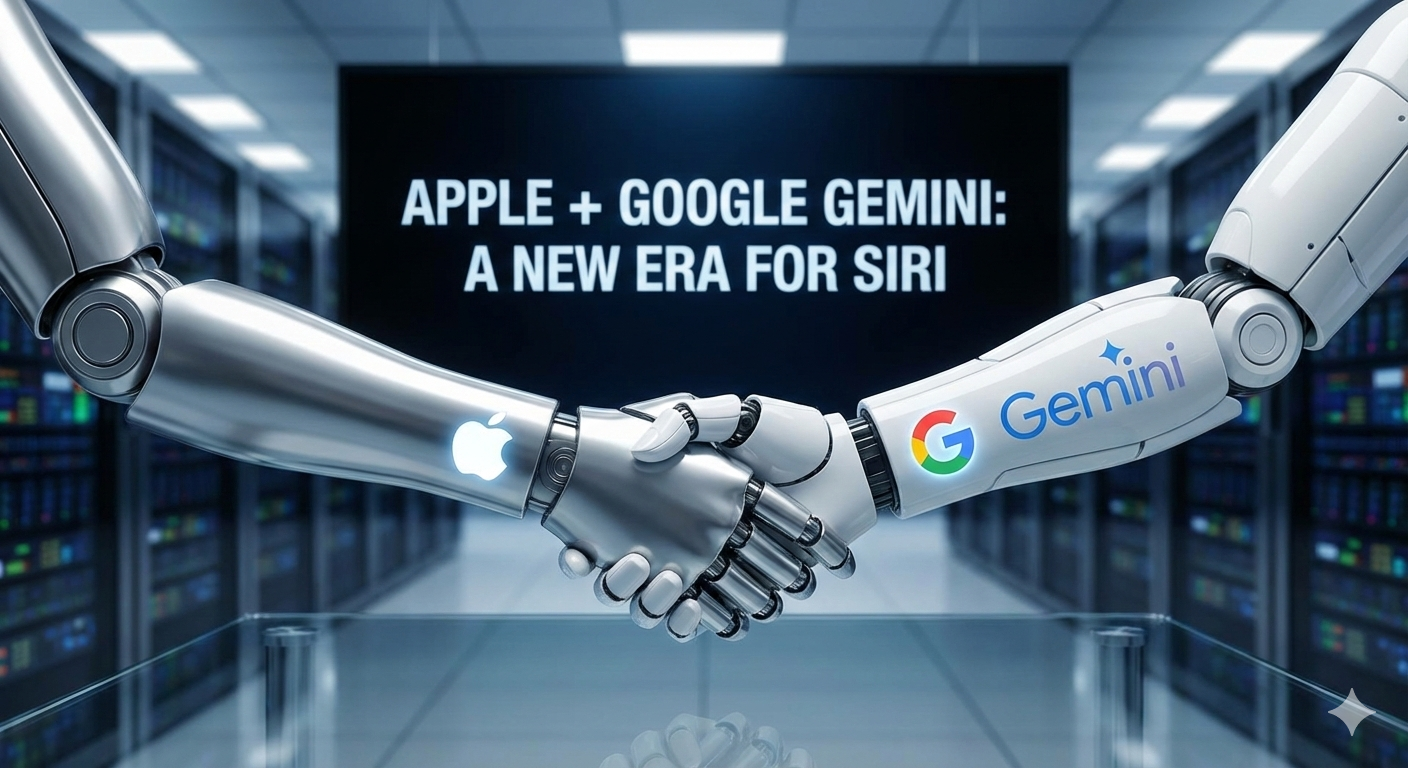
Apple Partners with Google Gemini to Power Next-Generation Siri in Multi-Billion Dollar AI Deal
Tech giants announce multi-year collaboration as Apple bets on Google’s AI to finally deliver smarter voice assistant expected in spring 2026
Published: January 13, 2026 | New York, NY
Apple made a stunning pivot in its artificial intelligence strategy Monday, announcing a multi-year partnership with Google that will see the search giant’s Gemini AI models power the next generation of Siri and other Apple Intelligence features—marking one of the most significant collaborations between the two Silicon Valley rivals in over a decade.
The groundbreaking deal, which could cost Apple approximately $1 billion annually according to Bloomberg reports, positions Google’s advanced Gemini technology as the foundation for Apple’s long-delayed Siri overhaul expected to launch as part of iOS 26.4 in March or April 2026.
“After careful evaluation, Apple determined that Google’s AI technology provides the most capable foundation for Apple Foundation Models and is excited about the innovative new experiences it will unlock for Apple users,” the companies said in a joint statement released Monday morning.
Google’s Market Cap Hits $4 Trillion on Apple Partnership News
Wall Street celebrated the announcement, with shares of both Apple (AAPL) and Google parent Alphabet (GOOGL) climbing nearly 1% in midday trading Monday. The bump pushed Google’s market capitalization past $4 trillion for the first time in intraday trading, making it the fourth publicly traded company to reach the milestone after Nvidia, Microsoft, and Apple achieved it in 2025.
The partnership represents a major victory for Google CEO Sundar Pichai in Silicon Valley’s escalating AI arms race. Securing Apple as a client gives Gemini instant access to more than 2 billion active devices worldwide—Siri currently processes 1.5 billion user requests daily—while validating Google’s AI technology against fierce competition from OpenAI, Anthropic, and Meta.

Apple’s Delayed Siri Upgrade Finally Gets AI Boost
The Gemini integration addresses Apple’s most glaring weakness in the AI revolution. While competitors like Microsoft, Google, and even Samsung have rolled out AI-powered assistants and features over the past two years, Apple’s promised Siri overhaul—first unveiled at the company’s 2024 Worldwide Developers Conference—has faced repeated delays that fueled concerns about the iPhone maker falling hopelessly behind.
“It’s going to take us longer than we thought to deliver on these features and we anticipate rolling them out in the coming year,” Apple admitted in previous statements about the delays. The company had to completely overhaul Siri’s underlying architecture after initial attempts proved inadequate.
The revamped Siri will be able to handle more complex queries, complete sophisticated multi-step tasks across multiple apps, and function more like ChatGPT or Claude—though Apple isn’t planning a dedicated chatbot application. The assistant will leverage Google’s massive 1.2 trillion parameter AI model, which dwarfs Apple’s current 150 billion parameter cloud-based model.
How the Partnership Actually Works: Privacy Protections Remain
Despite widespread confusion and concern among Apple users, the Gemini deal doesn’t mean Google will be processing user data or that Siri is being “taken over” by Google technology. Instead, Apple will use Gemini as a training foundation while maintaining complete control over the end-user experience.
“Apple Intelligence will continue to run on Apple devices and Private Cloud Compute, while maintaining Apple’s industry-leading privacy standards,” the companies emphasized in their statement.
Translation: Google’s Gemini models will help train and improve Apple’s own proprietary Foundation Models, but all actual user interactions will happen on Apple’s hardware or secure cloud infrastructure. Google won’t see user queries, won’t collect personal data, and users won’t see any Gemini branding when they talk to Siri.
“This deal is fundamentally different from the Google Search one, as it is completely obfuscated from the end user,” explained AppleInsider in detailed technical analysis. “Talking to Siri won’t produce some kind of Gemini logo, nor should it.”
Apple Evaluated OpenAI and Anthropic Before Choosing Google
The partnership wasn’t Apple’s first choice. According to Bloomberg, Apple spent months testing AI models from multiple competitors including OpenAI’s GPT and Anthropic’s Claude before ultimately selecting Google’s Gemini—largely due to financial terms and technical capabilities.
Apple previously evaluated Anthropic but determined the AI startup’s fees were too high. The decision to partner with Google also makes strategic sense given the companies’ existing $20 billion annual search deal, which has Google paying Apple to remain the default search engine on iPhones and other Apple devices.
That lucrative arrangement faced scrutiny in August 2024 when a federal judge ruled that Google acted illegally to maintain a monopoly in online search. However, a September decision avoided a worst-case scenario that could have forced Google to divest its Chrome browser and allowed the companies to continue their partnership.
What Happens to ChatGPT Integration on iPhone?
Apple’s existing partnership with OpenAI to integrate ChatGPT into Siri and Apple Intelligence features will continue unchanged, according to statements to CNBC. The ChatGPT integration, which launched in 2025, allows iPhone users to optionally route complex queries requiring broad world knowledge to OpenAI’s chatbot.
However, Monday’s announcement clearly positions Google Gemini as the cornerstone of Apple’s long-term AI infrastructure, not ChatGPT. Questions remain about how Apple will balance these dual AI partnerships and whether one will eventually supersede the other as the technology matures.
The non-exclusive nature of Apple’s Google deal leaves the door open for the company to pivot again if needed—or to eventually transition to fully in-house AI models once they reach sufficient capability.
Elon Musk Blasts Deal as “Unreasonable Concentration of Power”
Not everyone celebrated the Apple-Google partnership. Elon Musk, CEO of AI startup xAI and creator of Gemini competitor Grok, immediately criticized the deal on his X social media platform.
“This seems like an unreasonable concentration of power for Google, given that they also have Android and Chrome,” Musk wrote shortly after the announcement, warning that Google’s control across mobile operating systems, web browsers, and now Apple’s AI features could stifle competition.
Musk’s criticism carries obvious self-interest—his xAI company is currently suing Apple and OpenAI over their ChatGPT partnership, alleging that Apple’s App Store policies give OpenAI unfair advantages and make it impossible for rivals like Grok to compete effectively. That lawsuit survived dismissal attempts and is scheduled to proceed despite being “widely discredited” by legal experts.
The billionaire previously threatened to ban iPhones from his companies if Apple integrated OpenAI technology due to security concerns. His latest comments suggest he views the Google partnership as an even greater threat to xAI’s viability.
Neither Apple nor Google publicly responded to Musk’s criticism, and analysts don’t expect either company to engage with his complaints.
Wall Street Applauds Apple’s “Invisible AI Strategy”
Market analysts praised the partnership as addressing long-standing concerns about Apple’s AI capabilities—or lack thereof.
“This is what the Street has been waiting for with the elephant in the room for Cupertino revolving around its invisible AI strategy,” said Wedbush tech analyst Dan Ives in emailed commentary. “We believe this is an incremental positive to both” Apple and Google.
The deal comes at a critical time for Apple, which is betting that enhanced AI capabilities will revitalize iPhone sales after several challenging years. According to analyst estimates compiled by FactSet, Apple is projected to report approximately 11% year-over-year iPhone sales growth for the December quarter when earnings are released later this month—with total quarterly profits expected to exceed $39 billion, representing nearly 8% growth.
Apple desperately needs a hit AI feature to justify its premium pricing in an increasingly competitive smartphone market where Android manufacturers have already integrated advanced AI capabilities into their flagship devices.
Google’s Cloud Business Booms on AI Deals
For Google, the Apple partnership validates the company’s massive investments in AI infrastructure and model development. CEO Sundar Pichai revealed in October 2025 that Google Cloud signed more deals worth over $1 billion through the first three quarters of 2025 than in the previous two years combined—a clear sign that enterprises are betting big on Google’s AI technology.
Google introduced its upgraded Gemini 3 model in late 2025, positioning it as a direct competitor to OpenAI’s GPT-4 and Anthropic’s Claude. Independent benchmarks show Gemini 3 now leads most industry metrics used to determine AI model proficiency, giving Google ammunition in its battle for AI supremacy.
The search giant’s AI comeback represents a remarkable turnaround after OpenAI’s ChatGPT launch in late 2022 briefly made Google look like a dinosaur. In 2025, Google logged its best year since 2009, with the stock surging on strong AI momentum and surpassing Apple in market capitalization last week for the first time since 2019.
Apple’s Long-Term AI Strategy: Build In-House Models
While the Google partnership solves Apple’s immediate AI problem, it’s likely a temporary solution. According to sources familiar with Apple’s roadmap, the company is actively developing its own 1 trillion parameter cloud-based model that could be ready as soon as 2027.
This mirrors Apple’s historical pattern of relying on external partners while building internal capabilities:
- Leaned on Google Maps until Apple Maps was ready
- Used Weather Channel data until developing in-house weather services
- Depended on Intel and Qualcomm chips until Apple Silicon arrived
- Now leaning on Gemini until Apple’s AI models mature
“This is a stop gap to give Apple all the time it needs to get this right, since they got it so publicly wrong the first time, yet can’t risk not shipping an enhanced Siri in 2026,” explained one MacRumors forum commenter, capturing Apple’s strategic dilemma.
Even when Apple’s own trillion-parameter model launches, the company will likely maintain the Google relationship for reinforcement learning, model comparison, and continuous improvement—similar to how it still uses multiple suppliers for iPhone components despite developing its own chips.
What iPhone Users Can Expect in Spring 2026
When the Gemini-powered Siri finally launches as part of iOS 26.4 (expected in March or April), users can anticipate:
More Capable Voice Assistant:
- Complex multi-step task completion across multiple apps
- Better understanding of context and follow-up questions
- Improved natural language processing for conversational queries
- Enhanced summarization and content generation capabilities
Seamless App Integration:
- Deep hooks into third-party apps via App Intents framework
- Ability to coordinate actions across different applications
- More sophisticated automation and shortcuts
On-Device and Cloud Processing:
- Simple requests handled entirely on iPhone for speed and privacy
- Complex queries routed to Apple’s secure Private Cloud Compute
- Gemini-trained models running behind the scenes without Google seeing user data
Maintained Privacy Standards:
- No data sharing with Google despite using Gemini foundation
- Continued emphasis on on-device processing where possible
- Encryption and privacy protections for cloud-processed requests
CEO Tim Cook confirmed the spring timeline but hasn’t provided a specific launch date. Based on Apple’s historical release patterns, iOS 26.4 typically arrives in late March or early April.
Broader Implications for Tech Industry Competition
The Apple-Google partnership signals a significant shift in how tech giants approach the AI race. Even fierce competitors now recognize that collaboration may be necessary to deliver cutting-edge capabilities as AI model development becomes increasingly expensive and complex.
“The global AI market is expected to reach hundreds of billions of dollars in the coming years, and strategic partnerships like this one may become increasingly common,” noted industry analysts.
The deal also highlights the concentration of AI power in the hands of a few dominant players. Google, Microsoft (via OpenAI), and Anthropic (backed by Amazon) control the most advanced large language models, forcing even a company as wealthy and technically sophisticated as Apple to partner rather than build everything from scratch.
Regulatory scrutiny of these partnerships will likely intensify. The U.S. Department of Justice is already investigating Google’s search monopoly, and Musk’s complaints about “unreasonable concentration of power” echo concerns from antitrust advocates about a few companies controlling critical AI infrastructure.
Looking Ahead: The AI Assistant Wars Heat Up
With Apple finally entering the AI assistant race in earnest, competition will intensify across the industry:
Google Assistant gains validation and reach through the Apple partnership while maintaining its Android ecosystem presence.
Amazon Alexa faces increased pressure as both Apple and Google leverage more sophisticated AI models.
Microsoft Copilot (powered by OpenAI) competes across Windows, Office, and enterprise markets.
OpenAI’s ChatGPT maintains its partnership with Apple while watching Google encroach on its territory.
Anthropic’s Claude serves enterprises and API customers but lacks consumer device distribution.
Meta’s Llama powers Facebook/Instagram AI features and open-source projects.
xAI’s Grok struggles for relevance despite Musk’s social media platform integration.
The next 12-18 months will determine which AI assistants gain lasting traction with consumers. Apple’s massive installed base gives it a potential advantage, but only if the Gemini-powered Siri delivers a genuinely improved experience compared to today’s often-frustrating voice assistant.
For now, Apple and Google have joined forces in a pragmatic marriage of convenience—one that could reshape the AI landscape for years to come while raising important questions about innovation, competition, and the concentration of technological power.
Key Takeaways
- Apple partners with Google to use Gemini AI models for next-generation Siri
- Multi-year deal could cost Apple $1 billion annually
- Enhanced Siri expected to launch with iOS 26.4 in March/April 2026
- Google’s market cap hits $4 trillion milestone on partnership news
- User data stays on Apple devices/servers—Google doesn’t see queries
- ChatGPT integration continues alongside Gemini partnership
- Elon Musk criticizes deal as “unreasonable concentration of power”
- Apple developing own 1 trillion parameter AI model for potential 2027 launch
Related Topics: Apple Siri upgrade, Google Gemini AI, Apple Intelligence features, iPhone AI capabilities, tech partnerships 2026, AI assistant competition, Apple vs OpenAI, Elon Musk xAI criticism, iOS 26.4 release date, Google AI market dominance
Another News :
Social Connect

