

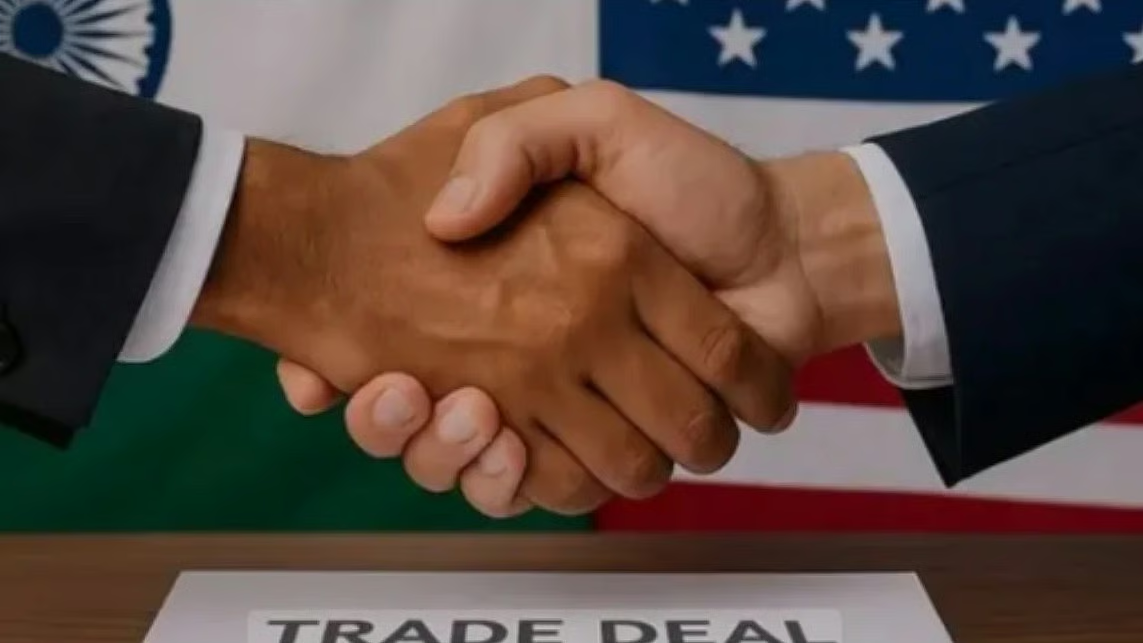
A New Era of Global Commerce: The “Historic” India-US Trade Deal of 2026
NEW YORK / NEW DELHI — In a move that has sent shockwaves through global markets and redefined the geopolitical landscape of the mid-2020s, United States President Donald Trump and Indian Prime Minister Narendra Modi have finalized a landmark trade agreement. Announced late Monday following a high-stakes telephone conversation, the deal effectively ends a year of escalating “tariff wars” and signals a profound shift in strategic bilateral cooperation between the world’s two largest democracies.
The agreement, which went into effect immediately on February 3, 2026, slashes the total U.S. tariff on Indian goods from a staggering 50% to a more competitive 18%. In return, India has committed to a sweeping “Buy American” initiative, pledging over $500 billion in purchases across the energy, technology, and agricultural sectors while promising to phase out its reliance on Russian crude oil.
US Justice Department Launches Federal Civil Rights Investigation Into Killing Of Alex Pretti
The Architect of the Deal: Resolving the Tariff Deadlock
For much of 2025, the economic relationship between Washington and New Delhi was under severe strain. Following the implementation of a 25% “reciprocal tariff” by the Trump administration in April 2025, tensions peaked in August when an additional 25% punitive duty was applied specifically to counter India’s continued purchase of discounted Russian oil. This 50% wall threatened to derail India’s “Make in India” ambitions and hammered key export sectors such as textiles, gems, and automotive parts.
The resolution of this conflict is being hailed as a masterstroke of strategic bilateral cooperation. By reducing the reciprocal rate to 18% and entirely rescinding the punitive 25% levy linked to Russian energy, the U.S. has provided Indian exporters with a vital lifeline. Prime Minister Modi welcomed the news on social media, stating that the deal “unlocks immense opportunities” for the 1.4 billion people of India.
Energy Sovereignty and the Pivot from Russia
Perhaps the most significant component of this strategic bilateral cooperation is India’s agreement to halt purchases of Russian crude oil. Since 2022, India had emerged as the largest buyer of seaborne Russian oil, a point of constant friction with Washington.
Under the new terms, India will pivot its energy sourcing toward the United States and potentially Venezuela. This shift is not merely economic; it is a calculated geopolitical move. President Trump noted that this agreement would help “end the war in Ukraine” by significantly choking off the revenue streams that have sustained the Russian military effort. This alignment demonstrates how strategic bilateral cooperation can serve as a tool for international diplomacy beyond simple trade metrics.
The $500 Billion Commitment: Agriculture, Tech, and Coal
The scale of the “Buy American” commitment is unprecedented. India’s pledge to purchase $500 billion worth of U.S. goods by 2030 covers several critical areas:
-
Energy and Coal: To replace Russian supplies, India will significantly increase its intake of American Liquefied Natural Gas (LNG) and metallurgical coal, supporting the U.S. energy sector.
-
Technology and AI: With both nations seeking to de-risk their supply chains from China, strategic bilateral cooperation in high-tech manufacturing and AI infrastructure has become a priority.
-
Agriculture: The deal aims to lower India’s notoriously high barriers to American agricultural products, providing U.S. farmers in the Midwest with a massive new market for poultry, dairy, and grains.
The move toward “Zero Tariffs” and the elimination of non-tariff barriers by the Indian side represents a fundamental restructuring of its domestic trade policy, aimed at fostering a deeper level of strategic bilateral cooperation.
Market Reaction: A “Wall Street to Dalal Street” Rally
Financial markets responded with immediate euphoria. In India, the GIFT Nifty surged by nearly 800 points, and the Rupee saw a sharp recovery from its record lows near 89 per USD. Analysts suggest that the removal of policy uncertainty is the “catalyst” global investors have been waiting for to return to Indian equities.
“This is the ‘mother of all deals’ for the Indo-Pacific region,” noted one senior economist at the Atlantic Council. “By securing a tariff rate lower than regional competitors like Vietnam (20%) and Pakistan (19%), India has secured a massive competitive edge, all thanks to this renewed strategic bilateral cooperation.”
Geopolitical Implications: The Indo-Pacific Balance
Beyond the balance sheets, the deal acts as a bulwark against regional instability. By strengthening the economic ties between Washington and New Delhi, the two nations are sending a clear signal to Beijing. The deal places India in a unique position—enjoying significantly lower U.S. tariffs than China, which currently faces an average levy of 34%.
This level of strategic bilateral cooperation ensures that India remains the primary alternative for global companies looking to “China-plus-one” their manufacturing bases. US Ambassador to India, Sergio Gor, emphasized that the relationship is now “stronger than ever,” rooted in mutual respect and shared economic goals.
Trump hails ‘historic bond’ with India on Republic Day amid trade strains – India Today
Challenges and “Loose Ends”
While the mood in both capitals is celebratory, critics and trade experts warn of “loose ends.” The Indian opposition has raised concerns over the “capitulation” on Russian oil, questioning how it might affect India’s long-standing diplomatic ties with Moscow. Furthermore, the transition to “Zero Tariffs” on U.S. goods will be a complex process that may face pushback from local Indian manufacturers who have long enjoyed protectionist policies.
However, the prevailing sentiment is that the benefits of strategic bilateral cooperation far outweigh the short-term adjustment pains. The agreement provides a roadmap for how two large, complex economies can find common ground despite ideological and historical differences.
A Blueprint for the Future
As we look toward the remainder of 2026, the India-US trade deal stands as a definitive moment in 21st-century commerce. It proves that strategic bilateral cooperation can dismantle even the most stubborn trade barriers when there is a shared vision for growth and security.
The success of this deal will ultimately be measured by the number of jobs created in the American heartland and the speed at which “Made in India” products fill shelves across the United States. For now, the world watches as these two “natural allies” embark on their most ambitious economic journey yet.
Social Connect:

