

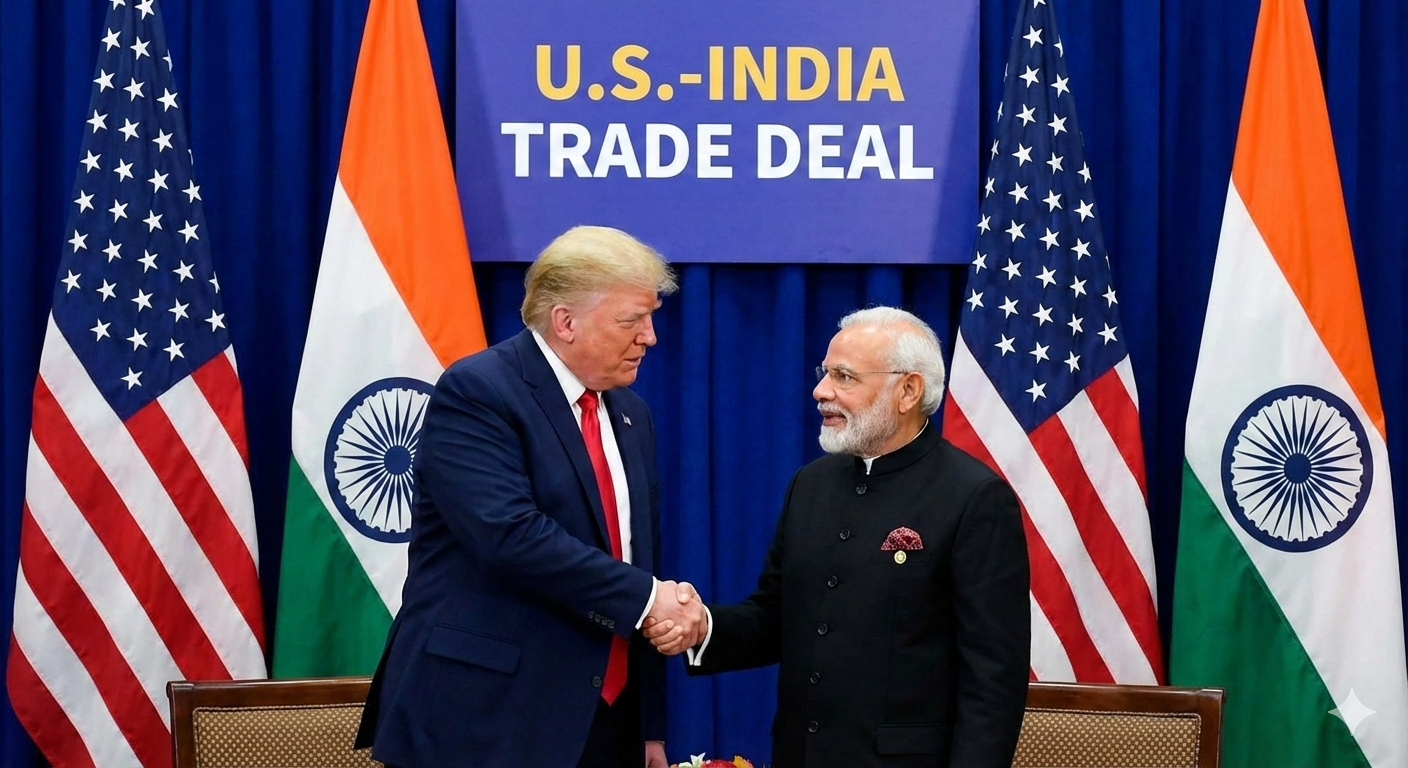
Trump Strikes U.S.-India Trade Deal, Slashing Tariffs from 50% to 18% — But Key Details Remain Murky
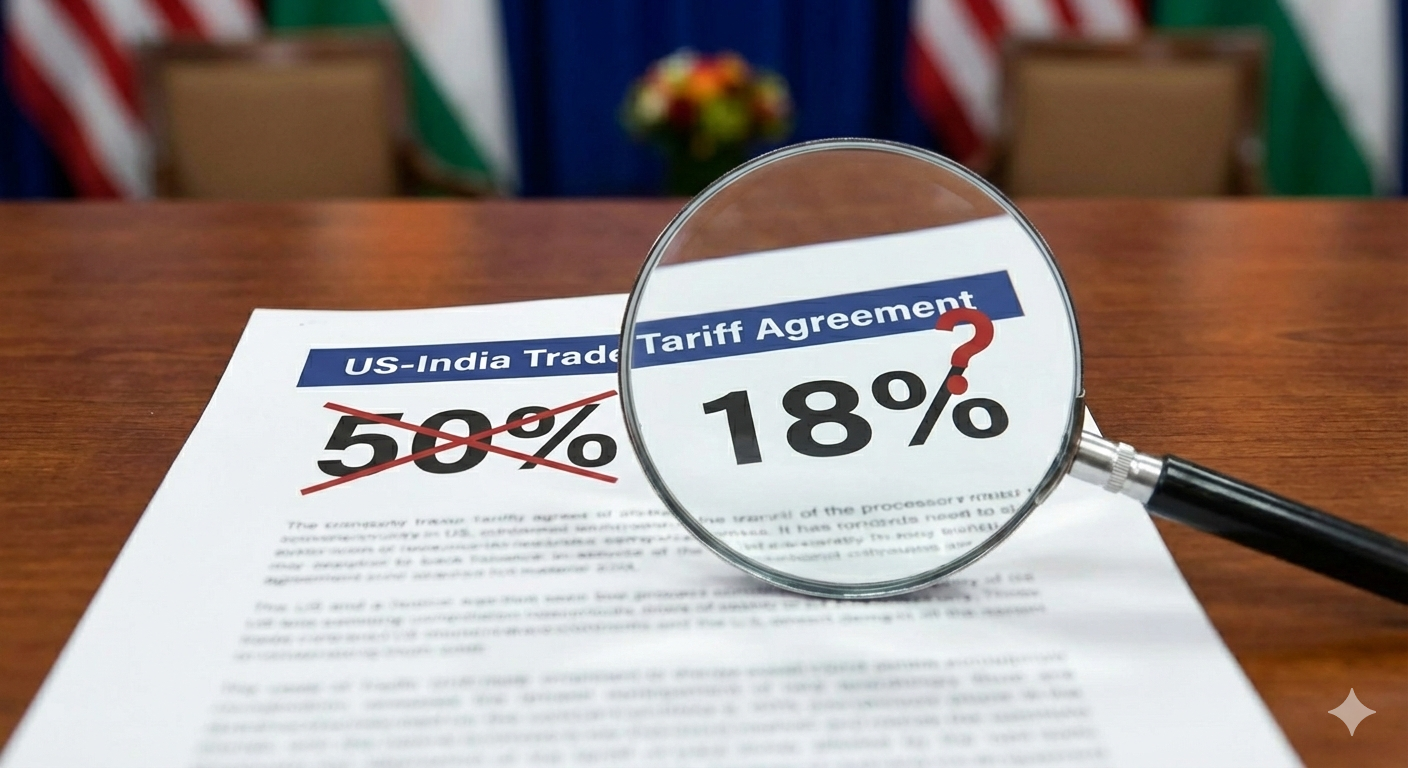
President Donald Trump announced Monday that the United States and India have reached a trade agreement that will cut U.S. tariffs on Indian goods from 50% to 18%, while India reportedly agreed to halt purchases of Russian oil and commit to buying over $500 billion in American products. The deal, announced just one week after the European Union locked in its own trade pact with New Delhi, sent Asian stock markets surging — but economists and legal experts are warning that the fine print has yet to materialize.
LATEST UPDATE (Feb. 3, 2026): India’s Commerce Minister Piyush Goyal confirmed that both countries will sign a formal trade deal “shortly,” and a joint statement is expected upon finalization. However, India has notably avoided confirming Trump’s claim that New Delhi will stop purchasing Russian oil — a critical element of the agreement. Asian markets rallied sharply, with India’s benchmark Nifty 50 index surging 2.5% on Tuesday. Legal experts and lawmakers are also questioning whether Trump has the constitutional authority to finalize binding trade deals without congressional approval.
50% → 18%
U.S. TARIFF CUT ON INDIAN GOODS
$212.3B
TOTAL U.S.-INDIA TRADE (2024)
Trump Announces the Deal — What We Know So Far
President Trump made the announcement Monday evening via his Truth Social media platform, stating that the agreement was reached following a phone call with Indian Prime Minister Narendra Modi. According to Trump’s post, the deal would take effect “immediately,” reducing the reciprocal tariff on Indian goods from 25% to 18%. The White House separately confirmed that an additional 25% punitive tariff — imposed on India last summer over its purchases of Russian crude oil — would also be removed, bringing the total tariff reduction from 50% down to 18%.
Trump stated that Modi had committed to purchasing “over $500 billion dollars of U.S. energy, technology, agricultural, coal, and many other products,” and that India would reduce its own tariffs and non-tariff barriers against American goods to zero. He also claimed that India had agreed to stop buying Russian oil entirely, redirecting those energy purchases toward the United States and potentially Venezuela.
Modi’s Response Tells a Different Story
Indian Prime Minister Modi confirmed the tariff reduction in a post on X (formerly Twitter), expressing that he was “delighted that Made in India products will now have a reduced tariff of 18%.” However, Modi’s statement made no mention of halting Russian oil purchases, no reference to the $500 billion buying commitment, and notably avoided using the words “trade deal” altogether — a discrepancy that analysts say could signal significant gaps between what both sides agreed to.
“It’s no deal, but just a declaration by both leaders when nothing has been signed. So far, whatever little has been revealed, it’s already a bad deal for India.”
The EU Factor: Why Trump Moved So Fast
The speed at which the U.S.-India agreement was announced has raised eyebrows among trade analysts, particularly because it came just seven days after the European Union and India finalized their own landmark free trade agreement. The EU-India FTA — hailed by Brussels as the “mother of all deals” after nearly two decades of negotiations — will slash tariffs on most goods between the two blocs to near zero, though the reductions will be phased in gradually over several years.
Many observers believe the EU deal directly accelerated Washington’s timeline. With India gaining preferential access to a 2-billion-person European market, U.S. businesses faced the prospect of being undercut by European competitors unless Washington acted quickly to secure comparable trade terms with New Delhi.
A Race to Lock Down India
Terry Haines, founder of analysis firm Pangaea Policy, called the U.S.-India deal “an emphatic answer to those thinking the EU is flanking or gaining speed on the U.S. on trade.” Haines noted on LinkedIn that the agreement is a signal that Trump is “walking and chewing gum at the same time,” balancing geopolitical strategy with economic deal-making simultaneously.
Arpit Chaturvedi, South Asia advisor at Teneo, agreed that the U.S.-India deal must be understood in the context of the EU pact. “That deal lifted some pressure on New Delhi by providing an alternative Western economic anchor amid global tariff volatility,” he said. “Even so, the U.S. agreement carries greater strategic weight. Stabilizing trade ties with Washington reinforces India’s place within Western supply chains and strategic calculus.”
| FEATURE | U.S.-INDIA DEAL | EU-INDIA FTA |
|---|---|---|
| Announced | February 2, 2026 | January 26, 2026 |
| Tariff Target | 18% (from 50%) | Near zero (phased) |
| Implementation | Claimed “immediately” | Gradually over years |
| Market Size | 330 million (U.S.) | 450 million (EU) |
| Formal Signing | Pending | Completed |
| Details Released | Very limited | Comprehensive |
The Russian Oil Question: India’s Biggest Sticking Point
Perhaps the most consequential — and most uncertain — element of the deal involves India’s commitment to stop purchasing Russian oil. India currently imports roughly 1.5 million barrels of Russian crude per day, accounting for more than one-third of the country’s total oil imports. Russian oil has traded at a significant discount of approximately $16 per barrel compared to U.S. or OPEC crude, making it a critical component of India’s energy security strategy for its 1.4 billion people.
Why Quitting Russian Oil Is So Difficult
India is the world’s third-largest oil consumer, and Russian crude has been essential to sustaining the country’s fast-growing economy. Robert Yawger at Mizuho Securities noted that the price differential alone makes it exceptionally hard for India to walk away from Russian oil purchases. Meanwhile, China — which imports significantly more Russian oil than India — has faced no comparable tariff penalties from Washington, a point that has drawn sharp criticism from Indian policymakers.
Late last year, India’s state-run refiners did sign their first long-term deal with the U.S. to import 2.2 million tons of liquefied petroleum gas in 2026, signaling New Delhi’s willingness to diversify its energy portfolio. Private Indian refiners have also reportedly cut back on Russian oil purchases in January. However, Evan Feigenbaum, vice president for studies at the Carnegie Endowment for International Peace, expressed skepticism that India would make any “explicit” Russian oil-related commitment in writing.
“India has been slow-walking these trade talks for months, and the terms here are so vague that they could be anything from major to nothingburger.”
Markets React: Asian Stocks Surge on the News
Financial markets responded enthusiastically to the announcement. India’s benchmark Nifty 50 stock index surged 2.5% on Tuesday, paring some gains from an early opening jump of 5%. Gains were led by Adani Enterprises, which climbed 10.6%, followed by Adani Ports at 9.2% and Jio Financial Services at 8.1%. The BSE Sensex soared as much as 4,205 points during intraday trading before settling into a strong close.
Foreign Investors May Return to Indian Equities
Bloomberg reported that fund managers view the deal as a potential catalyst for global investors to return to Indian stocks, which logged their worst January since 2016. Foreign investors had sold $3.2 billion worth of Indian stocks in January alone, on top of a record $18.8 billion in outflows during all of 2025. The Indian rupee, Asia’s worst-performing currency last year, also saw a sharp surge in overnight trading following the announcement.
Arvind Chari, chief investment strategist at Q India UK, called it “a good reset to India-US trade that may shift foreign investor sentiment toward India to positive,” adding that India’s prolonged underperformance relative to other emerging markets could finally reverse.
“When combined with the recently concluded India–EU trade agreement, this potentially represents one of the strongest external growth stimuli for the Indian economy in 2026.”
What This Means for American Consumers
Despite the market enthusiasm, economists are cautioning that the deal will have minimal immediate impact on everyday Americans who have already seen prices climb due to Trump’s broader tariff policies. Paul Donovan, chief economist at UBS Global Wealth Management, pointed out that Indian imports account for less than 3% of total U.S. imports — meaning the tariff reduction will barely move the needle on domestic inflation.
Donovan also flagged a well-documented asymmetry in trade policy: while tariff increases are readily passed on to consumers through higher prices, tariff reductions — somewhat counterintuitively — are far less likely to translate into lower prices at the store level. American shoppers are therefore unlikely to see meaningful relief from this specific agreement.
Industries That Could Benefit
U.S. exporters in energy, agriculture, coal, and technology stand to gain the most if India follows through on its purchasing commitments. Indian industries on the receiving end — including textiles, gems and jewelry, engineering goods, leather, chemicals, and pharmaceuticals — are also expected to see a boost in export competitiveness heading into the American market.
Legal and Constitutional Questions Loom
The deal has raised serious legal questions about the limits of presidential authority. Legal experts and several Democratic lawmakers have challenged whether Trump has the constitutional power to finalize binding trade agreements without congressional approval. Under Article I of the U.S. Constitution, trade policy has historically been a congressional prerogative, though successive presidents have exercised executive authority over tariffs under various statutes.
The Supreme Court Is Already Watching
Trump’s broader tariff authority is currently being litigated before the U.S. Supreme Court, which is expected to rule on how much power the executive branch holds to impose and remove tariffs unilaterally. Lori Mullins, director of operations at Rogers & Brown Custom Brokers, reminded industry observers that deals announced on social media are not yet official. “It’s official once the Federal Register notice is posted with dates, times and applicable tariff codes,” she said.
As of Tuesday morning, the White House had not issued a presidential proclamation or a Federal Register notice formalizing the tariff changes — both of which are legally required to put the agreement into effect.
The Bigger Picture: Trump’s Global Trade Strategy
The U.S.-India deal does not exist in isolation. It is part of a rapidly shifting global trade landscape in which nations are rushing to lock down bilateral agreements before the geopolitical landscape changes again. Since the start of 2026, the EU and India have signed their free trade pact, China and Canada have reached their own trade arrangement, and the U.S. has been simultaneously threatening new tariffs on South Korea, Canada, and Mexico.
America’s Balancing Act
Trump has in recent weeks threatened 100% tariffs on Canada over its trade deal with China, and last week increased tariffs on South Korea from 15% to 25%, accusing Seoul of “not living up to its deal.” The flurry of trade activity signals an administration that is attempting to maintain American economic dominance while simultaneously preventing allies and competitors from building trading relationships that exclude the United States.
Mark Linscott, a senior fellow on India at the Atlantic Council and former U.S. trade official, sees the India deal as an important confidence-building measure, but urges both sides to move beyond the initial framework. “The two sides should be entering into the next phase of negotiations and taking up a broader set of issues,” he said, particularly around economic security, digital trade, technical trade barriers, and intellectual property rights.
What Happens Next: Key Milestones to Watch
As the ink dries on Trump’s social media announcement, several critical developments will determine whether this deal becomes a binding, transformative agreement or fades into the background noise of the administration’s tariff-heavy trade policy:
Federal Register Notice: The formal posting of tariff changes in the Federal Register is required to make any reductions legally binding. This has not yet occurred as of Tuesday.
India’s Official Position on Russian Oil: Whether New Delhi publicly confirms — or quietly ignores — Trump’s claim that India will halt Russian crude purchases will be one of the most closely watched developments in the coming weeks.
Joint Statement Release: India’s Commerce Minister Goyal indicated a joint statement would be released upon formal signing. The contents of that statement will clarify what both governments have actually agreed to.
Congressional Response: Growing pushback from lawmakers on both sides of the aisle over executive trade authority could complicate or delay formal implementation of the deal.
Supreme Court Ruling on Tariff Authority: The ongoing litigation over Trump’s power to impose and remove tariffs could ultimately shape the legal foundation on which this and all future trade deals rest.
The Bottom Line
The U.S.-India trade deal represents a significant diplomatic and economic development — on paper. Trump’s announcement has brought short-term relief to global markets and signals that Washington is not willing to cede trade influence to Brussels or Beijing. But the deal’s long-term success will hinge on whether both nations can bridge the substantial gaps between what each side says was agreed upon, finalize legally binding documentation, and — most critically — resolve the enormously complicated question of India’s dependence on Russian oil.
For now, as economists and trade officials urge patience, one warning from the Cato Institute echoes loudly: the terms are so vague at this point that the deal could turn out to be anything from a historic economic reset to, in the blunt words of one analyst, a “nothingburger.”
Disclaimer: This article is for informational and news reporting purposes only. It does not constitute financial or investment advice. Trade deals and tariff policies are subject to change. Readers are encouraged to consult official government sources and qualified financial advisors before making any investment or business decisions based on this reporting.
Social Connect:
Related News :
Strategic Bilateral Cooperation: The 2026 Trade Breakthrough

