

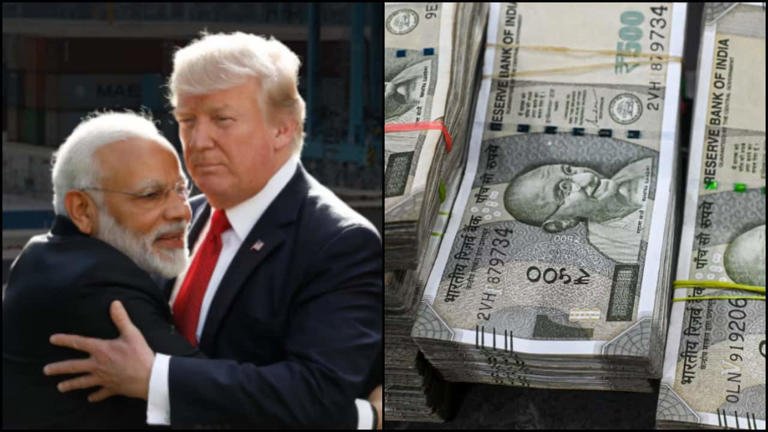
Rupee Hits Three-Week High: The Impact of the $1.25T India-US Trade Breakthrough
MUMBAI — The Indian Rupee (INR) surged to its highest level in three weeks today, closing at 90.27 against the US Dollar, after a landmark trade agreement between Prime Minister Narendra Modi and US President Donald Trump. This rapid appreciation, marking a gain of 124 paise, represents the currency’s best single-day performance in years and signals the beginning of a transformative trade synergy between the world’s two largest democracies.
A Breakthrough for the Indian Economy
The primary catalyst for this rally was the late-night announcement of a trade deal that slashed reciprocal tariffs on Indian goods to 18%, down from a staggering 50% penalty previously imposed. This transformative trade synergy has effectively removed the “geopolitical risk premium” that had pushed the Rupee to a record low of 92.00 just last month.
Under the terms of the agreement, Washington has agreed to drop the 25% “Russian oil penalty” after New Delhi committed to diversifying its energy imports. Analysts suggest that this transformative trade synergy will provide an immediate boost to India’s export sectors—including textiles, engineering, and pharmaceuticals—which now enjoy a competitive advantage over regional peers like Vietnam and Bangladesh.
Market Reaction: The “Modi-Trump” Rally
The news triggered a massive wave of short-covering by Foreign Institutional Investors (FIIs), who have been net sellers for much of the early year. The transformative trade synergy has reignited interest in Indian equities, with the Sensex jumping over 2,000 points.
“The deal is a massive positive, arriving exactly when the market needed a directional trigger,” noted one senior treasury head. “By establishing this transformative trade synergy, both nations have unlocked capital flows that had been sitting on the sidelines due to tariff uncertainty.”
Strategic Energy Re-alignment
A critical pillar of this transformative trade synergy is India’s agreement to halt crude oil purchases from Russia in favor of American and potentially Venezuelan supplies. President Trump hailed the move as a victory for “friendship and respect,” while PM Modi emphasized that the transformative trade synergy would benefit 1.4 billion people by stabilizing the energy supply chain.
Despite the Rupee’s sharp rise, the Reserve Bank of India (RBI) was reportedly seen buying dollars at the 90.05 level to prevent excessive appreciation. The central bank’s goal is to ensure that the transformative trade synergy does not hurt export competitiveness by making Indian goods too expensive on the global market.
A New Economic Order
As the dust settles on this historic week, the transformative trade synergy appears to have set a floor for the Rupee. With the current account deficit expected to narrow and FIIs returning to Dalal Street, the “India story” has been significantly de-risked. Whether this transformative trade synergy can sustain the Rupee at the 89-90 level depends on the implementation of the $500 billion trade target set by both leaders.
Sector-Wise Winners of the India-US Trade Synergy
| Sector | Key Beneficiaries | Expected Impact |
| Textiles & Apparel | Welspun, Trident, Indo Count, Gokaldas Exports | Massive Gain: The U.S. is the largest market for Indian textiles. The 18% tariff undercuts rivals like Vietnam (20%) and Bangladesh (20%). |
| Pharmaceuticals | Sun Pharma, Dr. Reddy’s, Aurobindo, Cipla | Game Changer: Lower duties on generics and APIs boost margins. The transformative trade synergy fosters faster FDA filings and regulatory harmony. |
| Seafood & Agri | Avanti Feeds, Apex Frozen Foods, LT Foods (Daawat) | Price Edge: India is the top shrimp exporter to the U.S. Lower tariffs restore competitiveness against Ecuador and Indonesia. |
| Auto Ancillaries | Bharat Forge, Sona BLW, Tata Motors, Samvardhana Motherson | Supply Chain Integration: Components for EVs and small trucks see reduced friction, aligning with the “China+1” strategy. |
| Engineering Goods | MSME clusters in Ludhiana, Coimbatore, and Pune | Competitive Recovery: Regain market share in machinery and aircraft components previously lost to high punitive duties. |
Deep Dive: The Strategic Winners
1. The Textile “Golden Phase”
The textile industry is perhaps the greatest beneficiary of this transformative trade synergy. With the effective tariff dropping from nearly 50% (inclusive of the old Russian oil penalty) to a flat 18%, Indian manufacturers now have a 2% pricing advantage over regional competitors. Export hubs like Tiruppur are expected to see a 30% revival in order volumes by Q3 2026.
2. Pharma and MedTech: The Global Pharmacy
Industry experts hail the deal as a “game-changer” for Indian MedTech. By aligning India’s rates below China’s base (which remains at 25%+), the transformative trade synergy positions Indian medical devices as the primary alternative for U.S. healthcare providers. Pharmexcil notes that this could unlock billions in untapped market potential for biosimilars and high-end medical equipment.
3. IT Services & Digital Trade
While the physical trade of goods steals the headlines, the transformative trade synergy includes a “co-creation” framework for AI and space tech. Under the iCET (Initiative on Critical and Emerging Technology) umbrella, Indian IT giants like TCS and Infosys are poised to lead multi-billion dollar digital transformation projects for U.S. energy firms transitioning away from Russian dependencies.
Summary of the “Modi-Trump” Economic Roadmap
The agreement aims for a bilateral trade target of $500 billion by 2030. To achieve this, the transformative trade synergy moves beyond simple buying and selling; it integrates Indian manufacturing directly into the American high-tech supply chain.
While the India-US trade deal has sparked a rally in the Rupee and opened new export doors, the pivot away from discounted Russian oil introduces a set of complex “energy friction” risks. The success of this transformative trade synergy depends on whether the tariff gains of 18% can outweigh the rising costs of the refinery “crude slate” shift.
Below is a risk report detailing the challenges facing Indian manufacturers in 2026.
Energy Friction Report: The Cost of the Russian Exit
For the past three years, Russian Urals crude—often trading at a $6–$10 discount per barrel compared to global benchmarks—acted as a hidden subsidy for Indian industry. By removing this discount as part of the transformative trade synergy, India faces three primary categories of risk.
1. The “Landed Cost” Disparity
Transitioning to US WTI (West Texas Intermediate) or Venezuelan heavy crude introduces a significant logistics penalty.
-
Freight and Distance: Shipping oil from the US Gulf Coast or Venezuela takes roughly 2–5 times longer than from Russian Baltic ports. This adds an estimated $2–$3 per barrel in pure transportation and insurance costs.
-
Refining Complexity: Indian refineries are highly complex, but many are “tuned” for the specific chemistry of Russian Urals. Switching to Venezuelan heavy crude requires more intensive processing, which increases internal energy consumption and potentially lowers the “crack spread” (profit margin) for refiners like IOC and BPCL.
2. Input Inflation for Manufacturers
Energy is the second-largest cost for Indian MSMEs (Micro, Small, and Medium Enterprises) after raw materials.
-
Diesel and Logistics: If refinery margins are squeezed by higher crude costs, domestic fuel prices may rise. This could offset the 32% tariff reduction (from 50% down to 18%) for heavy-engineering goods where transport costs account for a large portion of the final price.
-
The “Net Benefit” Calculation: Economists suggest the transformative trade synergy is only profitable for manufacturers if the global Brent price stays below $75 per barrel. Should global prices spike, the loss of the “Russian Discount” would act as a regressive tax on Indian production.
3. The “Execution Risk” of Venezuelan Supply
While the State Bank of India (SBI) suggests that Venezuelan oil could save India $3 billion annually due to its deep discount, this depends on political stability.
-
Sanction Fragility: Unlike the stable “Buy American” pillar of the transformative trade synergy, Venezuelan supply remains subject to the volatility of US Treasury licenses. Relying on this source creates a “single point of failure” for India’s energy security if US-Venezuela relations sour.
Comparative Risk-Benefit Table: 2026 Projections
| Risk Factor | Impact without Russian Oil | Offset by Transformative Trade Synergy |
| Crude Price | +$6 to $10 per barrel (Loss of discount) | High (Lower tariffs increase cash flow) |
| Logistics | +15-20 days in shipping lead time | Moderate (US energy “priority access”) |
| Inflation | Potential 0.5% rise in WPI | High (Cheaper US tech & coal imports) |
| Refinery Margin | 1.5%–2% compression expected | Low (Requires tech upgrades) |
A Strategic Trade-Off
The transformative trade synergy is essentially an exchange of “cheap energy” for “market access.” While the refinery sector will feel a temporary squeeze, the broader manufacturing base stands to gain from a more stable, US-aligned trade environment. The key will be the government’s ability to fast-track the $500 billion “Buy American” procurement plan, ensuring that cheaper US gas and coal imports provide the necessary energy buffer.
Also Read this:
High-Stakes Diplomatic Reset: Trump Negotiates As U.S. Downs Iranian Drone
Social Connect:

