

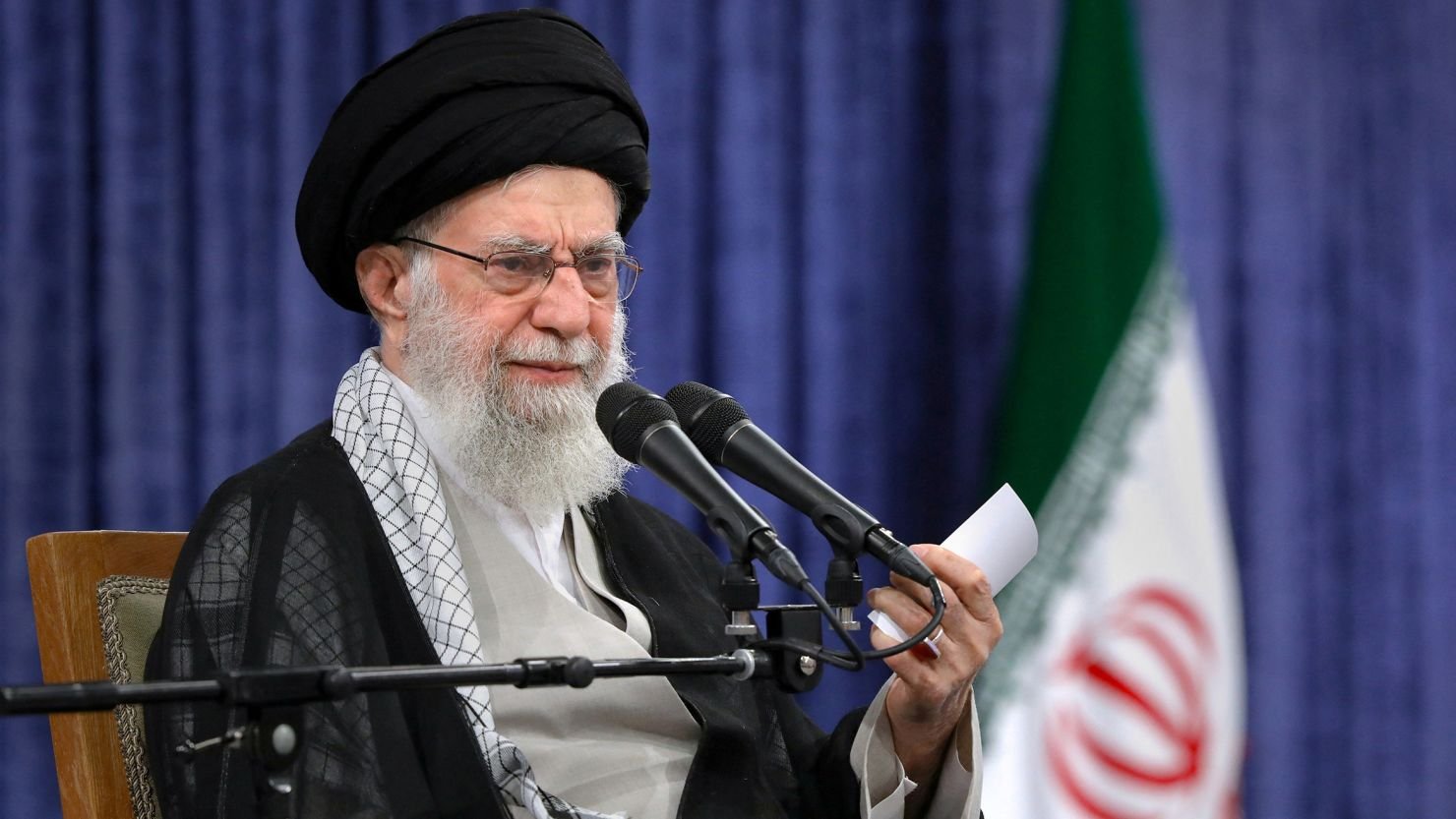
Khamenei’s Strategic Shift: Iran’s Supreme Leader Breaks 37-Year Precedent Amid Trump Threats
TEHRAN / WASHINGTON – In a geopolitical maneuver that has stunned observers from Riyadh to Brussels, Ayatollah Ali Khamenei has broken nearly four decades of religious and political protocol. For the first time in thirty-seven years, the Supreme Leader has personally intervened in the structural command of the Islamic Revolutionary Guard Corps (IRGC) while signaling a willingness to adjust Iran’s long-standing “neither East nor West” policy. This pivot, emerging in February 2026, is being viewed globally as a direct response to the escalating rhetoric and specific military posturing of U.S. President Donald Trump.
The catalyst for this unprecedented Khamenei’s strategic shift appears to be a series of classified intelligence reports detailing a high-precision “Decapitation and Infrastructure” strike plan currently sitting on the Resolute Desk in the Oval Office. As the Trump administration intensifies its “Maximum Pressure 2.0” campaign, Tehran’s aging leadership is realizing that the old playbooks of proxy warfare and indirect diplomacy may no longer be sufficient to ensure the survival of the clerical establishment.
The Breakdown: What is the 37-Year Rule?
Since 1989, Ali Khamenei has maintained a rigid distance from the day-to-day administrative minutiae of Iran’s elective government, preferring to act as the ultimate arbiter of morality and long-term vision. This 37-year rule of “strategic ambiguity” allowed the Supreme Leader to remain untarnished by the failures of the Iranian economy or the unpopularity of specific social crackdowns.
However, the current Khamenei’s strategic shift involves the Leader taking a “hands-on” executive role in the Supreme National Security Council. Experts argue that the existential threat posed by a second Trump term—one that has explicitly threatened to strike 52 high-value Iranian targets including cultural and leadership sites—has forced the Leader’s hand.
“We are witnessing the end of the ‘Elder Statesman’ era,” says Dr. Arash Azizi, a senior fellow at the Middle East Institute. “This Khamenei’s strategic shift signifies that the regime no longer trusts its bureaucratic layers to handle the volatility of a Trump presidency. The Leader is now the commander-in-chief in both title and active daily practice.”
The Trump Factor: Threats of “Total Obliteration”
Why is the White House rhetoric causing such a seismic change in Tehran? In late 2025 and early 2026, the Trump administration moved several B-21 Raider stealth bombers to bases in Diego Garcia and Al-Udeid. More significantly, the President’s recent “social media diplomacy” has warned that any Iranian interference in global shipping lanes or any advancement in uranium enrichment beyond 85% would result in “consequences the likes of which history has never seen.”
This specific threat profile has accelerated Khamenei’s strategic shift. Unlike the Biden years, where diplomacy was a slow-moving chess game, the current U.S. posture is perceived as a “lightning bolt” strategy. Tehran believes that Trump is looking for a “Legacy Event”—a decisive military victory that would permanently alter the balance of power in the Middle East.
Comparative Risk Assessment: Iran’s Vulnerabilities
Internal Resistance and IRGC Realignment
The Khamenei’s strategic shift has not been without its internal casualties. Reports from within Tehran suggest a purge of moderate elements who previously advocated for a return to the JCPOA (Nuclear Deal) framework. The Supreme Leader is now surrounding himself with “War Cabinets” consisting of the most hawkish IRGC commanders who favor a “Pre-emptive Defense” posture.
By breaking the 37-year rule of non-intervention, Khamenei is effectively telling the IRGC that he is the sole source of tactical legitimacy. This Khamenei’s strategic shift is intended to prevent internal coups or “regime change from within” that U.S. intelligence agencies have allegedly been cultivating through covert influence operations.
[Image: A satellite view of the Persian Gulf showing increased U.S. carrier presence alongside IRGC naval exercises, highlighting the 2026 tension.]
Economic Pivot: The “Resistance Economy” 3.0
A major pillar of Khamenei’s strategic shift is the final abandonment of European trade hopes. In a televised address last week, the Leader emphasized that “looking West is looking into a mirror of betrayal.” Instead, Iran is deepening its security and energy pacts with the BRICS+ nations, specifically China and Russia.
This economic dimension of Khamenei’s strategic shift involves a massive investment in domestic drone technology and missile defense systems, funded by “grey market” oil sales that bypass U.S. dollar-clearing systems. By insulating the economy from the SWIFT banking network, Khamenei hopes to neutralize Trump’s most potent weapon: economic strangulation.
The Nuclear Question: Will the Fatwa Change?
Perhaps the most terrifying aspect of Khamenei’s strategic shift for Western diplomats is the changing language surrounding Iran’s nuclear fatwa (religious decree). For decades, the regime claimed that nuclear weapons were haram (forbidden). However, recent sermons by high-ranking clerics close to Khamenei have begun to discuss the concept of “Deterrence for Survival.”
If the Khamenei’s strategic shift includes the weaponization of Iran’s nuclear stockpile, the Middle East enters a “Cold War” phase with zero room for error. Trump’s threats of pre-emptive strikes on enrichment facilities like Fordow and Natanz have only served to convince the Supreme Leader that a nuclear shield may be the only way to avoid the fate of previous regional leaders who lacked such a deterrent.
Conclusion: A Region on a Razor’s Edge
As we move further into 2026, the Khamenei’s strategic shift represents a gamble of historic proportions. By consolidating power and abandoning the traditional “arbiter” role, the Supreme Leader has removed the safety valves of the Iranian political system. If his direct control fails to deter a U.S. strike, the entire structure of the Islamic Republic could crumble under the weight of its own centralization.
Conversely, if Khamenei’s strategic shift successfully navigates the “Trump Storm” by forcing a new, more favorable deal through a show of absolute strength, he will have cemented his legacy as the most resilient leader in modern Middle Eastern history.
Gemini said
The recent developments surrounding Khamenei’s strategic shift and the aggressive “Maximum Pressure 2.0” tactics from the Trump administration have sent ripples through the global financial markets in early February 2026.
Below is an analysis of how these geopolitical maneuvers are directly impacting oil prices and gold futures for the Q2 2026 outlook.
1. Oil Market: The “War Premium” and Supply Deficit Risks
The primary driver in the oil market is no longer just supply-and-demand fundamentals; it is the “geopolitical risk premium.” Traders are pricing in the possibility of a direct conflict that could choke the world’s most vital energy artery.
-
Brent Crude Projections: As of February 10, 2026, Brent crude is trading near $69 per barrel. However, BloombergNEF warns that if Khamenei’s strategic shift leads to a total halt of Iranian exports (approx. 3.3 million barrels per day), prices could spike to $71/bbl in Q2 and potentially hit $91/bbl by Q4 2026.
-
The “Trump Tariff” Effect: On January 12, 2026, President Trump announced a 25% tariff on goods from any country (specifically targeting China and India) that continues to trade with Iran. This “secondary sanction” strategy is intended to force a global boycott of Iranian crude, potentially creating a supply deficit despite high U.S. shale production.
-
Strait of Hormuz Alert: The U.S. Maritime Administration has advised commercial vessels to stay clear of Iranian territorial waters. With 20% of global oil passing through this chokepoint, any retaliatory “blockade” by the IRGC would send oil prices into triple digits instantly.
2. Gold Futures: The $5,000 Milestone
In times of extreme instability, investors flee to “Safe Haven” assets. Gold has become the ultimate beneficiary of the 2026 U.S.-Iran standoff.
-
Record Highs: International gold prices have surged past the historic $5,000 per ounce mark as of February 9, 2026.
-
Domestic Impact (India): In the Indian market, 24-carat gold has reached a staggering ₹1,57,450 per 10 grams. This is fueled by a weakening USD and massive reserve buying by the Central Bank of China as part of a “de-dollarization” strategy to avoid U.S. sanctions.
-
Volatility Outlook: While prices are currently in a “redistribution phase,” the consensus for Q2 2026 remains bullish. Analysts expect gold to trade in a range of $5,000–$5,500 as long as the threat of U.S. strikes on Iranian nuclear facilities remains “active” on Trump’s social media.

