

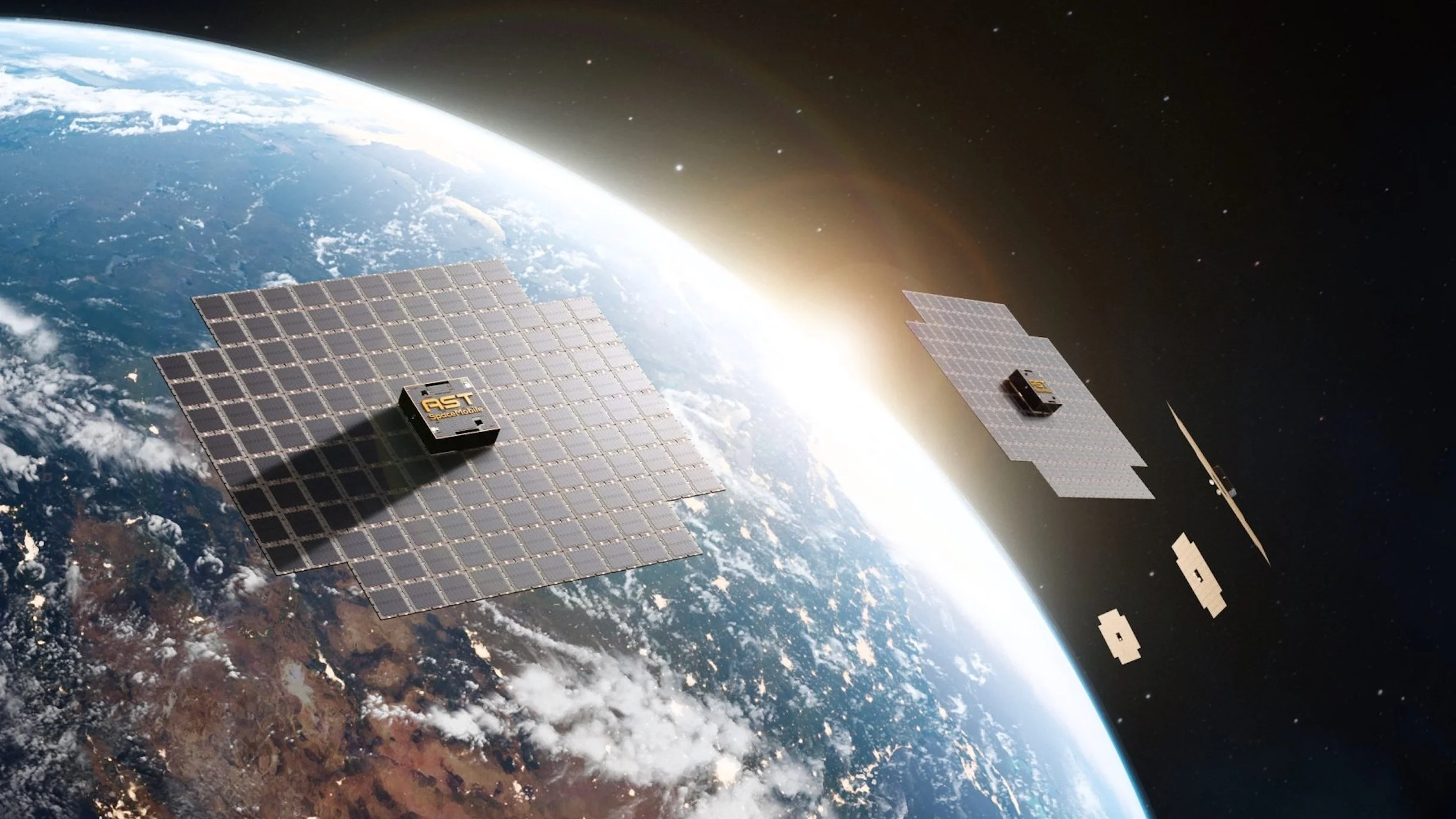
The Signal from Above: BlueBird 7 Successfully Unfolds, Marking a New Era for Satellite-to-Phone Technology
CAPE CANAVERAL – In the quiet vacuum of Low Earth Orbit (LEO), a giant has just stretched its wings. AST SpaceMobile officially confirmed this morning that BlueBird 7, the most ambitious communications satellite ever launched into the heavens, has successfully reached 85% deployment of its massive phased array. This milestone is not merely a win for aerospace engineering; it is the definitive proof of concept for Satellite-to-Phone Technology. For the first time in history, the “unfolding” of a spacecraft represents the unfolding of a truly global, borderless internet.
Engineers at the mission control center reported that the deployment sequence, a delicate ballet of motorized hinges and tensioned cables, has proceeded nearly flawlessly. As the array expands to its full size—roughly the area of a professional tennis court—it becomes the most powerful commercial “cell tower in the sky.” The success of this maneuver is the final hurdle before Satellite-to-Phone Technology moves from an experimental curiosity to a primary pillar of global infrastructure.
The Australian Proof: A 5G Video Call from Nowhere
The most startling piece of telemetry released today didn’t come from a sensor, but from a screen. During a test window over the Australian Outback—one of the most remote and “network-dry” regions on Earth—engineers successfully conducted a high-definition 5G video call.
What makes this call historic is the hardware involved. There were no specialized satellite dishes, no bulky external antennas, and no ground-based relay stations within hundreds of miles. The connection was established using a standard, off-the-shelf 5G smartphone. This “Direct-to-Device” capability is the holy grail of Satellite-to-Phone Technology. By successfully bridging the 300-mile gap between a pocket-sized device and an orbiting satellite, BlueBird 7 has proven that the constraints of terrestrial geography are finally being dismantled.
Understanding the Phased Array: The Secret to Satellite-to-Phone Technology
To understand why BlueBird 7 is succeeding where others have struggled, one must look at the physics of its design. Standard satellites often utilize “spot beams” that cover large, fixed areas. However, Satellite-to-Phone Technology requires a much more surgical approach. The BlueBird 7 array is a “phased array,” meaning it can electronically steer its beams without moving a single physical part.
As the satellite streaks across the sky at 17,000 miles per hour, its software constantly recalculates the phase of its thousands of tiny antennas. This allows it to “lock onto” a single smartphone on the ground, compensating for both the high-speed motion of the satellite and the atmospheric interference. This level of precision is what allows Satellite-to-Phone Technology to deliver 5G speeds rather than the slow, text-only connections of previous satellite generations.
Closing the Dead Zones: A Humanitarian Leap
The commercial implications of Satellite-to-Phone Technology are massive, but the humanitarian impact is arguably more significant. Currently, over one-third of the global population lives in regions where terrestrial cell towers are either geographically impossible or economically unfeasible to build.
In the event of a natural disaster—where ground-based infrastructure is often the first thing to be destroyed—Satellite-to-Phone Technology provides an “unbreakable” network. Search and rescue teams will no longer have to rely on intermittent radio signals; instead, they will have access to the same high-speed data tools in a hurricane-devastated zone as they would in a modern smart city. By providing a failsafe layer of connectivity, BlueBird 7 is essentially providing a global safety net.
The Economic Ripple: Paving the Way for Q4 Rollout
With the successful deployment of BlueBird 7, AST SpaceMobile is now moving at an accelerated pace toward its Q4 2026 commercial rollout. The telecommunications industry is watching with bated breath. Major carriers who have signed “Memorandums of Understanding” are now finalizing their “Space-Surcharge” data plans.
The beauty of Satellite-to-Phone Technology for the consumer is its simplicity. In the coming months, users will likely see a new icon in their status bar—perhaps a small satellite symbol next to their 5G bars—indicating that they are being served from orbit. This seamless integration ensures that Satellite-to-Phone Technology will see rapid adoption, as it requires zero effort or new hardware from the end-user.
Space-X and the Reusability Factor
It is impossible to discuss the success of BlueBird 7 without acknowledging the role of SpaceX. The Falcon 9 rocket that carried this payload to orbit has become the reliable workhorse of the Satellite-to-Phone Technology movement. The reduction in launch costs provided by reusable boosters has lowered the barrier to entry for the “Space Economy.”
As more BlueBird satellites are launched to complete the constellation, the frequency of these SpaceX missions will only increase. This partnership represents a synergy between two titans of tech: one providing the “bus” to space, and the other providing the revolutionary Satellite-to-Phone Technology that makes the trip worthwhile.
The Geopolitical Dimension: Connectivity as Sovereignty
As the “Islamabad Accord” stabilizes relations on the ground, Satellite-to-Phone Technology is creating a new kind of digital sovereignty. In regions where internet access is often controlled or censored by terrestrial gatekeepers, space-based signals offer a more resilient path for information flow.
However, this also creates a new theater for international regulation. How do we govern a signal that originates in international space but lands in a sovereign nation? The success of BlueBird 7 has forced the International Telecommunication Union (ITU) to fast-track its 2026 framework for Satellite-to-Phone Technology, ensuring that the “wild west” of space-based signals is brought into a structured, legal reality.
Technical Challenges: Managing the Heat and the Speed
Even with the 85% unfolding success, challenges remain. The electronics required to power Satellite-to-Phone Technology generate an immense amount of heat. In the vacuum of space, there is no air to cool components down. BlueBird 7 utilizes a revolutionary passive thermal management system—a series of heat pipes and radiators that are part of the array’s “skin.”
Furthermore, managing “hand-offs” between satellites is a feat of timing. Because LEO satellites move so fast, a single satellite is only over a specific user for a few minutes. Satellite-to-Phone Technology must be able to hand off a data session from one satellite to the next without dropping a single packet. The Australian video call proved that these hand-offs are now functioning at a level compatible with consumer-grade streaming.
Environmental Concerns: Space Debris and Light Pollution
The “unfolding” of such a massive array has not been without its critics. Astronomers have expressed concerns that the large reflective surface of BlueBird 7 could interfere with deep-space observations. In response, the developers of this Satellite-to-Phone Technology have applied a “low-albedo” coating to the back of the array to minimize its brightness in the night sky.
Regarding space debris, BlueBird 7 is equipped with an autonomous de-orbiting system. At the end of its life cycle, the satellite will use its remaining fuel to lower its orbit and burn up in the atmosphere, ensuring that the advancement of Satellite-to-Phone Technology does not come at the cost of a cluttered and dangerous orbital environment.
The 2026 Competitive Landscape
While AST SpaceMobile has taken the lead with the BlueBird 7 deployment, competitors are not far behind. SpaceX’s Starlink is rapidly iterating on its “V2 Mini” satellites, which also aim to dominate the Satellite-to-Phone Technology sector. This competition is healthy for the consumer, as it drives down latency and increases the available bandwidth.
The “Battle for the Pocket” is now being fought at 300 miles above the Earth’s surface. As we approach the end of the year, we can expect to see a flurry of launches as companies scramble to achieve “Continuous Coverage”—the point at which there is always a satellite overhead, regardless of the user’s location on the planet.
Conclusion: A World Without Borders
The successful unfolding of BlueBird 7 is a signal to the world that the age of the “disconnected” human is over. By proving that Satellite-to-Phone Technology can work with the devices we already own, we have effectively turned the entire atmosphere into a network.
As we look toward the Q4 commercial rollout, the lessons learned from BlueBird 7 will be invaluable. We are witnessing the birth of a global utility that is as fundamental as the air we breathe. From the Australian Outback to the most densely populated urban centers, Satellite-to-Phone Technology is bridging the final gap in human communication. Tomorrow, when you look at your phone, remember that your “five bars” might not be coming from a tower down the street, but from a miracle of engineering currently orbiting over your head.
The era of Satellite-to-Phone Technology has truly arrived, and the world will never be out of reach again.
SpaceX Launch Manifest: spacex.com/launches
Social Connect :

