

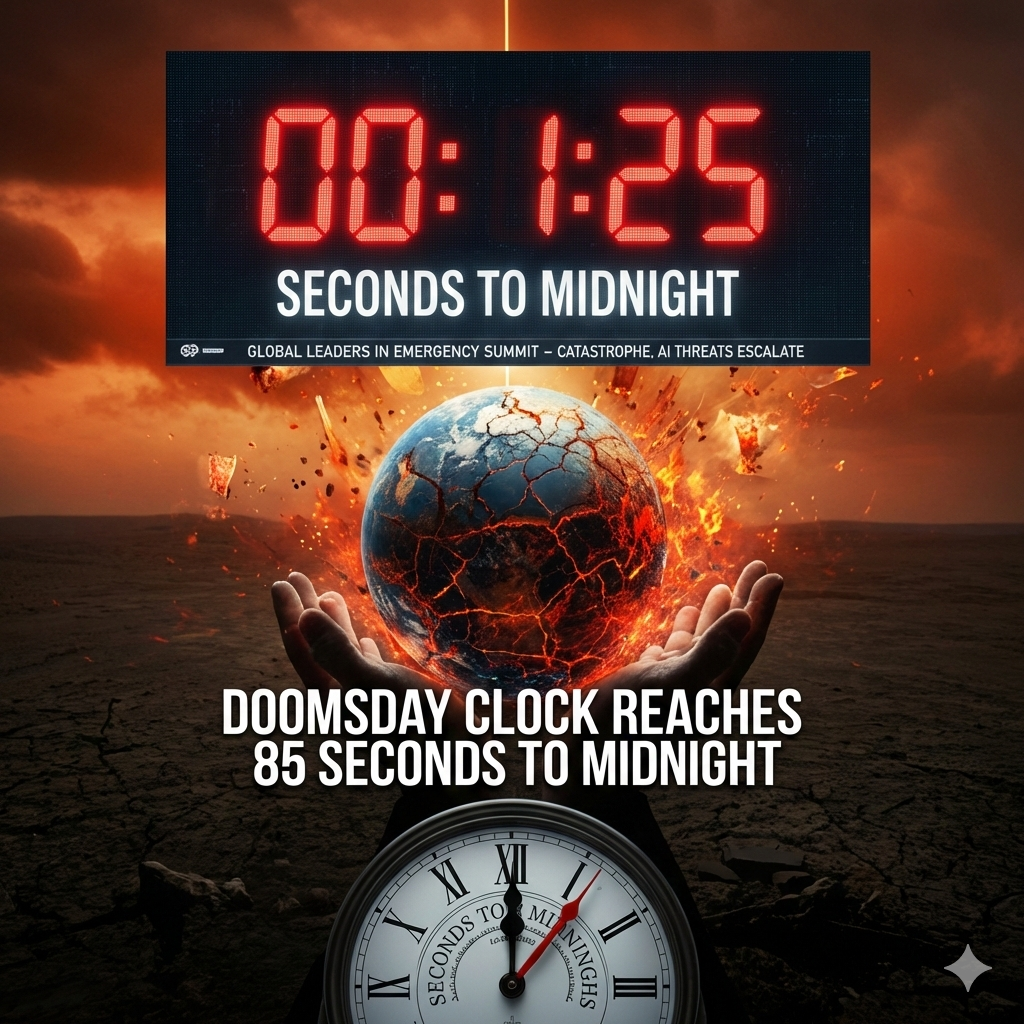
Doomsday Clock Reaches 85 Seconds to Midnight: Humanity Faces Closest Point to Extinction in History
Scientists warn nuclear threats, AI dangers, and climate crisis push world to brink of catastrophe
WASHINGTON — The Doomsday Clock has been set to 85 seconds before midnight, marking the closest humanity has ever come to annihilation since the symbolic timepiece was created nearly eight decades ago, leading atomic scientists announced Tuesday.
The Bulletin of the Atomic Scientists moved the clock forward four seconds from last year’s setting of 89 seconds, citing an alarming convergence of existential threats including nuclear weapons proliferation, unregulated artificial intelligence development, accelerating climate change, and the weaponization of disinformation.
“The Doomsday Clock’s message cannot be clearer,” said Alexandra Bell, President and CEO of the Bulletin of the Atomic Scientists, during a press conference at the Carnegie Endowment for International Peace. “Catastrophic risks are on the rise, cooperation is on the decline, and we are running out of time.”
The adjustment marks the fourth consecutive year the clock has been measured in seconds rather than minutes, underscoring what experts describe as an increasingly precarious moment for human civilization.
What Is the Doomsday Clock and What Does 85 Seconds Mean?
The Doomsday Clock serves as the world’s most recognized symbol of global catastrophe risk, with midnight representing the moment of humanity’s complete extinction. Created in 1947 by Manhattan Project scientists including Albert Einstein and J. Robert Oppenheimer, the clock was originally designed to warn the public about nuclear weapons dangers.
The decision to advance the clock to 85 seconds was made by the Bulletin’s Science and Security Board, which includes prominent physicists, climate scientists, and national security experts, in consultation with nine Nobel Prize laureates serving on the organization’s Board of Sponsors.
“Last year, we warned that the world was perilously close to catastrophe and that countries needed to change course towards international cooperation,” said Dr. Daniel Holz, chair of the Science and Security Board and professor at the University of Chicago. “Unfortunately, the opposite has happened. Rather than heed this warning, major countries became even more aggressive, adversarial and nationalistic.”
Critical Threats Driving the 2026 Setting
The 2026 announcement reflects several developments that have intensified global risks over the past 12 months:
Nuclear Arms Control Breakdown: The February 5, 2026 expiration of the New START treaty—just days away—will end the last remaining nuclear arms control agreement between the United States and Russia. For the first time in over half a century, there will be no binding limits on the world’s two largest nuclear arsenals.
Climate Emergency: Carbon dioxide levels and global sea levels have reached record highs, while droughts, wildfires, floods, and storms intensify worldwide. Scientists warn critical climate tipping points may arrive faster than previously projected.
Artificial Intelligence Arms Race: The rapid deployment of AI in military systems without adequate safety measures has emerged as a major concern, with autonomous weapons and AI-powered decision-making in conflict scenarios creating unprecedented dangers.
Biological Research Risks: Advances in synthetic biology and so-called “mirror life” research pose unregulated threats the international community remains unprepared to address.
Nuclear Crisis: New START Treaty Set to Expire in Days
One of the most pressing factors behind the clock’s advancement is the imminent collapse of nuclear arms control between the world’s superpowers.
The New START treaty, which limits each nation to 1,550 deployed strategic nuclear warheads and 700 strategic delivery systems, expires on February 5—just eight days from Tuesday’s announcement. The treaty also provides critical verification and inspection mechanisms that allow both sides to monitor compliance.
Trump Administration’s Stance on Treaty Renewal
The Trump administration’s response to the looming expiration has created significant uncertainty about global nuclear security. When asked about the treaty in early January, President Donald Trump told The New York Times: “If it expires, it expires. We’ll just do a better agreement.”
Arms control experts warn that no “better agreement” is currently being negotiated, and allowing the treaty to lapse without a replacement could trigger an unconstrained nuclear arms race not seen since the Cold War.
In September 2025, Russian President Vladimir Putin proposed both nations voluntarily maintain the treaty’s central quantitative restrictions for one additional year after expiration. While Trump initially called the proposal “pretty good” in October, his recent comments suggest the U.S. may allow the treaty to expire without interim measures.
Bipartisan groups of U.S. senators have urged the administration to accept Putin’s extension offer, with Senator Edward Markey warning that allowing the treaty to lapse would be “gravely short-sighted” and could make America less secure.
China’s Expanding Nuclear Arsenal Complicates Picture
The nuclear landscape has grown more complex with China’s rapidly expanding arsenal. Pentagon estimates indicate China’s nuclear warhead stockpile has nearly tripled since 2020, reaching over 600 warheads with projections to hit 1,000 by 2030.
This creates what experts call a “two-nuclear peer” environment that traditional bilateral arms control frameworks were never designed to handle. Without the New START treaty’s transparency mechanisms, the U.S. and Russia will lose critical visibility into each other’s nuclear capabilities, increasing risks of miscalculation and accidental conflict.
Climate Change Accelerates as Response Stalls
The climate crisis continues posing an existential threat to civilization, with 2025 bringing record-breaking temperatures, devastating extreme weather events, and accelerating ecosystem collapse.
Scientists point to insufficient international action despite overwhelming scientific consensus on the urgent need for dramatic reductions in greenhouse gas emissions. Rising sea levels are already displacing coastal populations, while intensifying droughts and floods threaten global food security.
“Droughts, fires, floods, and storms continue to intensify and become more erratic, and this will only get worse,” Holz stated during the announcement. The Bulletin emphasized the window to prevent climate change’s worst impacts is rapidly closing, requiring coordinated global action on an unprecedented scale.
U.S. Climate Policy Under Scrutiny
The Trump administration’s approach to climate policy has raised concerns among scientists and environmental advocates. With potential rollbacks of emissions reduction commitments and clean energy investments, experts worry global momentum on climate action could stall at a critical juncture.
The United States, historically the world’s largest greenhouse gas emitter and currently the second-largest behind China, plays a pivotal role in global climate efforts. American climate policy decisions have outsized impacts on international cooperation and the global transition away from fossil fuels.
Artificial Intelligence: Emerging Existential Threat
The rapid advancement of artificial intelligence without adequate regulation has emerged as one of the most concerning developments highlighted in the 2026 announcement.
AI systems are increasingly being integrated into military applications, raising fears about autonomous weapons that could make life-or-death decisions without meaningful human control. The technology is also “supercharging” misinformation and disinformation, undermining democratic institutions and making it harder to build consensus on existential threats.
“AI is a significant and accelerating disruptive technology,” Holz explained. “AI is also supercharging mis- and disinformation, which makes it even more difficult to address all of the other threats we consider.”
AI-Powered Misinformation Undermines Democracy
The proliferation of AI-generated deepfakes and coordinated disinformation campaigns has created what experts describe as an “information warfare” environment threatening democracy’s foundations. The ability to create convincing fake images, videos, and audio of public figures makes it increasingly difficult for citizens to distinguish fact from fiction.
Nobel Peace Prize laureate Maria Ressa, CEO of Filipino news outlet Rappler, emphasized the stakes during Tuesday’s briefing: “Without facts, you can’t have truth. Without truth, you can’t have trust. Without these three, we have no shared reality. We can’t have journalism. We can’t have democracy.”
With the 2026 U.S. midterm elections approaching, concerns about AI-generated deepfakes targeting voters have intensified. Election officials warn synthetic media could spread false information about candidates, voting procedures, and election results.
History of the Doomsday Clock: From Nuclear Dawn to AI Age
The Doomsday Clock was created in 1947 by scientists who worked on the Manhattan Project, the World War II program that developed the first atomic weapons. Scientists including Einstein and Oppenheimer designed it to warn the public about nuclear technology dangers.
The clock has been adjusted 26 times since its debut, reflecting changes in global threats and international cooperation.
Key Moments in Clock History
1947: Clock debuts at 7 minutes to midnight, two years after atomic bombings of Hiroshima and Nagasaki.
1953: Moves to 2 minutes to midnight as U.S. and Soviet Union test hydrogen bombs—the closest to midnight until 2018.
1991: Reaches farthest point—17 minutes to midnight—after President George H.W. Bush and Soviet leader Mikhail Gorbachev sign Strategic Arms Reduction Treaty.
2007: Bulletin considers climate change in clock settings for the first time.
2020: For the first time, measured in seconds rather than minutes, reaching 100 seconds to midnight.
2023: Advances to 90 seconds, largely due to Russia’s Ukraine invasion and nuclear escalation risks.
2025: Moves to 89 seconds with increased concerns about artificial intelligence and biological threats.
2026: Now stands at 85 seconds—closest ever to midnight.
Is the Clock Accurate? Expert Perspectives
While some critics question the Doomsday Clock’s methodology—noting it combines different types of risks with varying timescales—most experts agree it serves a valuable purpose in raising public awareness.
Dr. Michael Mann, Presidential Distinguished Professor at the University of Pennsylvania, has acknowledged the clock as “an imperfect metaphor” but emphasized “it remains an important rhetorical device that reminds us, year after year, of the tenuousness of our current existence on this planet.”
The clock’s influence extends beyond academic circles. World leaders have cited it in policy discussions, including former UK Prime Minister Boris Johnson, who referenced the Doomsday Clock when discussing climate change at the 2021 UN Climate Change Conference.
What Midnight Means—And Why We’ve Never Reached It
The Doomsday Clock has never reached midnight, and scientists hope it never will. Rachel Bronson, senior adviser to the Bulletin and former president and CEO, explained midnight would represent nuclear exchange or catastrophic climate event effectively eliminating human civilization.
“When the clock is at midnight, that means there’s been some sort of nuclear exchange or catastrophic climate change that’s wiped out humanity,” Bronson said. “We never really want to reach that point, and we hope we never will know when we do.”
The fact that the clock can be moved backward provides hope. Throughout its history, the clock has retreated from midnight when nations worked together to reduce threats, most notably in 1991 following major nuclear arms reduction agreements.
How to Turn Back the Clock: Solutions and Actions
Despite dire warnings, scientists emphasize humanity still has time to reverse course through bold, coordinated action.
“We at the Bulletin believe that because humans created these threats, we can reduce them,” Bronson stated. “But doing so is not easy, nor has it ever been. It requires serious work and global engagement at all levels of society.”
What Political Leaders Must Do
Scientists call for immediate action from world leaders:
Salvage Nuclear Arms Control: Replace the expiring New START agreement with stronger arms control measures including verification mechanisms, and bring additional nuclear powers into the framework.
Accelerate Climate Action: Implement binding international commitments to reduce greenhouse gas emissions, invest massively in renewable energy, and support vulnerable nations in climate adaptation.
Regulate Artificial Intelligence: Establish international protocols governing AI development and deployment, particularly in military applications and information systems.
Address Biological Threats: Create coordinated international plans for managing emerging biotechnologies and pandemic preparedness.
Combat Misinformation: Support independent journalism, fact-checking initiatives, and media literacy programs to rebuild shared understanding of reality.
What Americans Can Do Now
Individual citizens have more power than they might realize to influence these global issues:
Contact Your Representatives: Call, email, or write to senators and congressional representatives urging them to prioritize nuclear arms control, climate legislation, and AI regulation. Public pressure moves elected officials to action.
Support Fact-Based Journalism: Subscribe to reputable news sources, share verified information, and call out misinformation. Democracy depends on an informed citizenry.
Take Climate Action: Make lifestyle changes reducing your carbon footprint—drive less, improve home energy efficiency, eat locally and seasonally, reduce food waste, conserve water, minimize plastic use, and recycle properly.
Engage in Informed Conversations: Discuss these critical issues with family, friends, and colleagues. Sparking conversations helps combat misinformation and builds momentum for change.
Stay Informed: Follow reputable sources on nuclear policy, climate science, and emerging technologies. Organizations like the Bulletin of the Atomic Scientists, Union of Concerned Scientists, and Arms Control Association provide expert analysis.
Vote: Support candidates who take existential threats seriously and have concrete plans addressing nuclear weapons, climate change, and emerging technologies.
What Happens Next: 2027 Outlook
The next Doomsday Clock announcement is scheduled for January 2027. Whether the clock moves closer to midnight, stays at 85 seconds, or hopefully moves backward will depend on actions taken by world leaders and global citizens in the coming year.
Key factors influencing the 2027 assessment include:
- Whether U.S. and Russia salvage nuclear arms control through interim agreements or new treaties
- Progress (or lack thereof) on global climate action and emissions reductions
- Development of international frameworks for AI governance and regulation
- Success in combating misinformation and rebuilding trust in democratic institutions
- Whether conflicts involving nuclear powers escalate or de-escalate
Why This Matters for Americans
For Americans, the Doomsday Clock 2026 announcement carries particular significance. The United States plays a central role in each major threat identified by the Bulletin:
Nuclear Weapons: As one of the world’s two largest nuclear powers, U.S. decisions on arms control directly impact global security. The choice to let New START expire without replacement would trigger an arms race increasing nuclear war risk.
Climate Change: As historically the world’s largest greenhouse gas emitter and currently second-largest, U.S. climate policy is critical to global efforts limiting warming. American innovation in clean energy technology could accelerate the global transition from fossil fuels.
Artificial Intelligence: The U.S. leads global AI development, giving American policymakers and companies enormous responsibility ensuring the technology develops safely with appropriate regulation.
Democratic Institutions: As the world’s oldest continuous democracy, America’s ability to combat misinformation and maintain informed public discourse has global implications for democratic governance.
National Security and Economic Implications
The threats highlighted by the Doomsday Clock aren’t just moral or environmental concerns—they pose direct threats to American economic prosperity and national security:
- Climate change damages U.S. infrastructure, agriculture, and coastal communities, costing hundreds of billions annually
- Nuclear proliferation increases the risk of weapons falling into terrorist hands
- AI development without safeguards could lead to uncontrollable autonomous weapons
- Misinformation undermines trust in American institutions and social cohesion
The Path Forward: Hope Remains Despite Urgent Warning
The Doomsday Clock’s movement to 85 seconds before midnight represents more than symbolic pessimism—it’s a scientifically-backed warning that humanity’s margin for error has nearly disappeared.
“It is a hard truth, but this is our current reality,” Bell stated. “The question now is whether global leaders and citizens will heed the warning and take meaningful action before time runs out.”
Scientists behind the Doomsday Clock stress that while threats are real and growing, human ingenuity and cooperation have created periods of relative safety in the past and can do so again. The 1991 move to 17 minutes to midnight following U.S.-Soviet arms control agreements proves progress is possible when nations work together.
“Every time we’ve been able to turn back the hands of the clock, it’s been because we had scientists and experts working to find solutions and a public that was demanding action,” Bell said.
As the clock ticks closer to midnight, the choice is clear: humanity can continue on its current trajectory toward catastrophe, or choose to work together building a safer, more sustainable future. The next 12 months will be critical in determining which path we take.
Related News :
2026 New Cars: Complete Guide to 32+ Electric Vehicles and Game-Changing Models Launching This Year

