

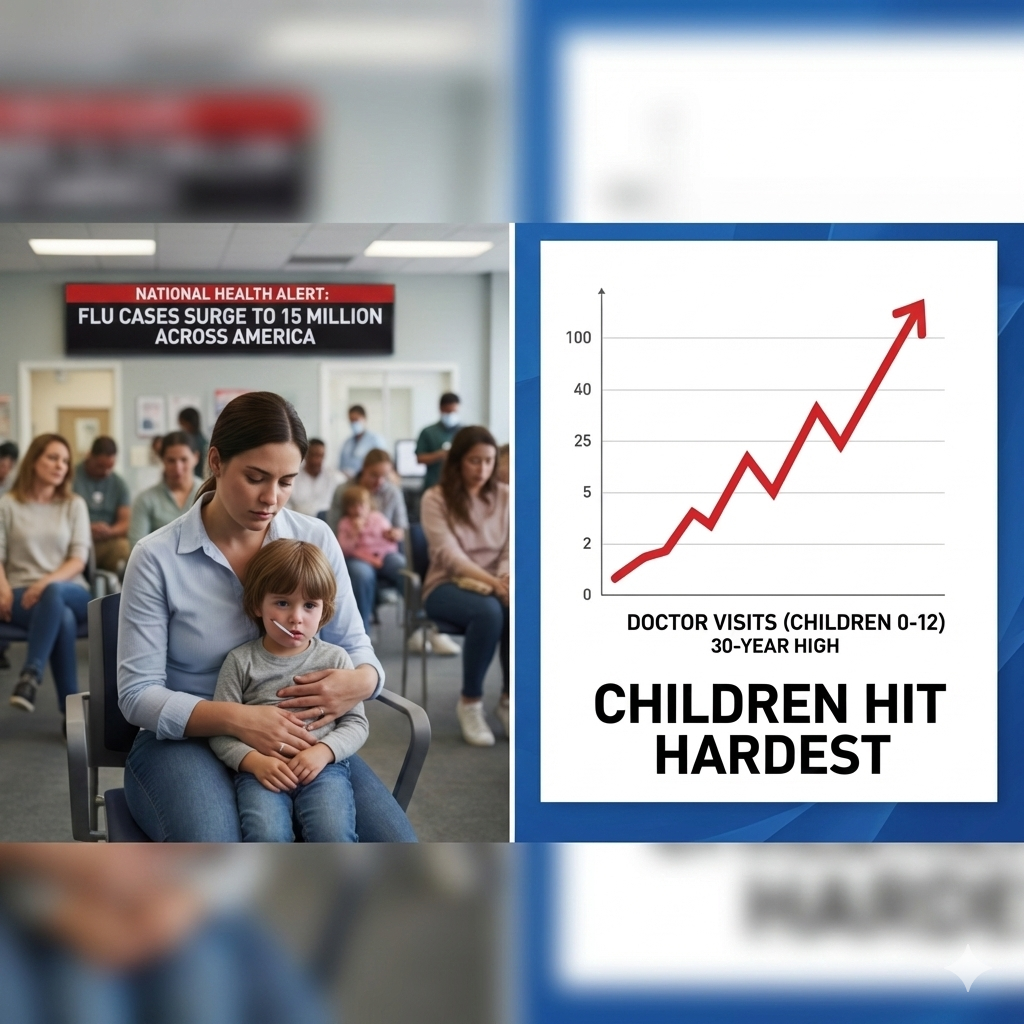
Flu Cases Surge to 15 Million Across America: Children Hit Hardest as Doctor Visits Reach 30-Year High
CDC reports unprecedented pediatric infection rates as emergency rooms overflow nationwide and controversial vaccine policy change sparks outrage
Updated: January 10, 2026 | Atlanta, Georgia
Breaking: Flu Activity at Highest Levels in Nearly 30 Years
ATLANTA — The United States is experiencing one of the most severe flu seasons in recent history, with at least 15 million illnesses, 180,000 hospitalizations, and 7,400 deaths reported so far this season, according to data released Friday by the Centers for Disease Control and Prevention.
Young children are bearing the brunt of the 2025-2026 flu outbreak, with doctor visits for influenza among kids under age 4 reaching their highest level in at least a decade—more than 18% of all medical visits for this age group—as the CDC warns that peak activity likely hasn’t arrived yet.
“I have been watching the data over the past couple of weeks coming out, and concerned about the little kids and how sick we are seeing them come in,” said Dr. Anne Zink, a practicing emergency medicine physician who also runs Yale’s PopHIVE platform that tracks respiratory illness spread.
The surge comes amid a controversial policy shift that removed the flu vaccine from the list of universally recommended childhood shots—a decision announced just days before the CDC confirmed 17 pediatric flu deaths this season.
Record-Breaking Pediatric Infections Overwhelm Hospitals
Children Under 4 at Historic Risk
More than 18% of medical visits for children under 4 years old are now related to flu, marking the highest level since at least 2016 when the CDC began tracking this specific metric, federal health officials reported Friday.
Overall, approximately 7.2% of all healthcare visits nationwide are now for flu-like illness, which health officials define as patients presenting with fever plus either a cough or sore throat—a rate that continues to break records for this time of year.
17 Children Dead, Eight Just This Week
Eight pediatric flu deaths were reported this week alone, bringing the total to 17 for this season, according to CDC data released Friday. The deaths occurred during the weeks ending December 20 and 27, 2025, and January 3, 2026.
All 17 deaths were associated with influenza A viruses. Six of the influenza A viruses that had subtyping performed were all A(H3N2) viruses—the dominant strain this season.
Boston Mourns Two Toddlers
Four of this season’s pediatric flu deaths have been in Massachusetts, including two young children in Boston who were both under the age of 2.
“Flu cases are surging in Boston, and we are seeing an uptick in serious cases involving children, including the tragic deaths of two very young children,” Dr. Bisola Ojikutu, Boston’s commissioner of public health, said in a statement.
“While the flu is usually mild, it can cause hospitalization and death. Children under the age of two are at higher risk. Parents should get their children ages six months and older vaccinated as soon as possible to decrease the risk of severe complications.”
Last Season’s Devastating Toll Provides Context
This tragic death toll follows the deadliest flu season on record for children last year, when 289 youngsters died from influenza complications—the highest number since the CDC began tracking pediatric flu deaths in 2004. One additional death from last season was just reported this week, bringing that final tally to 289.
Research has shown that approximately 90% of children who died from flu last season were unvaccinated, underscoring the protective effect of immunization against severe disease outcomes.
Sacramento Mother Watches 3-Year-Old Suffer
The flu’s impact on young children is playing out in real time at hospitals across America. At UC Davis Medical Center in Sacramento, 3-year-old Naya Kessler has been hospitalized since Wednesday, January 7, after developing flu symptoms on Christmas morning.
“She was getting pretty dehydrated. She wasn’t taking anything in. Her fevers were continuously spiking,” Naya’s mother, Kat Kessler, told ABC News. “There was just something screaming at me in my mind that something was wrong.”
Naya remains hospitalized nearly a week after her diagnosis, still vomiting and running fevers.
Emergency Rooms Overwhelmed Nationwide
Alaska ER: “Didn’t Even Have Enough Places to Sit”
Dr. Zink recounted her recent experience working in an Alaska emergency department during the surge.
“We didn’t even have enough places to sit people in our lobby,” she told ABC News. “My colleagues in other states are sharing very similar stories of just overwhelming flu numbers.”
40,000 Weekly Hospital Admissions
About 40,000 people were admitted to hospitals with flu during the week ending January 3, according to CDC data published Friday—a 10% increase from the previous week’s 36,600 hospitalizations.
The weekly hospitalization rate reached 12 per 100,000 people nationwide, with seniors facing the highest risk but children also showing sharply elevated rates.
Cumulative Rate Second Highest Since 2010
The cumulative hospitalization rate observed in early January was 40.6 per 100,000 population—the second highest cumulative rate at this point in the season since 2010-2011, underscoring the severity of this year’s outbreak.
Among all hospitalizations tracked by the CDC’s FluSurv-NET surveillance system, 97% were associated with influenza A virus, 2.2% with influenza B virus, and a tiny fraction with co-infections.
Geographic Spread: 45 States Experiencing High Activity
Nearly Universal Impact
The flu outbreak is wreaking havoc nationwide, with 45 states experiencing high to very high levels of flu activity. Only Montana, South Dakota, Vermont, and West Virginia are currently reporting low to moderate flu spread, while data for Nevada was classified as insufficient.
CDC surveillance data reveals that 26 states are currently seeing “very high” levels of flu-like illnesses, with an additional 16 states experiencing “high” levels of disease activity—accounting for 42 of the 50 states plus Washington, D.C.
Doctor Visits Reach 30-Year High
For the week ending December 27, doctors’ visits for flu-like symptoms hit 8.2% of all outpatient visits nationwide—the highest rate since the CDC began tracking this metric in 1997, nearly 30 years ago.
At the same point last season, which was itself classified as “high severity,” that number was 6.7%—meaning this season is significantly worse.
“This is definitely a banner year,” said Dr. Caitlin Rivers, an epidemiologist and senior scholar at Johns Hopkins Center for Health Security. “It’s the worst we’ve had in at least 20 years. We’re seeing a majority of the country is experiencing very high levels of activity, and we’re still in the thick of it.”
New York Sets Records
New York has been particularly hard hit. New York City recorded its highest number of flu cases in a single year since 2004, when flu case reporting became mandatory. The state also reported record-breaking weekly flu hospitalizations.
“This is really quite a severe flu season right now,” Dr. James McDonald, New York State’s health commissioner, told “Good Morning America.”
However, officials note that New York City, which was among the first areas to experience very high flu activity, may be showing early signs of stabilization—though the virus continues circulating at extremely elevated levels.
“We’re not out of the woods yet. Flu seasons are unpredictable, and the virus continues to circulate at very high levels,” said Dr. Michelle Morse, New York City’s acting health commissioner.
Massachusetts Issues Urgent Warning
Massachusetts, reporting very high levels of flu activity, issued an urgent call to action.
“This is a moment for clarity, urgency, and action,” Massachusetts Public Health Commissioner Dr. Robbie Goldstein said in a news release. “These viruses are serious, dangerous, and life-threatening. We are seeing children who are seriously ill, families grieving devastating losses, and hospitals under capacity strain.
“There is a simple, effective, and available way to address these concerns: vaccines. They can prevent serious illness and hospitalization.”
“Subclade K” Variant Driving Unprecedented Surge
New H3N2 Strain Behind 90% of Cases
The dominant virus this season is a new influenza A variant called subclade K, which accounts for approximately 90% of confirmed cases analyzed by laboratories nationwide.
This variant is a mutation of the H3N2 virus and has proven particularly virulent across all age groups.
“Subclade K has acquired some mutations in the virus that make it a little bit different than what’s in the vaccine and what was circulating over the last couple years,” explained Dr. Carrie Reed, chief of the epidemiology and prevention branch of the CDC’s influenza division.
Global Spread Before Hitting US
The variant emerged last summer and spread through other countries before reaching the United States, causing early and severe flu seasons in Canada, Japan, and the United Kingdom.
Health experts tracking the variant’s movement warned in the fall that the U.S. could expect a difficult season when subclade K inevitably arrived on American shores.
H3N2 Historically More Severe
Health experts note that H3N2 strains historically cause more severe flu seasons across all age groups compared to other influenza types.
“H3N2 tends to be more virulent,” infectious disease specialists have observed, explaining why this season has proven particularly challenging even for vaccinated individuals.
The combination of a new variant (subclade K) within an already-virulent type (H3N2) has created what some experts are calling a “perfect storm” for flu spread.
Timing and Duration: Peak Activity Still Ahead
“A Lot of Influenza Out There Right Now”
Despite already record-breaking numbers, public health officials warn that flu activity will likely continue increasing in the coming weeks.
“There’s a lot of influenza out there right now,” Dr. Reed told reporters earlier this week. “We often see activity continue into the spring … I think the reality is that it’s going to continue to be elevated for a little bit longer.”
Holiday Dip May Be Misleading
CDC data from the most recent week showed some indicators have decreased or remained stable compared to the previous week. However, officials cautioned this “could be due to changes in healthcare seeking or reporting during the holidays rather than an indication that influenza activity has peaked.”
In other words, fewer people going to the doctor during Christmas and New Year’s celebrations doesn’t necessarily mean fewer people are getting sick—it may simply mean sick people are staying home instead of seeking care during the holiday period.
Spring Surge Possible
Historical patterns show flu activity often continues well into spring, meaning Americans could face elevated flu levels for two more months or longer.
“We often see activity continue into the spring,” Dr. Reed noted, suggesting that even if the peak arrives soon, the decline could be gradual and prolonged.
Controversial Vaccine Policy Change Sparks Outrage
HHS Removes Flu Shot from Universal Childhood Recommendations
In a highly controversial move that has alarmed pediatricians and public health experts nationwide, the Department of Health and Human Services announced on Monday, January 5, 2026, that it was removing the flu vaccine from the list of shots universally recommended for all children.
The changes direct that decisions on flu vaccinations be based on “shared clinical decision-making,” requiring parents to consult with healthcare providers rather than following a universal recommendation that all children get annual flu shots.
Timing Draws Sharp Criticism
The timing of this policy shift has drawn fierce criticism, coming in the midst of one of the worst flu seasons in recent memory and just days after the CDC confirmed nine pediatric flu deaths this season (the tally has since risen to 17).
“To back off on a flu recommendation in the midst of a pretty severe flu year seems to me to be pretty tone-deaf,” said one medical expert interviewed about the policy change by NBC News.
“And that’s coming off an influenza year where we had the most childhood deaths from influenza in many years,” the expert added, referencing last season’s record 289 pediatric deaths.
Pediatricians Condemn Decision
Dr. Sean O’Leary, chair of the American Academy of Pediatrics Committee on Infectious Diseases, issued a scathing statement about the announcement.
“This is part of a decades-long effort on the part of the health secretary to spread fear and falsehoods about vaccines, and this is another step in the secretary’s effort to dismantle the US vaccination system,” O’Leary stated.
The policy change follows a presidential directive to align the U.S. vaccination schedule with countries like Denmark that recommend fewer vaccines, despite experts noting that the U.S. has different disease prevalence patterns and healthcare systems.
CDC Website Still Recommends Universal Vaccination
As of Monday afternoon, the CDC’s website still stated: “Everyone 6 months and older, with rare exceptions, should get a flu vaccine.”
The disconnect between HHS policy and CDC guidance has created confusion among healthcare providers and parents trying to make informed decisions about protecting their children.
Vaccination Rates Remain Alarmingly Low
Less Than Half of Americans Vaccinated
As of late December 2025, only 43.5% of U.S. adults aged 18 and older and 42.5% of children had received a flu vaccine this season.
Approximately 130 million vaccine doses have been distributed nationwide—enough to cover less than 40% of the U.S. population.
These rates represent a decline from previous years:
- 2019-2020 season: Nearly 61 million adults vaccinated
- 2025-2026 season: Roughly 48 million adults vaccinated
Experts Say It’s Not Too Late
Public health officials continue to emphasize that it’s not too late for unvaccinated individuals to get their flu shot, especially given that peak activity may still lie ahead.
“I still think that if you have not been sick this year, it is not too late to get the flu vaccine,” Dr. Zink stressed, noting that vaccination provides important protection against severe disease, hospitalization, and death.
“In the next 48 hours, if you haven’t been vaccinated, get vaccinated. Don’t wait,” urged Dr. Michael Osterholm, who directs the Center for Infectious Disease Research and Policy at the University of Minnesota.
“You may still be able to protect yourself from the last parts of the seasonal epidemic, but it takes seven to 10 days to develop some immunity relative to the vaccine, and so you don’t have a lot of time to waste,” he added.
Vaccine Effectiveness Against Subclade K
Imperfect Match Still Offers Protection
While the current flu vaccine is not a perfect match for the subclade K variant, research and clinical data indicate it still offers substantial protection against severe outcomes.
“Although the current flu vaccine is not a perfect match to subclade K, it is still expected to offer some protection against the new variant and lower the risk of serious disease, hospitalization and death,” health officials explained.
Dr. Rivers, the Johns Hopkins epidemiologist, noted that “the vaccine is not really expected to protect against infection and therefore transmission. It’s really just about preventing severe illness.”
This is a critical distinction: getting vaccinated may not prevent you from catching the flu entirely, but it can dramatically reduce your chances of ending up in the hospital or dying from complications.
Antiviral Medications Remain Crucial
Dr. Reed emphasized the importance of antiviral medications like Tamiflu (oseltamivir) for those who do contract the flu, particularly individuals at higher risk for severe disease.
“For those who contract the flu and have a higher risk of severe disease, they should seek care early and speak with their doctor about receiving a prescription for flu antivirals,” Reed advised.
Flu antivirals have been shown to reduce illness duration and lower the risk of serious complications when started early in the course of infection—ideally within 48 hours of symptom onset.
Public Demand Surges for Medications and Tests
155% Increase in Three Weeks
Consumer demand for over-the-counter cold and flu medications, along with at-home flu and COVID-19 tests, has increased 155% over the past three weeks, according to data from pharmacy chain Walgreens shared with ABC News.
This surge reflects both the widespread nature of the outbreak and heightened public awareness of respiratory illness symptoms, as people try to determine whether they have flu, COVID-19, RSV, or common colds.
Pharmacy chains report periodic shortages of popular cold and flu medications in heavily affected regions, though supplies generally remain adequate nationwide.
Comparison to Previous Seasons: Back-to-Back Severity Unusual
Surpassing Last Year’s “High Severity” Season
The 2025-2026 season is surpassing the 2024-2025 flu epidemic, which was itself classified as a “high severity” season by the CDC.
Infectious disease experts note that seeing two severe flu seasons back-to-back is highly unusual. Typically, a bad flu year is followed by a milder one as population immunity increases.
“It’s striking to see such an intense season coming off last year’s bad flu season,” Dr. Rivers noted, “as bad years don’t typically occur back to back.”
Historic Context
The cumulative hospitalization rate, doctor visit rates, and overall disease burden all point to this being one of the worst flu seasons in at least two decades, with some metrics reaching levels not seen since the late 1990s.
For context:
- Doctor visits for flu-like illness: Highest since 1997-98 season
- Cumulative hospitalization rate: Second highest since 2010-11 season
- Pediatric death toll: On pace to potentially rival last season’s record
What Americans Should Know and Do
Recognizing Flu Symptoms
Common flu symptoms include:
- Sudden onset of high fever (typically 100-104°F)
- Severe body aches and muscle pain
- Headache
- Extreme fatigue and weakness
- Sore throat
- Dry cough
- Runny or stuffy nose
- In children: Vomiting and diarrhea (more common than in adults)
Flu symptoms typically come on suddenly, unlike cold symptoms which develop gradually.
When to Seek Immediate Medical Care
Parents and caregivers should seek immediate medical attention if a child displays signs of severe illness, including:
Emergency Warning Signs in Children:
- Difficulty breathing or rapid breathing
- Bluish skin color (lips or face)
- Not drinking enough fluids / decreased urination / no tears when crying
- Persistently high fever that doesn’t respond to medication
- Extreme lethargy, difficulty arousing, or lack of interaction when awake
- Severe or persistent vomiting
- Flu-like symptoms that improve but then return with fever and worse cough
- Seizures
Emergency Warning Signs in Adults:
- Difficulty breathing or shortness of breath
- Persistent pain or pressure in the chest or abdomen
- Persistent dizziness, confusion, inability to arouse
- Seizures
- Not urinating
- Severe muscle pain
- Severe weakness or unsteadiness
- Fever or cough that improves but then returns or worsens
High-Risk Groups
Flu poses particular dangers for certain populations, including:
- People 65 years and older
- Pregnant women
- Young children, especially those under age 2
- Individuals of any age with chronic health conditions:
- Asthma or other lung diseases
- Diabetes
- Heart disease
- Weakened immune systems
- Kidney or liver disorders
- Obesity (BMI of 40 or higher)
People in these high-risk groups should contact their healthcare provider as soon as flu symptoms develop to discuss antiviral treatment options.
Prevention Measures
Get Vaccinated: If you haven’t gotten your flu shot yet, do it now. It’s not too late.
Practice Good Hygiene:
- Wash hands frequently with soap and water for at least 20 seconds
- Use alcohol-based hand sanitizer when soap isn’t available
- Avoid touching your eyes, nose, and mouth
- Cover coughs and sneezes with a tissue or your elbow
Stay Home When Sick: Don’t go to work, school, or public places when you have flu symptoms. Stay home until at least 24 hours after your fever is gone without fever-reducing medication.
Clean and Disinfect: Regularly clean frequently touched surfaces like doorknobs, light switches, counters, and phones.
Consider Masks: In crowded indoor settings or when caring for someone sick, wearing a mask can reduce transmission risk.
RSV and COVID-19: Triple Threat Continues
While flu dominates headlines, respiratory syncytial virus (RSV) and COVID-19 continue circulating.
RSV Activity Elevated in Children
RSV activity is elevated in many areas of the country, with emergency department visits and hospitalizations increasing among children 0-4 years old, according to the CDC’s Respiratory Illnesses Data Channel updated January 9, 2026.
RSV can be particularly dangerous for infants and young children, causing bronchiolitis and pneumonia.
COVID-19 Activity Low But Increasing
COVID-19 activity is currently low but increasing nationally, the CDC reports. While far below pandemic peaks, COVID-19 still contributes to the overall burden of respiratory illness.
Combined Impact
CDC continues to expect that the fall and winter respiratory disease season in the United States will likely have a similar number of combined peak hospitalizations due to COVID-19, influenza, and RSV compared to last season.
However, with flu activity significantly elevated compared to this point last year, the combined burden may exceed initial projections.
The Path Forward: What Comes Next
As flu activity continues to climb across the United States, public health officials urge Americans to take preventive measures seriously.
Immediate Actions
- Get vaccinated if not yet immunized—protection takes about 2 weeks to develop fully
- Practice good hand hygiene and respiratory etiquette
- Stay home when sick to avoid spreading illness to others
- Seek prompt medical care for high-risk individuals who develop symptoms
- Ask about antivirals if you’re in a high-risk group and develop flu symptoms
Looking Ahead
With experts predicting continued elevated activity for weeks to come, the full toll of the 2025-2026 flu season remains to be seen. However, several things are becoming clear:
This is one of the worst flu seasons in decades. Multiple metrics—doctor visits, hospitalizations, pediatric deaths—are at or near record levels.
Children are suffering disproportionately. With 18% of medical visits for kids under 4 related to flu, and 17 pediatric deaths already, this season poses exceptional risks to young children.
The peak hasn’t arrived yet. Despite already-record numbers, CDC experts believe flu activity will continue increasing before eventually declining, meaning the worst may still be ahead.
Vaccination remains underutilized. With less than half of adults and children vaccinated, and the controversial removal of flu shots from universal childhood recommendations, vaccination rates may remain problematically low.
A Stark Reminder
This year’s outbreak serves as a stark reminder of influenza’s continued ability to cause widespread illness and serious complications, particularly among the most vulnerable populations.
For families with young children, seniors, and those with chronic health conditions, the coming weeks will require vigilance, preventive measures, and prompt medical attention at the first sign of serious symptoms.
As one epidemiologist put it: “We’re still in the thick of it.”
Quick Facts: 2025-2026 Flu Season
✅ 15 million illnesses reported nationwide (and counting) ✅ 180,000 hospitalizations so far this season ✅ 7,400 deaths including 17 children ✅ 18% of doctor visits for kids under 4 are flu-related (10-year high) ✅ 8.2% of all doctor visits for flu-like illness (30-year high) ✅ 45 states experiencing high or very high flu activity ✅ Subclade K variant driving 90% of cases ✅ 40,000 weekly hospitalizations in early January ✅ Only 43% of Americans have gotten flu shots ✅ Peak activity still expected in coming weeks
Related Information:
- CDC Flu View: Weekly Surveillance Report
- Find a Flu Vaccine Near You: Vaccines.gov
- Flu Symptoms and Complications: CDC Guide
- When to Seek Emergency Care: CDC Emergency Warning Signs
Stay Informed:
- CDC Flu Updates: cdc.gov/flu
- Local Health Departments: Check your state/county health department website
- Flu Hotlines: Many states operate flu information hotlines
This story will be updated as new information becomes available from the CDC and state health departments.
About This Coverage: This article is based on CDC surveillance data released January 9, 2026, along with reporting from state health departments, interviews with medical experts, and peer-reviewed research. Statistics and case counts are preliminary and subject to revision as more data becomes available.
Last Updated: January 10, 2026, 11:00 AM EST
Another News :
Social Connect

