

NASA Orders Historic Medical Evacuation: Crew-11 Astronauts Coming Home Early from Space Station
First medical evacuation in 25-year ISS history as NASA cuts mission short due to undisclosed crew member health issue
Updated: January 10, 2026 | Cape Canaveral, Florida
Breaking: Four Astronauts to Return “Within Days” After Medical Emergency
CAPE CANAVERAL, Fla. — In an unprecedented decision that marks a historic first for the International Space Station, NASA announced Thursday it will bring home all four Crew-11 astronauts ahead of schedule after one crew member experienced a serious medical issue that cannot be fully diagnosed in orbit.
NASA Administrator Jared Isaacman, making his first major operational decision since being sworn in last month, confirmed the early return following consultations with the agency’s Chief Health and Medical Officer. While officials stressed the situation is “stable” and not an emergency, the affected astronaut requires medical equipment and diagnostic capabilities only available on Earth.
“Yesterday, January 7th, a single crew member on board the station experienced a medical situation and is now stable,” Isaacman stated during a Thursday press conference at NASA Headquarters in Washington, D.C. “After discussions with Chief Health and Medical Officer Dr. J.D. Polk and leadership across the agency, I’ve come to the decision that it’s in the best interest of our astronauts to return Crew-11 ahead of their planned departure.”
The decision represents the first time in U.S. space history that a mission has been cut short due to a medical issue, underscoring both the risks of long-duration spaceflight and NASA’s unwavering commitment to crew safety.
Who’s Coming Home: The Crew-11 Team
The international crew of four launched from Kennedy Space Center in Florida on August 1, 2025, aboard SpaceX’s Crew Dragon Endeavour. They were originally scheduled to remain on station until late February 2026. The team includes:
- Zena Cardman (NASA, Mission Commander) — 38, geoscientist on her first spaceflight
- Mike Fincke (NASA, Pilot) — 58, veteran astronaut with prior ISS experience
- Kimiya Yui (JAXA, Mission Specialist) — 55, Japan Aerospace Exploration Agency astronaut
- Oleg Platonov (Roscosmos, Mission Specialist) — 39, Russian cosmonaut
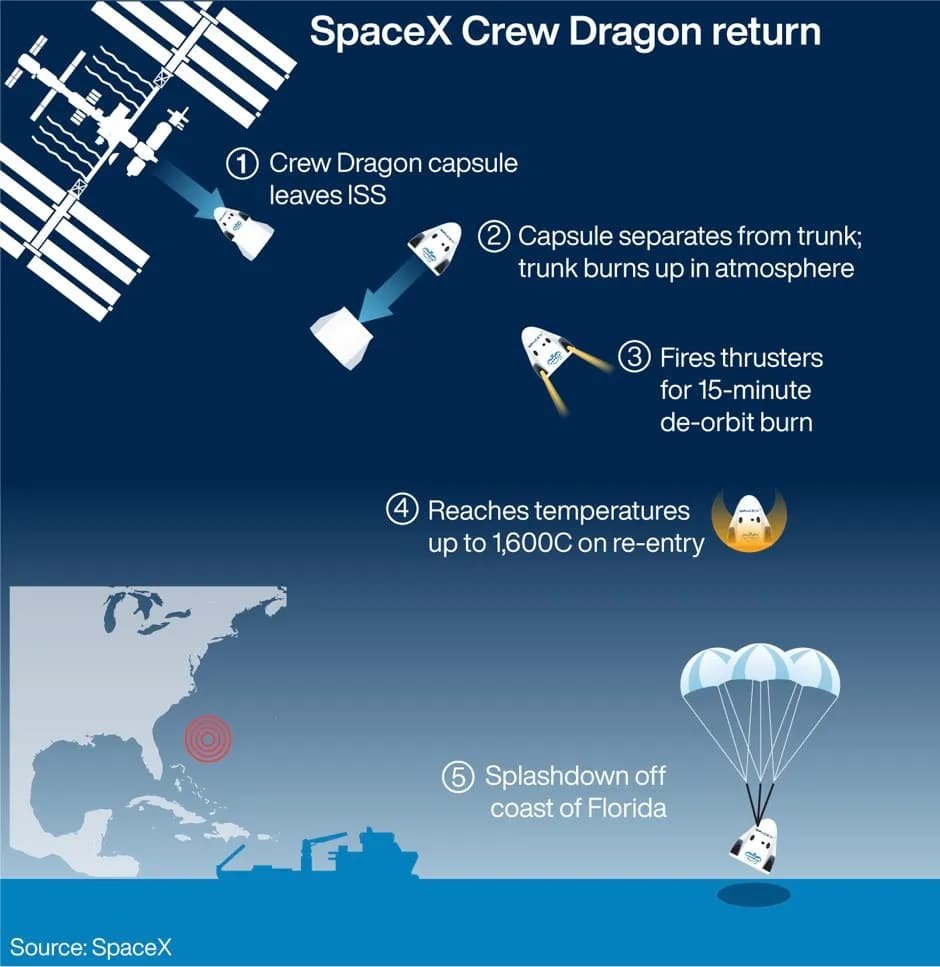
All four will return together on the same Crew Dragon capsule that brought them to space, with splashdown expected in the Pacific Ocean off the Florida coast “in the coming days.”
What Happened: Timeline of the Medical Emergency
Wednesday, January 7, 2026
- Afternoon: One crew member experiences an undisclosed medical issue
- Medical situation emerges during routine station operations
- Affected astronaut receives immediate assistance from trained crew members
- NASA officials consulted; situation assessed as stable but concerning
Thursday, January 8, 2026
- Early Morning: NASA postpones planned spacewalk citing “medical concern”
- Extravehicular Activity (EVA) 94 indefinitely delayed — would have seen Cardman and Fincke installing solar array equipment
- Afternoon: NASA Administrator Jared Isaacman announces decision to bring Crew-11 home early
- Agency promises update on specific return timeline within 48 hours
Expected: Next 24-48 Hours
- NASA and SpaceX finalizing undocking and reentry schedule
- Recovery ship deploying from Southern California to Pacific splashdown zone
- Weather and ocean conditions being evaluated for optimal return window
- Medical personnel preparing to board recovery vessel

NASA Orders Historic Medical Evacuation: Crew-11 Astronauts Coming Home Early from Space Station
The Medical Issue: What We Know (and Don’t Know)
NASA Is Not Disclosing:
- Identity of affected crew member — protected by medical privacy protocols
- Nature of the medical condition — specific diagnosis remains confidential
- Severity of the issue — beyond confirming it’s “stable” and not life-threatening
What Officials Have Confirmed:
It’s NOT an operational injury. Dr. J.D. Polk, NASA’s Chief Health and Medical Officer, clarified the issue did not result from station operations, spacewalk preparations, or any accident.
“This was not an injury that occurred in the pursuit of operations,” Polk explained. “It’s mostly having a medical issue in the difficult areas of microgravity, and with the suite of hardware that we have at our avail to complete a diagnosis.”
It’s NOT a spacewalk-related problem. Though the medical concern led to the cancellation of Thursday’s scheduled EVA, officials emphasized the two are unrelated.
It IS stable but requires Earth-based diagnosis. The crew member’s condition is not deteriorating, but ISS medical equipment cannot provide the comprehensive diagnostic workup available in a hospital emergency department.
“The capability to diagnose and treat this properly does not live on the International Space Station,” Isaacman said, explaining his decision to accelerate the return timeline.
Why Bring Everyone Home Instead of Just One Astronaut?
The decision to return all four Crew-11 members rather than evacuating only the affected astronaut comes down to practical and financial considerations:
Mission Timeline
Crew-11 was already scheduled to return in late February — just over a month away. The crew has been in space for five months and has likely accomplished most mission objectives.
Cost Considerations
Each seat on a SpaceX Crew Dragon costs tens of millions of dollars. Sending a capsule now for one astronaut, then returning weeks later for the remaining three, would be extraordinarily expensive and operationally complex.
Logistical Efficiency
The Crew Dragon Endeavour is already docked at the station and ready for departure. Using it now for the entire crew makes more sense than coordinating two separate return missions.
“Crew safety always remains our highest priority,” said NASA Associate Administrator Amit Kshatriya. “And as it always is across the agency, we never take shortcuts. We never compromise when it comes to protecting our astronauts.”
Medical Capabilities in Space: What’s Possible at 250 Miles Up?
Available Medical Equipment on ISS
The space station houses medical gear comparable to what emergency medical technicians carry in ambulances:
- Diagnostic equipment for monitoring vital signs
- Emergency medical supplies including medications and first aid
- Telemedicine capabilities allowing real-time consultations with Earth-based physicians
- Trained crew capable of performing basic medical procedures, including CPR adapted for microgravity
What’s Missing
Despite these resources, the ISS cannot match a hospital’s diagnostic capabilities:
- Advanced imaging equipment (MRI, CT scans)
- Comprehensive blood testing laboratories
- Specialist consultations beyond remote telemedicine
- Surgical facilities for complex procedures
- Extended intensive care capabilities
“We have a very robust suite of medical hardware onboard the International Space Station, but we don’t have the complete amount of hardware that I would have in the emergency department, for example, to complete a workup of the patient,” Dr. Polk explained.
“Any time we have a medical incident, we embark on looking at diagnoses and what we would call a workup to get a differential diagnosis on what’s happening with that patient or astronaut on board. The best way to complete that workup is on the ground with where we have the full suite of medical testing hardware.”
Previous Medical Situations in Orbit
While this represents the first ISS medical evacuation, astronauts have faced health challenges before:
2019 Blood Clot Case: An astronaut was remotely diagnosed with a deep vein thrombosis (blood clot) in a neck vein. The crew member was treated with available medications while awaiting a shipment of blood thinners from Earth. The astronaut completed their mission without requiring early return.
Minor Issues: Over 25 years, ISS crews have managed various ailments including minor injuries, illness, and discomfort — all handled on orbit.
Soviet Precedent: In 1985, the Soviet Union ended an expedition to the Salyut 7 space station early after the mission commander became ill — the only previous instance of a space mission being cut short for medical reasons.
Predictive Models vs. Reality
Interestingly, NASA’s predictive models suggested the ISS would require a medical evacuation approximately once every three years. Instead, it took 25 years of continuous human habitation for this scenario to occur.
Dr. Polk credited improved medical training, enhanced onboard capabilities, and better preventive care for beating these predictions.
“During that period, NASA enhanced astronauts’ abilities to manage pain, minor injuries, and common illnesses,” he noted. “Orbiting crews can now treat conditions that might have forced an earlier return to Earth in the past.”
Impact on Space Station Operations
Skeleton Crew Until Mid-February
Once Crew-11 departs, the ISS will operate with only three crew members:
- Christopher Williams (NASA) — Arrived November 27, 2025, aboard Russian Soyuz MS-28
- Sergey Kud-Sverchkov (Roscosmos) — Russian cosmonaut
- Sergei Mikayev (Roscosmos) — Russian cosmonaut
This reduced staffing will limit research activities and prevent spacewalks, though essential station operations will continue normally.
Notably, Williams will be NASA’s only astronaut aboard the $150 billion orbiting laboratory — an unusual situation that highlights the staffing gap created by the early departure.
Crew-12 Launch May Be Accelerated
NASA and its international partners are evaluating whether to move up the Crew-12 launch, originally scheduled for no earlier than February 15, 2026.
“Alongside our international and commercial partners, NASA is evaluating their timeline to include earlier launch opportunities,” the agency stated.
Accelerating Crew-12 could potentially bump the launch to as early as February 6, though no official date has been announced.
No Impact on Artemis II Moon Mission
Despite the scheduling complexities, NASA Administrator Isaacman confirmed the Crew-11 situation will not affect the highly anticipated Artemis II mission — which will send four astronauts around the Moon in early February for the first crewed lunar flyby in over 50 years.
“These would be totally separate campaigns at this point,” Isaacman told reporters. “There’s no reason to believe at this point in time that there’d be any overlap that we have to deconflict for.”
Both Crew-12 and Artemis II are expected to launch from Kennedy Space Center in Florida, while Crew-11 will splashdown in the Pacific Ocean — making operational conflicts unlikely.
Meet Crew-12: The Incoming Team
The replacement crew bringing fresh personnel to the ISS includes:
- Jessica Meir (NASA, Commander)
- Jack Hathaway (NASA, Pilot)
- Sophie Adenot (ESA, Mission Specialist) — European Space Agency astronaut
- Andrey Fedyaev (Roscosmos, Mission Specialist) — Russian cosmonaut
Michelin-Star Dining in Space
Crew-12 has already attracted media attention for reasons unrelated to the current medical situation. ESA astronaut Sophie Adenot plans to bring a Michelin-starred restaurant menu to the ISS, highlighting growing attention to quality-of-life factors for astronauts on long-duration missions.
Extended Mission Duration
Due to cost-reduction measures implemented by the Trump administration, Crew-12 may become the first ISS crew to remain in orbit for eight months rather than the standard six — a change also being adopted by Russia as both nations prepare for the station’s eventual retirement at decade’s end.
Security Concerns and Last-Minute Changes
The Crew-12 mission saw a significant change when original crew member Oleg Artemyev (Roscosmos) was removed in late 2025 following accusations of national security violations. Reports indicate Artemyev allegedly photographed SpaceX engines, documents, and other proprietary technologies with his phone, then “exported” that information — a serious breach that led to his replacement.
The Return Process: What Happens Next
Preparing for Departure
NASA and SpaceX are coordinating multiple elements for the safe return:
- Scheduling undocking from ISS docking port
- Calculating optimal reentry window based on weather and ocean conditions
- Positioning recovery ship from Southern California to Pacific splashdown zone
- Staffing recovery vessel with medical personnel for immediate post-landing evaluation
- Coordinating with international partners (JAXA and Roscosmos)
Splashdown and Recovery
The Crew Dragon Endeavour will perform a normal reentry and splashdown in the Pacific Ocean — the standard return profile for SpaceX commercial crew missions.
“It is not an emergency de-orbit, even though we always retain that capability, and NASA and our partners train for that routinely,” Isaacman emphasized.
Medical personnel will be standing by on the recovery ship to examine all four astronauts immediately after they exit the capsule, with particular attention to the affected crew member.
Post-Landing Medical Care
The crew will undergo comprehensive medical evaluations upon return to Earth. For the affected astronaut, this will include the diagnostic workup that prompted the early return decision.
All returning astronauts face standard post-spaceflight reconditioning as their bodies readjust to gravity after five months in orbit.
Isaacman’s First Major Test as NASA Administrator
This medical emergency represents the first significant operational challenge for Jared Isaacman, who was sworn in as NASA Administrator in December 2025.
From Private Astronaut to NASA Chief
Isaacman brings a unique perspective to the role, having personally experienced spaceflight as:
- Commander of Inspiration4 (2021) — The first all-civilian orbital mission
- Commander of Polaris Dawn (2024) — Which achieved the highest Earth orbit since Apollo and conducted the first commercial spacewalk
His hands-on spaceflight experience gives him direct insight into crew safety concerns, potentially informing his quick decision to prioritize the affected astronaut’s health over mission completion.
“NASA has set the standard for safety and security in crewed spaceflight in these endeavors, including the 25 years of continuous human presence on board the International Space Station,” Isaacman said. “The health and well-being of our astronauts is always and will be our highest priority.”
Broader Implications: Space Medicine and Future Missions
Health Challenges of Long-Duration Spaceflight
This incident highlights the inherent medical risks astronauts face in the harsh space environment:
Microgravity Effects:
- Bone density loss (1-2% per month)
- Muscle atrophy without resistance exercise
- Fluid shifts causing vision changes
- Cardiovascular adaptation
Environmental Hazards:
- Radiation exposure from cosmic rays and solar events
- Elevated carbon dioxide levels
- Psychological stress from isolation and confinement
Operational Risks:
- Equipment failures
- Collision hazards from space debris
- Limited emergency medical capabilities
Preparing for Deep Space: The Mars Challenge
As NASA plans crewed missions to Mars — which could take 6-9 months just to reach the Red Planet — medical emergencies become exponentially more complicated.
Unlike the ISS, where a Crew Dragon can return astronauts to Earth within hours, Mars missions would have no quick return option. The communications delay alone (4-24 minutes each way depending on planetary positions) would make real-time telemedicine impossible.
NASA is developing:
- Advanced autonomous diagnostic systems
- Surgical capabilities for spacecraft
- Pharmaceutical manufacturing in space
- AI-assisted medical decision-making tools
- Remote-operated robotic surgery
The current Crew-11 situation, while concerning, provides valuable data and operational experience that will inform these critical future capabilities.
Cutting-Edge Medical Technologies in Development
NASA and its partners are exploring innovative solutions:
Holographic Doctors: Ground trials have tested projecting holographic representations of physicians to the ISS for remote consultations, allowing more immersive medical guidance.
Robotic Surgery: Doctors have used robot arms to simulate surgical procedures on the space station, preparing for potential future needs during deep space missions.
Advanced Diagnostics: Continuous development of compact medical devices capable of sophisticated testing in microgravity, from ultrasound to blood analysis.
3D-Printed Pharmaceuticals: Research into manufacturing medications on-demand in space, eliminating the need to predict every possible medical need.
Public and Expert Reaction
Space Community Responds
Retired Canadian astronaut Chris Hadfield noted the historic nature of the situation: “First time in the 25-year history of the International Space Station we’ve had a serious enough medical emergency in space to bring a crew home early.”
Space historians and editors emphasized the unprecedented nature of the decision, with many praising NASA’s transparent communication and safety-first approach.
Social Media Activity
The announcement sparked widespread discussion across social media platforms, with users:
- Expressing concern and well-wishes for the affected crew member
- Highlighting the inherent dangers of space exploration
- Praising NASA’s commitment to crew safety
- Noting the reminder that space remains a challenging environment despite routine operations
What Makes This Historic?
This medical evacuation stands out in space history for several reasons:
First U.S. Medical Evacuation
While the Soviet Union ended a Salyut 7 mission early in 1985 due to illness, this marks the first time the United States has brought astronauts home specifically for medical reasons.
25 Years Without Major Medical Emergency
The ISS has hosted over 270 individuals from 23 countries since November 2000. That it took a quarter-century for a medical issue serious enough to warrant evacuation is testament to astronaut training, medical screening, and improved space medicine.
Precautionary Rather Than Emergency
Unlike emergency evacuations that might be imagined in disaster scenarios, this represents a controlled, measured response to a stable but concerning situation — demonstrating mature operational judgment.
Transparent Communication
NASA’s relatively open communication about the situation (within privacy constraints) reflects modern expectations for transparency in government operations.
The Human Side: Life Aboard the ISS
While NASA hasn’t revealed which crew member is affected, each brings unique backgrounds and expertise:
Zena Cardman, a first-time astronaut, trained as a geoscientist and brings research experience to the mission. As commander, she leads the crew through daily operations.
Mike Fincke, with prior ISS experience, serves as pilot and brings veteran knowledge of station systems and procedures.
Kimiya Yui represents Japan’s continued partnership in the ISS program, conducting experiments for JAXA while maintaining station operations.
Oleg Platonov exemplifies ongoing U.S.-Russia cooperation in space, which has endured despite terrestrial political tensions.
Each crew member undergoes years of training, health screening, and preparation before launch — making any medical issue unexpected and concerning.
Looking Ahead: Key Questions
As the space community awaits Crew-11’s safe return, several questions remain:
Short-Term Questions:
- When exactly will Crew-11 undock? (Answer expected within 48 hours of January 8 announcement — approximately Saturday afternoon)
- What are the specific splashdown coordinates? (Dependent on weather and ocean conditions)
- Will Crew-12 launch be accelerated? (Under evaluation; decision pending)
- How will three-person crew manage station operations? (Essential functions maintained; research scaled back)
Long-Term Questions:
- What lessons will inform future medical protocols? (Comprehensive review expected)
- How will this affect Mars mission planning? (Emphasizes need for autonomous medical capabilities)
- Will ISS medical equipment be upgraded? (Possible enhancements to diagnostic tools)
- How will this inform commercial space station designs? (Private stations may incorporate enhanced medical facilities)
The Bottom Line: Safety First
NASA’s decision to bring Crew-11 home early reinforces a fundamental principle that has guided human spaceflight since the beginning: when in doubt, err on the side of crew safety.
As Associate Administrator Kshatriya emphasized: “We never take shortcuts. We never compromise when it comes to protecting our astronauts.”
The ability to make this call — bringing four astronauts home ahead of schedule rather than risking a potentially serious medical situation developing further — demonstrates the maturity and operational excellence that has kept astronauts safe aboard the ISS for 25 years.
What Happens Now?
Next 24-48 Hours:
- NASA will announce specific undocking and splashdown timeline
- Recovery operations finalized
- Weather monitoring for optimal return window
Upon Return:
- Immediate medical evaluation of all crew members
- Comprehensive diagnostic workup for affected astronaut
- Post-flight reconditioning for all crew
- Mission debrief and lessons learned review
Coming Weeks:
- ISS operations with three-person crew
- Crew-12 launch date determination
- Artemis II preparations continue
- Station research activities adjusted to reduced staffing
Long-Term:
- Medical protocols review
- Potential equipment upgrades
- Deep space mission planning adjustments
- Lessons incorporated into future operations
The Bigger Picture
This historic medical evacuation serves as a powerful reminder that despite decades of experience and increasingly routine operations, space remains an inherently risky frontier. The swift, professional response demonstrates why NASA’s commitment to crew safety has enabled 25 years of continuous human presence in orbit.
As humanity pushes toward the Moon, Mars, and beyond, events like this provide critical experience in handling the unexpected — preparing us for the day when “coming home early” isn’t an option, and crews must be fully capable of handling any medical situation autonomously, hundreds of millions of miles from Earth.
For now, the focus remains on bringing four dedicated astronauts safely home and ensuring the crew member at the center of this historic event receives the care they need.
Stay Updated: This is a developing story. NASA has promised additional updates within 48 hours of Thursday’s announcement, with specific return timeline information expected by Saturday afternoon.
Quick Facts: Crew-11 Medical Evacuation
✅ First medical evacuation in ISS’s 25-year history ✅ Crew member stable, not life-threatening emergency ✅ All four Crew-11 astronauts returning together ✅ Splashdown in Pacific Ocean “within days” ✅ ISS will operate with 3-person crew until mid-February ✅ Crew-12 launch may be moved up from February 15 ✅ No impact on Artemis II Moon mission ✅ Medical privacy protects crew member identity ✅ Issue unrelated to spacewalk or station operations ✅ Recovery ship deploying with medical personnel
Related Coverage:
- [Complete Crew-11 Mission Timeline: August 2025 to Present]
- [ISS Medical Capabilities: What Can Astronauts Do in Space?]
- [Crew-12 Mission Preview: Meet the Incoming Astronauts]
- [Artemis II Update: Moon Mission On Track for February Launch]
- [Jared Isaacman: From Private Astronaut to NASA Administrator]
Follow for Updates:
- NASA Official: nasa.gov
- NASA Social Media: @NASA (Twitter/X)
- Live Coverage: NASA TV
- Mission Updates: blogs.nasa.gov
This article will be updated as new information becomes available.
About This Story: Reporters covering this story include correspondents from Cape Canaveral, NASA Headquarters in Washington, and Johnson Space Center in Houston. Information sourced from NASA press conferences, official statements, and agency briefings conducted January 8-9, 2026.
Last Updated: January 10, 2026, 10:00 AM EST
Another News :
Social Connect

