

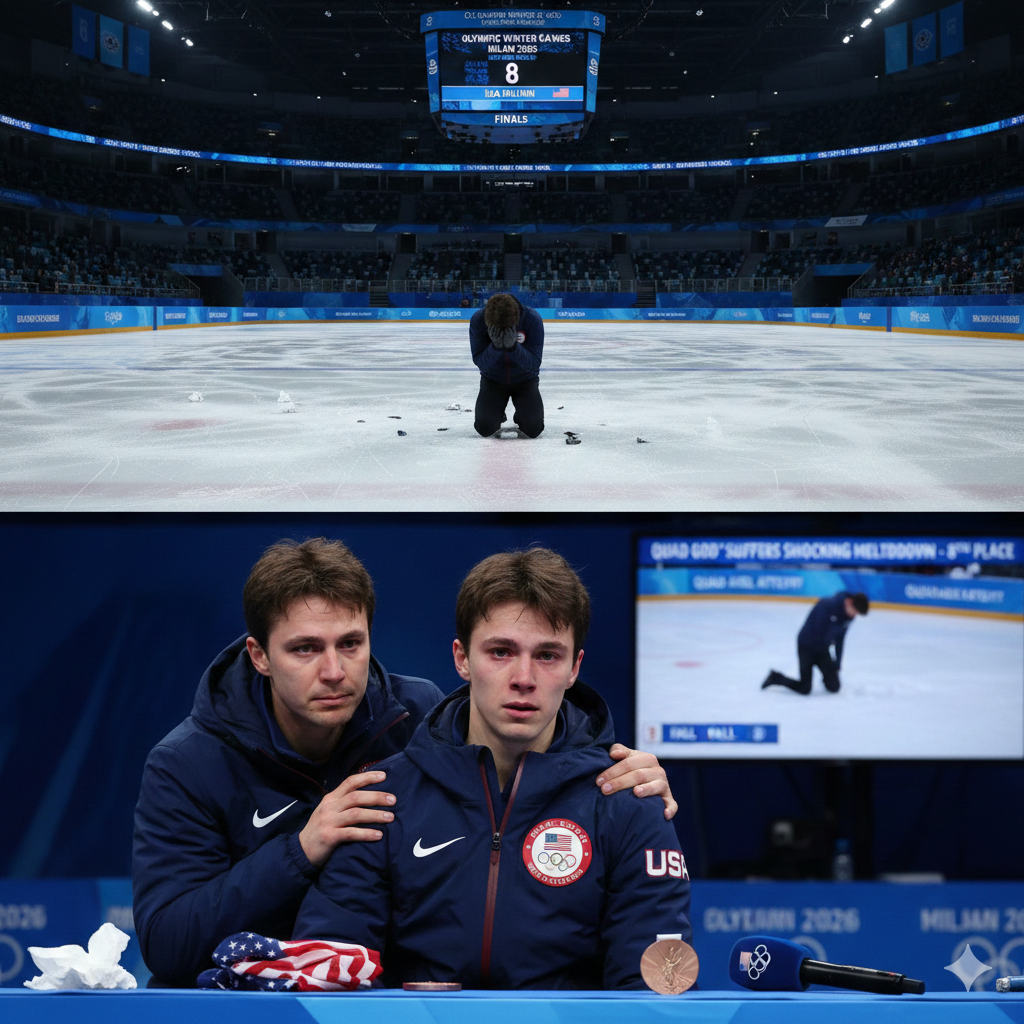
‘Quad God’ Ilia Malinin Suffers Shocking Olympic Meltdown, Finishes 8th After Falls and Mistakes Derail Gold Medal Dreams in Milan
Kazakhstan’s Mikhail Shaidorov Wins Stunning Upset Gold as American Figure Skating Phenom Crumbles Under Pressure in ‘Worst Olympic Meltdown in Figure Skating History’
MILAN, Italy — In what sports analyst Christine Brennan called “probably the worst meltdown in figure skating history, certainly Olympic history,” American figure skating sensation Ilia Malinin suffered a catastrophic collapse Friday at the 2026 Winter Olympics, plummeting from overwhelming gold medal favorite to a stunning eighth-place finish that left the Milano Ice Skating Arena in shocked silence.
The 21-year-old “Quad God”—undefeated since 2023 and holder of a commanding five-point lead after Wednesday’s short program—fell twice, downgraded multiple quadruple jumps to singles and doubles, and scored just 156.33 points in his free skate. His total score of 264.49 points was more than 27 points behind Kazakhstan’s Mikhail Shaidorov, who captured his country’s first Winter Olympics gold medal in 32 years with a stunning upset performance.
“Honestly, I still haven’t been able to process what just happened,” a visibly devastated Malinin told reporters minutes after his disastrous routine. “It’s a lot of mixed emotions. The nerves just were so overwhelming, and especially going into that starting post, I just felt like all the traumatic moments of my life really just started flooding my head, and I just did not handle it.”
The Collapse: How the ‘Sure Thing’ Became History’s Biggest Upset
Five-Point Lead Evaporates in Four Minutes of Chaos
When Malinin took the ice as the final skater Friday evening, the competition appeared over before he’d even struck his opening pose. Japan’s Yuma Kagiyama—his closest competitor—had struggled through his own free skate moments earlier, leaving the door wide open for the American to cruise to what everyone assumed would be an inevitable coronation.
The atmosphere in the arena was electric with anticipation. Fans held up signs reading “QUAD GOD” and “GO ILIA.” Journalists prepared stories celebrating America’s newest figure skating champion. NBC commentators discussed not whether Malinin would win, but by how much—and whether he’d become the first skater in Olympic history to successfully land the quadruple axel, figure skating’s most difficult jump.
Then the music started, and everything fell apart.
The Breakdown:
Jump 1 (0:20): Quad toe loop – LANDED CLEAN
Early optimism. Malinin’s signature power evident.
Jump 2 (0:42): Planned quad salchow – BAILED TO SINGLE SALCHOW
First sign of trouble. Crowd gasps audibly.
Jump 3 (1:15): Planned quad lutz – DOWNGRADED TO DOUBLE LUTZ
Disaster deepens. Malinin visibly shaken.
Jump 4 (2:08): Quad toe loop combination – FALL
Arena erupts in sympathetic cheers trying to rally the struggling skater.
Jump 5 (2:45): Triple axel – FALL
Even Malinin’s usually reliable triple axel betrays him.
Remaining Elements: Multiple step sequences and spins completed, but technical value destroyed by early mistakes.
“I did not think it would be that heavy,” Malinin admitted about the Olympic pressure. “I thought that I could come into this like any other competition, but honestly I definitely underestimated it.”
The Numbers Tell a Devastating Story
Malinin’s free skate score of 156.33 points was a catastrophic 82 points below his personal best of 238.24 set at December’s Grand Prix Final—and 44 points below what he scored in the team event just days earlier.
Score Comparison:
- Personal Best (Dec 2025 Grand Prix Final): 238.24 points
- Team Event Free Skate (Feb 8, 2026): 200.03 points
- Individual Free Skate (Feb 13, 2026): 156.33 points
- Deficit from personal best: -82 points (-35%)
To put this in perspective: Malinin’s collapse was equivalent to an NBA player who averages 30 points per game scoring just 4 points in the championship game, or a quarterback throwing five interceptions in the Super Bowl.
“This is probably the worst meltdown in figure skating history, certainly Olympic history, by a favorite,” Brennan told CNN from Milan. “I’ve never seen anything quite like this in figure skating.”
Mikhail Shaidorov: From Shopping Mall Rink to Olympic Champion
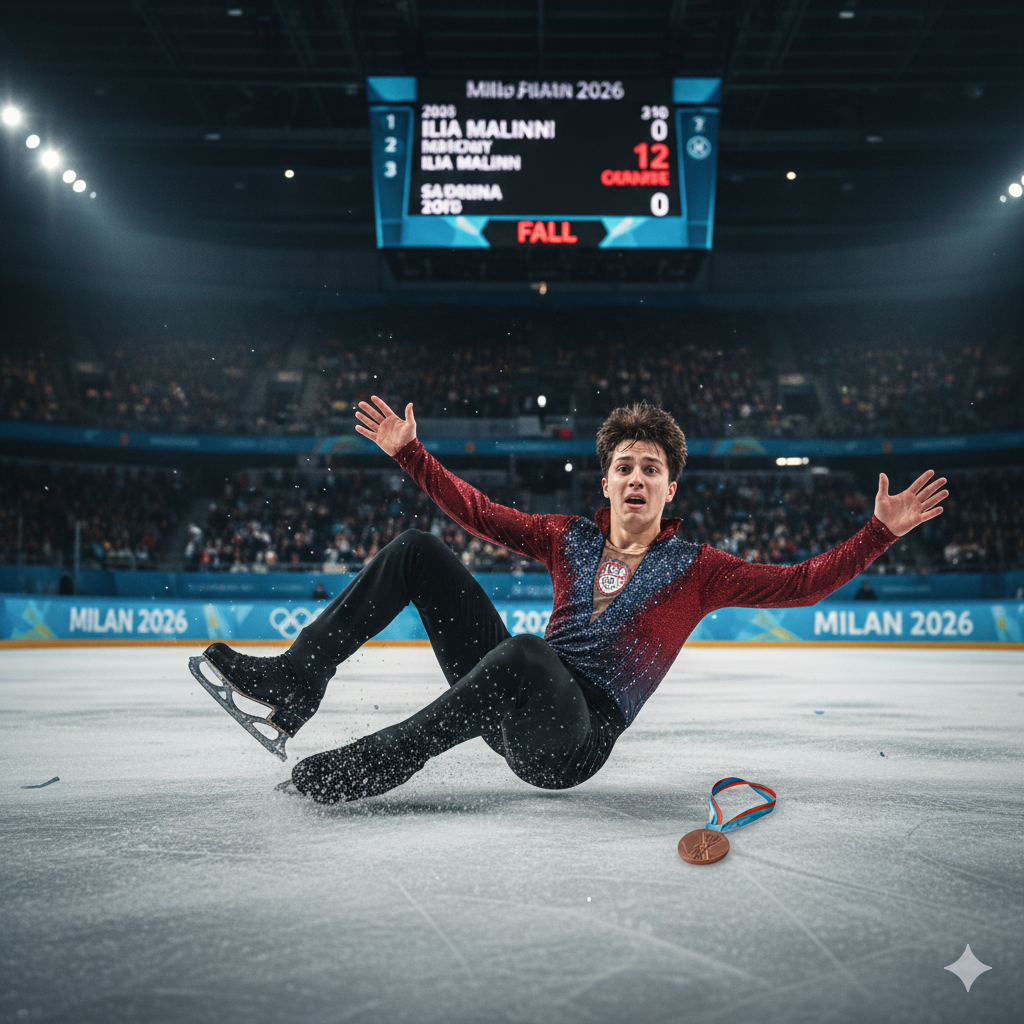
Kazakhstan’s Unlikely Hero Didn’t Believe What He’d Just Witnessed
While Malinin’s dreams shattered on Olympic ice, 21-year-old Mikhail Shaidorov of Kazakhstan was experiencing the opposite emotion: disbelief that he’d actually won.
When Malinin’s score was announced, placing him eighth, Shaidorov—who had been sitting in silver medal position—put his hands over his mouth and began crying. About five minutes later, when it became official that he’d won gold, the young Kazakh was still in shock.
Malinin, displaying the class that has defined his career, immediately walked over to congratulate Shaidorov. The two shared a hug and handshake that represented both the grace of the defeated and the humility of the unexpected victor.
“He is a very important athlete in the history of figure skating and so, of course, I was rooting for Ilia, but the ice is slippery,” Shaidorov said through a translator, his eyes still red from crying.
Final Medal Standings:
- GOLD: Mikhail Shaidorov (Kazakhstan) – 291.58 points
- SILVER: Yuma Kagiyama (Japan) – 289.79 points
- BRONZE: Shun Sato (Japan) – 283.36 points
- 8th Place: Ilia Malinin (USA) – 264.49 points
A Journey from Humble Beginnings
Shaidorov’s victory carries special significance for Kazakhstan, a country with limited figure skating resources. He learned to skate on a rink in the middle of a shopping mall—the same humble facility where Kazakhstan’s skating legend Denis Ten (2014 Olympic bronze medalist) learned the sport.
Shaidorov grew up idolizing Ten, who was tragically murdered in 2018 at age 25 during a robbery. Ten had paved the way for young Kazakh skaters, showing that Olympic glory was possible even from a country without the deep skating tradition of Russia, the United States, or Japan.
Friday’s gold medal represents Kazakhstan’s first Winter Olympics gold in any sport since cross-country skier Vladimir Smirnov won at the 1994 Lillehammer Games—a 32-year drought finally ended.
“Denis showed us all that we could dream big, even from a shopping mall rink,” Shaidorov said. “This gold medal is for him, for Kazakhstan, for everyone who believes impossible dreams can come true.”
The Warning Signs Were There
Team Event Struggles Foreshadowed Individual Disaster
Looking back with the cruel clarity of hindsight, there were signals that the “Quad God” was struggling with the Olympic pressure more than he let on.
During the team event short program on February 7, Malinin appeared shaky and uncertain—a stark contrast to his usual supreme confidence. He stepped out of a triple axel and fell to second place behind Japan’s Yuma Kagiyama, raising eyebrows among figure skating insiders.
His free skate in the team event final on February 8 was better—good enough to help Team USA edge Japan by a single point for gold—but still well below his usual stratospheric standards. The 200.03 score was nearly 30 points off his world record 228.97 from October’s Skate Canada.
At the time, commentators dismissed the struggles as “opening jitters” that would disappear once Malinin got comfortable with Olympic ice. After all, he still helped deliver Team USA’s second consecutive Olympic team gold medal.
But Malinin himself admitted Wednesday after the short program that he’d underestimated the Olympic pressure.
“I did not think it would be that heavy,” he told reporters. “I thought that I could come into this like any other competition, but honestly I definitely underestimated it.”
That quote now reads as almost prophetic foreshadowing of Friday’s catastrophe.
The ‘QUAD GOD’ Persona: Confidence or Overconfidence?
Part of Malinin’s appeal has been his swagger—the kind of brash confidence that borders on arrogance but feels earned when you’re the only human capable of landing a quad axel.
He’s walked around backstage at competitions wearing a gold-lettered shirt reading “QUAD GOD”—a self-given nickname that celebrated his mastery of quadruple jumps. He’s joked with crowds, waved to adoring fans, and generally projected an image of unshakeable self-belief.
But sports psychologists note that athletes who project extreme confidence often do so to mask inner doubts and insecurities. The bigger the front, sometimes the more fragile the foundation.
“All the traumatic moments of my life really just started flooding my head,” Malinin revealed after Friday’s collapse—a stunning admission that suggests the confident “Quad God” persona was concealing a much more vulnerable young man beneath.
The Pressure Cooker: Understanding Olympic Mental Collapse
Why Elite Athletes Crumble on Sport’s Biggest Stage
Malinin’s meltdown, while historic in its magnitude, follows a pattern sports psychologists have observed for decades: elite athletes who dominate their sport for years suddenly fall apart when it matters most.
Famous Olympic Collapses:
- Greg Louganis (1988 Seoul): Hit his head on diving board during preliminaries
- Jana Novotna (1993 Wimbledon): Broke down crying during trophy presentation after choking away championship
- Jean van de Velde (1999 British Open): Blew six-shot lead on final hole
- Nathan Chen (2018 PyeongChang): Expected to win gold, finished fifth after falls in short program
The common thread? Each athlete later described experiencing intrusive thoughts, overwhelming anxiety, and a sense of being mentally paralyzed despite having performed the same skills thousands of times.
The Neuroscience of Choking
Dr. Sian Beilock, a cognitive scientist who studies performance under pressure, explains that “choking” occurs when athletes shift from automatic, subconscious execution to conscious, overthinking mode.
“When you’re performing at an elite level, your skills are procedural—stored in parts of the brain that don’t require conscious thought,” Beilock told ESPN in a previous interview. “But extreme pressure activates your prefrontal cortex, which starts monitoring and second-guessing movements that should be automatic. It’s like trying to think about each individual muscle movement while walking—you’ll trip over your own feet.”
This appears to be exactly what happened to Malinin.
“Maybe I was too confident it was going to go well,” he told NBC immediately after his performance, his voice breaking. “The blocks were mental. Finally experiencing that Olympic atmosphere, it’s crazy. It’s not like any other competition.”
The ‘Hot Mic’ Moment: Blaming Himself for Not Making 2022 Team
Perhaps the most revealing moment came when NBC’s cameras caught Malinin on a hot microphone while sitting in the “kiss and cry” area awaiting his scores.
“If they had sent me to Beijing, I wouldn’t have skated like that,” Malinin said, referring to the 2022 Olympics when Team USA selected veteran Jason Brown (a 2014 Sochi team bronze medalist) instead of the then-18-year-old Malinin. “It’s not easy.”
The comment reveals Malinin’s belief that missing the 2022 Olympics left him unprepared for the unique pressure of skating on sport’s biggest stage. Had he experienced that pressure four years ago—when expectations were lower and failure less consequential—perhaps he would have handled Friday’s moment differently.
It’s a haunting “what if” that will follow Malinin for years.
Reactions: Skating World Rallies Around Devastated Champion
Scott Hamilton Leads Outpouring of Support
Olympic gold medalist and skating legend Scott Hamilton, who won in 1984 and has been one of Malinin’s biggest supporters, immediately took to social media to offer words of encouragement.
“One performance should never define anyone,” Hamilton wrote on X (formerly Twitter). “A good one or a disappointing one. @iliaskating is someone I admire and has all my respect. As badly as I feel for him tonight, I know he will respond with strength, courage, and dignity. We all love you Ilia!”
The message resonated across the skating community, where Malinin is universally respected not just for his athletic ability but for his kindness and willingness to mentor younger skaters.
Christine Brennan: ‘Hard to See’ Someone Struggle Like That
Veteran Olympics broadcaster and sports analyst Christine Brennan, who has covered every Winter Olympics since 1984, told CNN the collapse was painful to watch.
“This was hard to see,” Brennan said from Milan. “Ilia is so confident, so calm, so delightful, delightfully sure of himself. To see someone who exudes that kind of swagger just completely fall apart—it’s heartbreaking.”
Brennan compared the moment to other historic Olympic upsets but concluded that given Malinin’s utter dominance of men’s figure skating over the past two years, this ranked among the most shocking sports moments she’s ever witnessed.
“This is as big an upset in sports as we’ve probably ever seen,” Brennan stated unequivocally.
Skating Insiders Note Malinin’s Class
Despite his own devastation, Malinin showed remarkable grace in the immediate aftermath. He congratulated Shaidorov, thanked the crowd, and spoke articulately with reporters even as his world was crumbling.
“That’s the mark of true champion—how you handle defeat,” said 1992 Olympic champion Kristi Yamaguchi. “Ilia showed class and maturity beyond his 21 years. This will make him stronger.”
The Nathan Chen Parallel: Is Olympic Redemption Possible?
2018 PyeongChang: When the ‘Quad King’ Fell
The immediate comparison everyone in figure skating is making is to Nathan Chen’s experience at the 2018 PyeongChang Olympics.
Chen, nicknamed the “Quad King” for his mastery of quadruple jumps, was the overwhelming favorite heading into PyeongChang. He’d won the previous year’s world championship and appeared unstoppable.
Then disaster struck in the short program. Chen fell multiple times, scored poorly, and essentially eliminated himself from gold medal contention before the free skate even began. He finished fifth overall—a result that shocked the skating world.
The parallels to Malinin are eerie:
- Both nicknamed for quad jump mastery (“Quad King” vs “Quad God”)
- Both undefeated heading into their first Olympics
- Both fell apart in their Olympic debut under intense pressure
- Both are American men’s skaters from Southern California
- Both were 21 years old at the time (Chen turned 21 during 2018 Olympics)
Chen’s Redemption: Beijing 2022
But here’s where Malinin can find hope: Nathan Chen didn’t let PyeongChang define him.
He came back even stronger, continuing to dominate men’s figure skating for four years. At the 2022 Beijing Olympics, Chen delivered a flawless performance, winning gold decisively and finally achieving the Olympic glory that had eluded him.
“The difference between who I was in 2018 and who I became in 2022 was learning how to handle pressure, how to trust myself, and how to skate for joy rather than obligation,” Chen said after his Beijing triumph.
Those lessons now await Ilia Malinin.
Four Years to Get It Right
At 21 years old, Malinin will be 25 at the 2030 Winter Olympics—right in the prime of his career for a male figure skater.
If history is any guide, Malinin will continue dominating world championships, Grand Prix events, and every other competition for the next four years. The question is whether he can develop the mental toughness to handle Olympic pressure.
“This is just the first chapter,” said Malinin, his voice steady despite obvious pain. “From here, it’s just regrouping, figuring out what to do next and going from there.”
What Went Wrong: Technical Breakdown of the Disaster
The Quad Axel That Never Was
Perhaps the most anticipated moment of the 2026 Winter Olympics never happened: Ilia Malinin attempting the quadruple axel on Olympic ice.
The quad axel—requiring 4.5 rotations in the air—is considered figure skating’s most difficult jump. Malinin is the only human who can land it in competition, having first achieved the feat at the 2022 U.S. International Figure Skating Classic.
He’d talked confidently about showcasing the jump in Milan. He’d landed it cleanly in practice sessions Thursday. NBC had prepared entire segments explaining the physics and difficulty of the jump.
But when Friday’s free skate began unraveling, Malinin abandoned any thought of the quad axel. In fact, he bailed on multiple planned quad jumps, downgrading them to doubles and even a single.
The planned element that should have been a quad axel? Malinin popped it into a single axel—losing approximately 13 points in technical value in that one moment alone.
“When you’re in survival mode, you can’t attempt your hardest tricks,” explained former Olympic champion Brian Boitano. “Your body won’t let you. The fear takes over.”
The Snowball Effect: How One Mistake Became Five
Sports psychologists describe a phenomenon called “cascading failure” where one mistake triggers a mental spiral that leads to more mistakes.
Malinin’s first major error—bailing on the quad salchow 42 seconds into his routine—set off exactly this kind of spiral.
“Once you miss that first big jump, doubt creeps in,” explained 2010 Olympic champion Evan Lysacek. “You start thinking instead of just skating. And once you’re thinking, you’re done.”
The second bail (quad lutz to double lutz) confirmed Malinin wasn’t going to recover. The two falls that followed were almost inevitable at that point—his confidence shattered, his muscle memory disrupted, his mental state in chaos.
The Scoring Breakdown
Technical Elements Score (TES): 76.85 (Should have been 110+)
- Lost 13+ points on downgraded quad axel
- Lost 10+ points on downgraded quad salchow
- Lost 8+ points on downgraded quad lutz
- Lost 7+ points each on two fall deductions
- Total technical deficit: ~45 points from planned content
Program Components Score (PCS): 79.48 (Below his usual 85-90 range)
- Skating skills compromised by visible anxiety
- Transitions rushed and uncertain
- Performance quality absent—no joy or artistry
- Interpretation suffering from mental distress
Combined Deficit: Approximately 50+ points below what Malinin should have scored with a clean program.
Team USA Figure Skating: Mixed Results in Milan
Malinin’s Individual Collapse Can’t Overshadow Team Gold
Despite Friday’s devastating individual result, Ilia Malinin leaves Milan with Olympic gold—won as part of Team USA’s victory in the figure skating team event.
That gold medal, secured on February 8, represents the United States’ second consecutive Olympic team event championship (following 2022 Beijing) and the fourth overall for American figure skating at the Winter Olympics.
Team USA Figure Skating Medal Count (Milan 2026):
- Team Event: GOLD (Malinin, Madison Chock, Evan Bates, Alysa Liu, others)
- Ice Dance: SILVER (Madison Chock & Evan Bates)
- Men’s Individual: 8th place (Ilia Malinin)
- Women’s Individual: TBD (competition Saturday)
- Pairs: TBD (competition Sunday)
Chock and Bates: Redemption After Controversial Loss
While Malinin struggled, veteran ice dancers Madison Chock and Evan Bates delivered one of Team USA’s feel-good stories, winning silver medals in their fourth and final Olympics.
The duo, competing at ages 32 and 35 respectively, finished just 2.35 points behind France’s Gabriella Papadakis and Guillaume Cizeron in what many observers considered a controversial judging decision.
“After everything we’ve been through, to leave with Olympic silver and team gold—we can be proud of that,” said Chock, fighting back tears.
The Broader Context: US Figure Skating’s Olympic Struggles
A Pattern of Underperformance When It Matters Most
Friday’s collapse fits into a troubling pattern for American men’s figure skating at the Olympics over the past two decades:
Recent US Men’s Olympic Results:
- 2026 Milan: Ilia Malinin – 8th place (expected gold)
- 2022 Beijing: Nathan Chen – GOLD (redemption after 2018)
- 2018 PyeongChang: Nathan Chen – 5th place (expected gold)
- 2014 Sochi: Jason Brown – 9th place
- 2010 Vancouver: Evan Lysacek – GOLD
- 2006 Torino: Johnny Weir – 5th place
The United States has won just two Olympic gold medals in men’s figure skating since 1988 (Evan Lysacek 2010, Nathan Chen 2022)—despite producing some of the sport’s most talented athletes.
The Pressure of Representing Team USA
American figure skaters face unique pressures that athletes from other nations don’t experience to the same degree:
- Media Scrutiny: US media coverage of Olympics is more intense than almost any other country
- Commercial Expectations: Endorsement deals worth millions ride on Olympic performance
- Cultural Significance: Figure skating remains one of few winter sports Americans care about
- Historical Weight: Living up to legends like Dick Button, Scott Hamilton, and Michelle Kwan
“Being an American figure skater at the Olympics is different,” said Hamilton. “The entire country is watching. Your family is watching. Your future is riding on four minutes of skating. That’s a lot for a 21-year-old to carry.”
What Happens Next: Malinin’s Path Forward
Immediate Future: Sitting Out World Championships?
The 2026 World Figure Skating Championships are scheduled for March 23-29 in Montreal, Canada—just six weeks after Milan.
Malinin must decide whether to compete or sit out and regroup mentally. Nathan Chen took a brief break after PyeongChang before returning to competition, while other athletes have skipped Worlds to reset.
Figure skating experts suggest Malinin should compete.
“The worst thing he can do is sit at home dwelling on this,” said Kristi Yamaguchi. “He needs to get back on the ice, remind himself why he loves this sport, and prove to himself that he’s still the best in the world.”
Long-Term: Sports Psychology and Mental Training
Malinin acknowledged Friday that he underestimated the mental aspect of Olympic competition—a mistake he won’t repeat.
Expect Team USA to connect Malinin with sports psychologists specializing in performance under pressure. Techniques like visualization, meditation, controlled breathing, and cognitive behavioral therapy can help athletes manage anxiety and intrusive thoughts.
“I’ve already had athletes reach out offering to connect me with their mental performance coaches,” Malinin told reporters. “I’m going to take advantage of that. I need help with this part of competition.”
2030 Olympics: The Redemption Arc
If Malinin follows the Nathan Chen template, the next four years will be about:
- Continued Dominance: Winning world championships and Grand Prix events
- Mental Preparation: Working with sports psychologists
- Reduced Pressure: Letting go of “must win” mentality
- Perspective: Skating for joy rather than obligation
- Experience: Using 2026’s pain as motivation for 2030
“This doesn’t define me,” Malinin said Friday, his jaw set with determination despite red-rimmed eyes. “Four years from now, this will just be part of the story—not the ending.”
Conclusion: When Perfection Meets Pressure, Humanity Wins
Ilia Malinin’s shocking eighth-place finish at the 2026 Winter Olympics will be analyzed, discussed, and debated for years to come.
It serves as a reminder that even the most supernatural athletes—those who make the impossible look routine—are fundamentally human. They feel pressure. They experience doubt. They can crack under the weight of expectation.
But it also serves as a reminder of resilience, grace, and the long game of athletic excellence.
Nathan Chen fell in PyeongChang, then won gold in Beijing.
Michelle Kwan never won Olympic gold, but became America’s most beloved figure skater.
Scott Hamilton battled cancer after winning gold and emerged stronger.
Ilia Malinin’s Olympic journey is just beginning. Friday’s nightmare will fade. The quad axel will be landed. The gold medal will come.
But even if it doesn’t, Malinin has already shown the world something more valuable than technical brilliance: the courage to keep going when everything falls apart.
“It wasn’t my best day, and it was definitely something I wasn’t expecting,” Malinin said, his voice steady despite the devastation. “But it’s done, I can’t go back and change it, even though I would love to. From here, it’s just regrouping, figuring out what to do next and going from there.”
That’s not the voice of someone defeated. That’s the voice of a champion who just learned the hardest lesson sports can teach: losing with grace is harder than winning with glory.
The “Quad God” is indeed mortal. But mortality doesn’t mean weakness—it means being human enough to fall, and strong enough to rise again.
Final Results – Men’s Figure Skating
GOLD: Mikhail Shaidorov (Kazakhstan) – 291.58 points
SILVER: Yuma Kagiyama (Japan) – 289.79 points
BRONZE: Shun Sato (Japan) – 283.36 points
4th: Adam Siao Him Fa (France) – 277.92 points
5th: Kao Miura (Japan) – 274.18 points
6th: Kevin Aymoz (France) – 271.45 points
7th: Maxim Naumov (USA) – 268.77 points
8th: Ilia Malinin (USA) – 264.49
Related News:
2026 Winter Olympics: Team USA Men’s Hockey Schedule and Results as Americans Chase First Gold Medal Since 1980 Miracle on Ice
Social Connect:

