

Trump Silent as India and EU Finalize Historic ‘Mother of All Deals’ Trade Agreement
White House Yet to Comment on Massive EU-India Free Trade Pact That Creates 2 Billion-Person Market
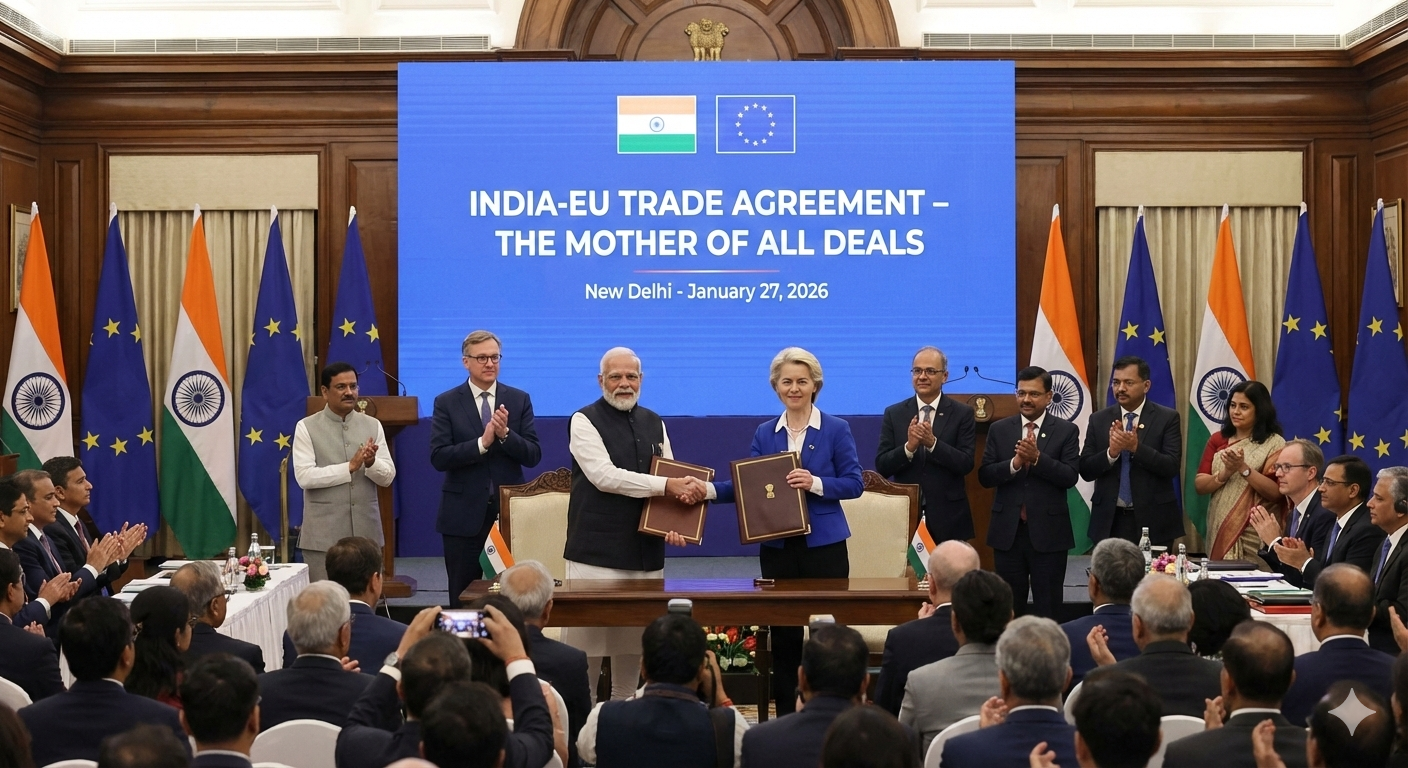
WASHINGTON/NEW DELHI — The European Union and India have concluded a landmark free trade agreement after nearly two decades of negotiations, but President Donald Trump has remained conspicuously silent on a deal that appears designed to bypass his aggressive tariff policies.
The historic trade pact, announced Tuesday morning in New Delhi, will gradually eliminate tariffs on the vast majority of goods traded between the world’s most populous democracy and the 27-nation European bloc. Both sides have hailed what they’re calling the “mother of all deals”—a massive free trade zone covering approximately 2 billion people and representing nearly 15% of global GDP.
But the celebration in Europe and India comes as the Trump administration faces questions about whether the deal undermines U.S. economic leverage and represents a strategic rebuff to Washington’s tariff-heavy trade strategy.
Treasury Secretary Already Blasting the Deal
While President Trump has not publicly commented on the EU-India agreement, Treasury Secretary Scott Bessent wasted no time criticizing the pact during a Sunday interview with ABC News.
“The U.S. has made much bigger sacrifices than Europeans have,” Bessent said. “We have put 25% tariffs on India for buying Russian oil. Guess what happened last week? The Europeans signed a trade deal with India.”
Bessent went further, accusing European nations of indirectly financing Russia’s war effort against Ukraine by purchasing refined oil products from India—products made from Russian crude oil.
“The Russian oil goes into India, the refined products come out, and the Europeans buy the refined products,” Bessent told ABC. “They are financing the war against themselves.”
The Treasury Secretary’s sharp comments signal potential friction ahead as Washington grapples with allies and trading partners forming economic partnerships that could reduce American influence.
What’s Actually In the India-EU Trade Deal?
The agreement represents India’s most ambitious trade pact to date and one of the European Union’s largest commercial partnerships outside its immediate neighbors. Here’s what both sides have agreed to:
For the European Union:
- India will eliminate or reduce tariffs on 96.6% of EU goods exports
- Up to 250,000 European-made vehicles can enter India annually at preferential duty rates—six times larger than India’s recent trade deals
- Tariffs on premium European wine will drop from 150% to 20% over time
- European exports of industrial goods, wine, chocolates, and pasta will see major tariff cuts
- EU goods exports to India expected to double by 2032
For India:
- EU will eliminate or cut tariffs on 99.5% of Indian imports over seven years
- Major benefits for labor-intensive Indian exports hit by Trump tariffs: apparel, gems, jewelry, and footwear
- Binding commitments from EU on student mobility and post-study work visas
- Concessions across 144 services sectors
- India’s politically sensitive dairy sector protected from the deal
Current Trade Volume: Bilateral trade between India and the EU reached $136.5 billion in India’s fiscal year ending March 2025, with the European Union accounting for more than 17% of India’s total exports.
Why This Deal Is a Big Problem for Trump
The timing of the EU-India agreement couldn’t be more pointed. Both Europe and India are currently facing punitive U.S. tariffs under the Trump administration:
- India: Slapped with 50% tariffs on goods, including an additional 25% specifically targeting India’s purchases of Russian oil
- European Union: Facing 15% tariffs on exports to the U.S., despite having negotiated a separate trade deal with Washington
The message appears clear: major U.S. trading partners are hedging against what they view as volatile and unpredictable American trade policies by forming their own alliances.
“This is a deal that they can do that will have a positive impact, while the U.S. and China will remain closed as new market openings go,” said Hosuk Lee-Makiyama, director of the European Centre for International Political Economy. “So in that respect, this is probably one of the best deals they can do at the moment.”
India’s Diplomatic Balancing Act
India’s Petroleum and Natural Gas Minister Hardeep Singh Puri told CNBC Tuesday that he expects the U.S.-India relationship to remain strong despite the EU deal.
“The relationship structure between the U.S. and India is very strong,” Puri said. “I would try and look at the positive side. I’m not a soothsayer, I don’t know when trade deals will get signed, how long it takes… but everybody needs to chill a bit.”
Puri added that negotiations for a U.S.-India trade agreement are at “a very advanced stage” and expressed hope that a deal would materialize “sooner rather than later.”
However, Republican Senator Ted Cruz reportedly told donors in leaked audio recordings that it’s the White House—not New Delhi—that has been holding up progress on a U.S.-India trade agreement, according to Axios.
European Leaders Call Deal ‘Historic’ Amid Trump Tariff Threats
European Commission President Ursula von der Leyen, who traveled to New Delhi to announce the agreement alongside European Council President Antonio Costa, praised the pact as proof that cooperation beats confrontation.
“We have concluded the mother of all deals,” von der Leyen declared on social media. “We have created a free trade zone of two billion people, with both sides set to benefit.”
Speaking at a press conference in New Delhi, von der Leyen added: “India has risen and Europe is truly glad about it because when India succeeds, the world is more stable, more prosperous and more secure.”
Indian Prime Minister Narendra Modi, who met with Trump in Washington in February 2025, described the EU agreement as a “landmark” deal that opens “a new chapter in strategic relations” between India and Europe.
Europe’s Growing Independence From U.S. Trade
David McAllister, chair of the European Parliament’s foreign affairs committee, summed up Europe’s delicate balancing act between economic self-interest and maintaining the transatlantic alliance.
“Europe needs to become more sovereign. Europe needs to grow up, and that means we need to become economically more competitive,” McAllister told CNBC. “We need to do much more for our own security and defense, but we also want to maintain the close transatlantic relationship with the United States… but this relationship needs to be based on mutual respect and trust.”
The EU-India deal follows the European Union’s recent conclusion of negotiations with the Mercosur bloc of South American countries—Brazil, Argentina, Paraguay, Uruguay, and recently joined Bolivia. Both agreements signal Europe’s determination to diversify its trading relationships beyond the United States and China.
Modi’s Trade Deal Blitz: Four Agreements Since May 2025
Tuesday’s announcement marks Prime Minister Modi’s fourth major trade deal since May 2025, following agreements with:
- United Kingdom (signed 2025)
- Oman (signed late 2025)
- New Zealand (signed January 2026)
- European Union (concluded January 27, 2026)
India is also pursuing trade partnerships with the Mercosur bloc, Chile, Peru, and the Gulf Cooperation Council as Modi seeks to expand India’s global economic footprint and reduce dependence on the American market.
This flurry of trade diplomacy comes after Trump famously dubbed India the “tariff king” for its historically protectionist trade policies. Modi appears determined to shake that reputation while simultaneously offsetting the impact of Trump’s 50% tariffs on Indian exports.
What Happens Next?
The EU-India trade agreement still faces several hurdles before implementation:
Legal Vetting: The deal text must undergo legal review, expected to take five to six months, according to Indian government officials.
Ratification: The European Council and European Parliament must ratify the agreement, which could become contentious given the EU’s recent trade policy debates.
Implementation Timeline: Indian officials expect the deal to be fully implemented within one year. The European Commission hopes to begin phased implementation by January 2027.
U.S. Response: All eyes remain on how President Trump and the White House will react once Trump breaks his silence on the agreement.
Will Trump Retaliate With More Tariffs?
Trade experts are closely watching for potential U.S. retaliation. The Trump administration has already demonstrated willingness to impose tariffs on allies:
- Increased tariffs on South Korea to 25% (from 15%) after Seoul delayed legislative approval of a U.S. trade deal
- Maintained 15% tariffs on EU imports despite an existing trade agreement
- Imposed 50% tariffs on India, doubling the rate in August 2025
Lee-Makiyama noted that “EU trade ministers are now getting used to the fact that there is a new tariff threat coming from Washington every week, and of course, their skins get a little bit thicker each time.”
The Bigger Picture: Global Trade Realignment Under Trump
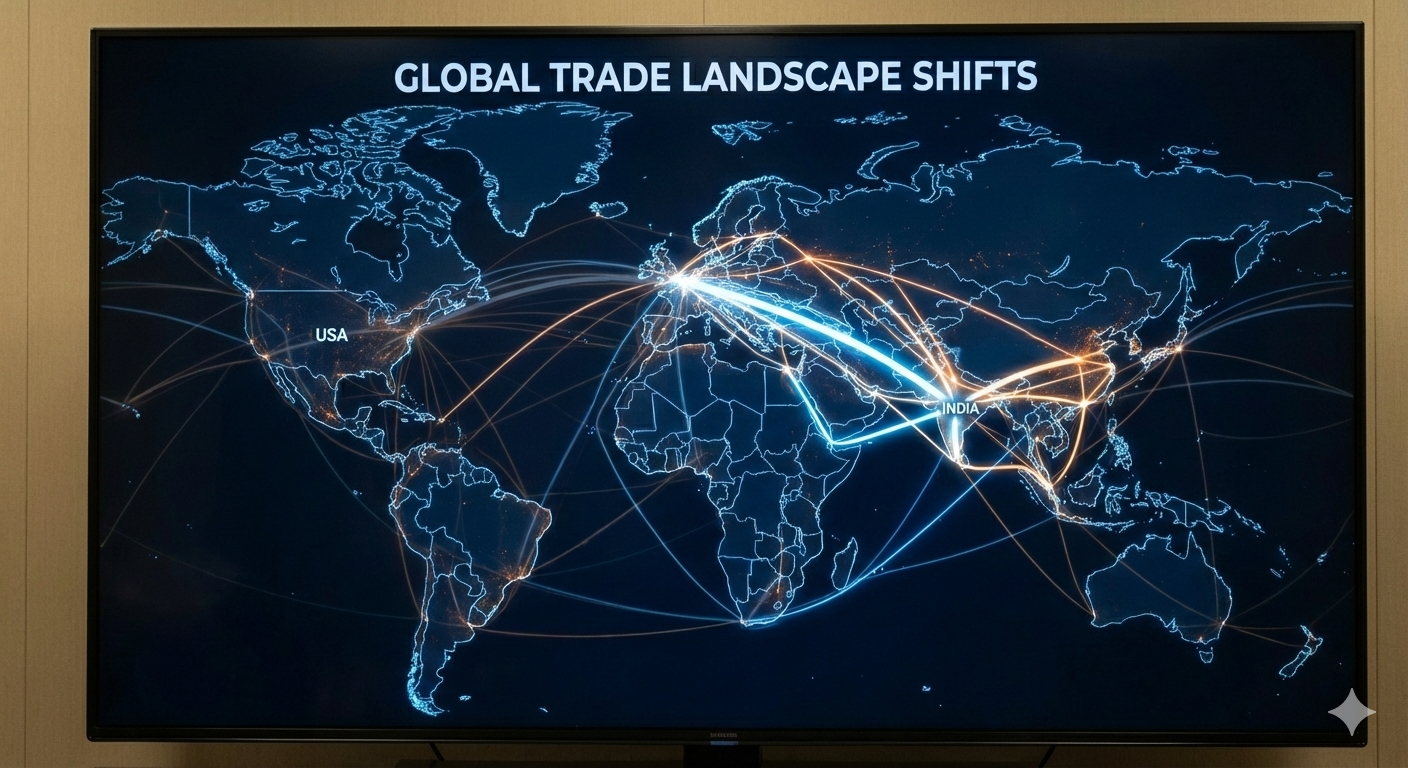
The EU-India trade deal represents a fundamental shift in global economic alliances under the Trump presidency:
Countries Seeking Alternatives to U.S. Markets:
- European Union (pursuing deals with India, Mercosur, and others)
- India (four major trade deals since May 2025)
- Canada (repositioning India as key economic partner under Prime Minister Mark Carney)
- United Kingdom (Prime Minister Keir Starmer beginning three-day diplomatic tour of China)
The Russia Factor: India’s continued purchases of Russian crude oil remain a major sticking point with Washington. India defends these purchases as necessary for affordable energy for its 1.4 billion people, while the U.S. sees them as undermining sanctions against Moscow.
NATO Concerns: Some European officials worry that antagonizing Washington with independent trade deals could jeopardize U.S. commitment to NATO’s collective defense principles, particularly as Russia’s war in Ukraine continues.
Expert Analysis: Why This Deal Matters for American Interests
The EU-India free trade agreement has significant implications for U.S. economic and strategic interests:
Economic Impact:
- Reduces European and Indian economic dependence on U.S. markets
- Creates competitive disadvantages for American exporters in both markets
- Potentially undermines effectiveness of U.S. tariffs as diplomatic leverage
Strategic Concerns:
- Tests transatlantic alliance cohesion as Europe pursues independent trade policy
- Demonstrates limits of Trump’s tariff-heavy negotiating strategy
- Shows U.S. allies willing to form partnerships that exclude American participation
Opportunity Cost:
- India and U.S. failed to finalize their own trade agreement despite negotiations
- American businesses may lose market share to European competitors in India
- U.S. could miss out on India’s rapidly growing consumer market of 1.4 billion people
What Industry Leaders Are Saying
European Automobile Industry: Celebrating access to India’s massive market with 250,000 vehicles annually at preferential rates—a major win for German, French, and Italian carmakers.
Indian Textile and Jewelry Exporters: Viewing the deal as essential lifeline after Trump’s 50% tariffs devastated U.S. exports of labor-intensive goods.
American Business Community: Remaining largely silent publicly but privately expressing concern about losing competitive position in both European and Indian markets.
Trade Policy Experts: Warning that continued U.S. tariff threats could accelerate formation of trade alliances that exclude American participation.
Key Questions Moving Forward
As the dust settles on the “mother of all deals,” several critical questions remain:
- When will Trump respond? The President’s silence has been deafening, and his eventual reaction could shape global trade dynamics for years.
- Will the U.S. retaliate? Could Trump impose additional tariffs on either India or the EU in response to the agreement?
- Can the deal survive ratification? European Parliament approval is not guaranteed, particularly given ongoing debates about the Mercosur deal.
- What about the U.S.-India trade deal? Will Washington and New Delhi revive negotiations, or has the EU agreement reduced India’s incentive to compromise with the U.S.?
- Is this the new normal? Are we witnessing a permanent realignment of global trade relationships away from U.S.-centered partnerships?
The Bottom Line
The EU-India free trade agreement represents one of the most significant economic partnerships of 2026 and a potential turning point in global trade dynamics. By creating a 2 billion-person free trade zone, Europe and India have sent a clear message: they’re prepared to build economic alliances that don’t depend on American participation.
For President Trump, who has made aggressive tariffs central to his trade strategy, the deal poses an uncomfortable question: Are punitive tariffs driving U.S. allies into each other’s arms rather than to the negotiating table with Washington?
As Treasury Secretary Bessent’s pointed criticism makes clear, the Trump administration views the EU-India deal with suspicion and frustration. But whether that frustration translates into additional tariffs, diplomatic pressure, or a rethinking of America’s trade approach remains to be seen.
What’s certain is that the global trading system is undergoing a fundamental transformation—and for the first time in decades, the United States may not be calling all the shots.
Related News :
Trump Pulls US Out of UN Climate Treaty Making America Only Nation Outside Global Framework
Social Connect

