

Why Team USA Marched Third-to-Last at 2026 Olympics Opening Ceremony — Salt Lake City 2034 Hosting Honor Explained
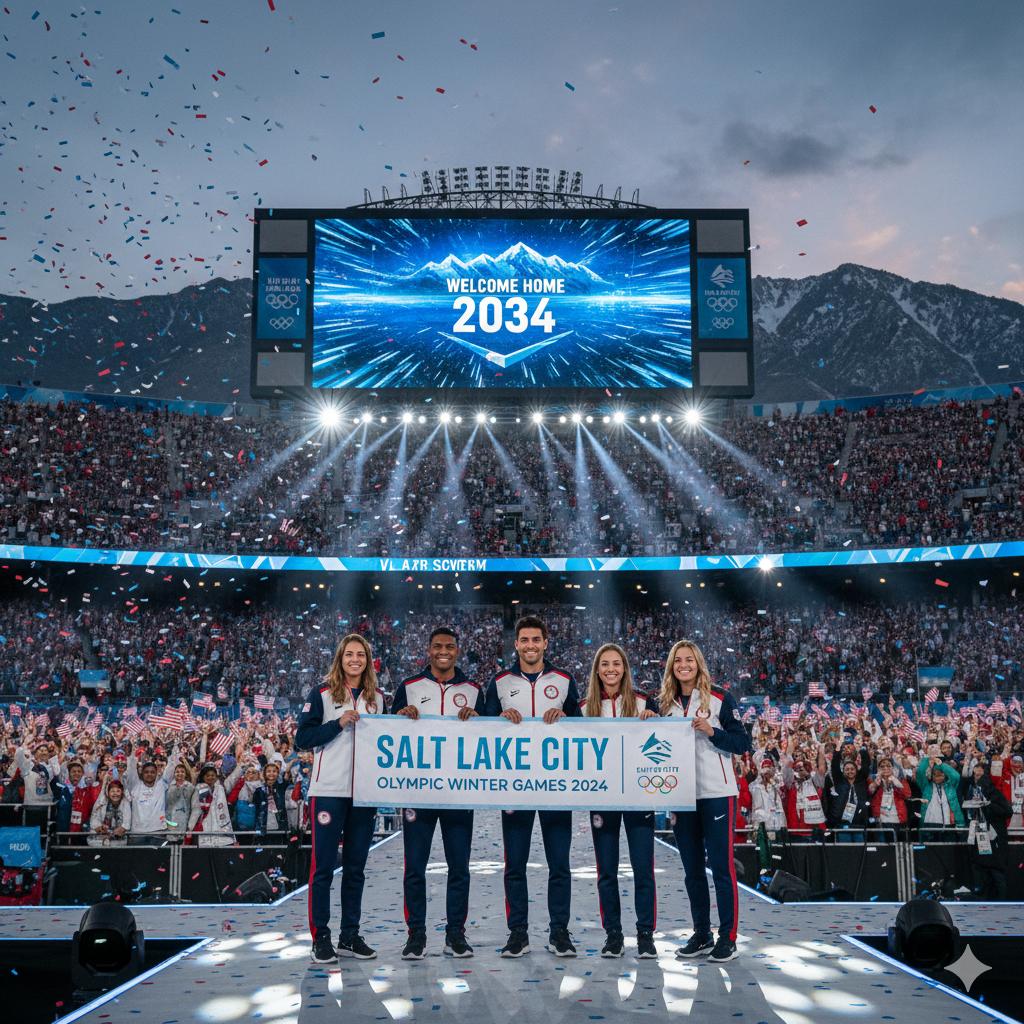
For the second Olympics in a row, Team USA fans had to wait until nearly the end of Friday’s opening ceremony to see American athletes parade through Milan’s iconic San Siro Stadium. The United States delegation appeared third-to-last in the Parade of Nations — not because of alphabetical order, but due to an Olympic tradition that honors future host countries with special placement. With Salt Lake City set to host the 2034 Winter Games, Team USA earned the privilege of marching ahead of only France (2030 host) and Italy (2026 host) in a ceremony that featured Mariah Carey, dual Olympic cauldrons, and athletes parading simultaneously across four Italian cities.
OPENING CEREMONY HIGHLIGHTS: The “Armonia” (Harmony) ceremony on February 6 featured performances by Mariah Carey, Andrea Bocelli, and Laura Pausini at San Siro Stadium in Milan. For the first time in Olympic history, two cauldrons were lit simultaneously — one in Milan and one in Cortina d’Ampezzo. Athletes paraded at four locations: Milan, Cortina, Livigno, and Predazzo. Colorado sent the most U.S. athletes (30), and Saudi Arabia competed at its first-ever Winter Olympics. Italian officials foiled Russian cyberattacks days before the ceremony, while Israeli athletes were booed as they entered the stadium.
The Olympic Parade Order: How It Works
The Parade of Nations follows a time-honored protocol with specific rules that determine which countries march in which order. While most delegations proceed alphabetically by country name, several notable exceptions create the dramatic finale of every Olympic opening ceremony.
The Standard Rules
Under normal circumstances, countries march in alphabetical order based on the language of the host nation. For the 2026 Milan Cortina Games, this meant Italian alphabetical order. Albania (Albania in Italian) marched first among the alphabetical nations, followed by other countries in Italian alphabetical sequence.
However, three permanent exceptions apply at every Olympic Games:
- Greece always goes first: As the birthplace of the ancient and modern Olympic movement, Greece holds the permanent honor of leading the Parade of Nations at every Summer and Winter Olympics, regardless of where the Games are held.
- Host country always goes last: The current host nation closes the parade, allowing the stadium to build to a crescendo as the home country’s athletes enter to massive applause from local fans.
- Future hosts get priority placement: In recent Olympics, the next one or two host nations have been granted special positions near the end of the parade, immediately before the current host country.
Why USA Went Third-to-Last at Milan Cortina 2026
The United States appeared in the third-to-last position during Friday’s opening ceremony because Salt Lake City, Utah will host the 2034 Winter Olympics. This marks Salt Lake City’s second time hosting the Winter Games, following the highly successful 2002 Olympics held just months after the September 11 attacks.
| PARADE POSITION | COUNTRY | REASON |
|---|---|---|
| First | Greece | Birthplace of Olympics (permanent honor) |
| 2nd through 88th | Various Nations | Italian alphabetical order |
| Third-to-Last | United States | Host of 2034 Winter Olympics (Salt Lake City) |
| Second-to-Last | France | Host of 2030 Winter Olympics (French Alps) |
| Last | Italy | Current host (Milan Cortina 2026) |
France’s Second-to-Last Position
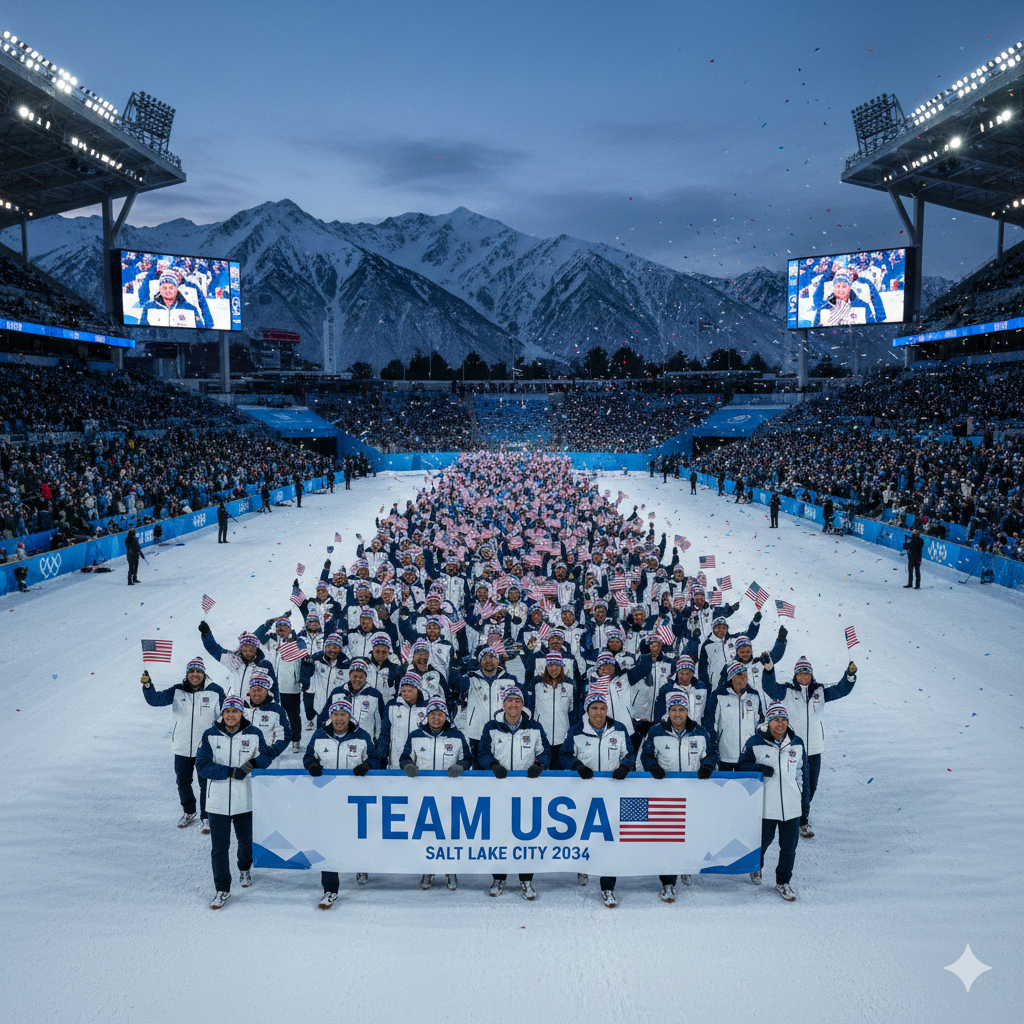
France marched immediately before Italy because the French Alps will host the 2030 Winter Olympics. The 2030 Games will be spread across several French cities and Alpine resort areas, continuing the trend of geographically distributed Winter Olympics that Milan Cortina 2026 has taken to unprecedented levels.
Italy’s Grand Finale
As tradition dictates, Italy closed the Parade of Nations with a jubilant celebration at San Siro Stadium. Italian athletes entered to thunderous applause and a rendition of “Figaro,” capping off a ceremony that showcased Italian art, culture, music, and innovation.
This Happened at Paris 2024 Too
Olympic fans may experience déjà vu, as this is the second consecutive Games where Team USA appeared near the end of the parade for similar reasons. At the 2024 Summer Olympics in Paris, the United States marched second-to-last because Los Angeles will host the 2028 Summer Olympics.
During that historic ceremony, athletes from around the world paraded down the Seine River on boats in the first-ever opening ceremony held entirely outside a stadium. Team USA floated past Parisian landmarks in the penultimate position, with only host nation France following behind.
The Pattern Continues
For American Olympic fans, this creates a pattern of long waits during opening ceremonies:
- Paris 2024 (Summer): USA second-to-last (Los Angeles hosting 2028 Summer Olympics)
- Milan Cortina 2026 (Winter): USA third-to-last (Salt Lake City hosting 2034 Winter Olympics)
- Los Angeles 2028 (Summer): USA will go last as host nation
- Salt Lake City 2034 (Winter): USA will go last as host nation
This means that from 2024 through 2034, American athletes will never march in the traditional alphabetical position during an Olympic opening ceremony — appearing instead at or near the very end of every parade for the next decade.
The Most Spread-Out Olympics in History
The 2026 Milan Cortina Winter Games have earned the distinction of being the most geographically dispersed Olympics — Summer or Winter — in history. Competition venues span an area of approximately 8,500 square miles, roughly equivalent to the entire state of New Jersey.
Four Simultaneous Opening Ceremonies
In keeping with this distributed model, the opening ceremony itself took place across four different locations:
Milan (San Siro Stadium): The main hub of Friday’s ceremony was at the iconic Giuseppe Meazza Stadium in Milan, where approximately 60,000 spectators gathered for the spectacular “Armonia” (Harmony) show. The stadium hosted performances by Mariah Carey, Andrea Bocelli, Laura Pausini, and Italian actors Pierfrancesco Favino and Sabrina Impacciatore.
Cortina d’Ampezzo: Athletes from select nations paraded through Piazza Dibona in Cortina d’Ampezzo, nestled in the heart of the Dolomite mountains. This Alpine resort town previously hosted the 1956 Winter Olympics and serves as a co-host city for 2026.
Livigno: Located in the Alps near the Swiss border, Livigno hosted another simultaneous athlete parade during the opening ceremony.
Predazzo: This town in the autonomous province of Trento featured a parade at the ski jumping stadium in Val di Fiemme.
Dual Olympic Cauldrons — A First in History
Perhaps the most symbolic element of this distributed Games was the lighting of not one, but two Olympic cauldrons in perfect synchrony — marking the first time in Olympic history that multiple cauldrons have been lit simultaneously. One cauldron stands in Milan, while its twin burns in Cortina d’Ampezzo, representing the “harmony between the two host cities and the territories of the distributed Games,” according to organizers.
The cauldrons were designed by ceremony creative director Marco Balich in collaboration with Lida Castelli and Paolo Fantin, with support from sponsor Fincantieri. They draw inspiration from Leonardo da Vinci’s famous geometric knots and pay homage to the sun as a source of life, energy, and renewal.
Opening Ceremony By the Numbers:
- 1,200 volunteer performers
- Youngest performer: 10 years old
- Oldest performer: 70 years old
- 700+ hours of rehearsals across five locations
- 110 makeup artists and 70 hairdressers
- 1,400 costumes using 7,500 meters (8,202 yards) of fabric
- 92 National Olympic Committees participating
- 2 Olympic cauldrons lit simultaneously (first time ever)
Team USA at Milan Cortina 2026
The United States sent a robust delegation to the 2026 Winter Olympics, with athletes representing 32 different states. Colorado led all states with 30 Olympic athletes — an unsurprising result given that Colorado Springs is home to the headquarters of the United States Olympic and Paralympic Committee (USOPC) and boasts some of the world’s premier skiing and snowboarding mountains.
Notable Team USA Storylines
Several compelling narratives surround American athletes at these Games:
Shaun White Returns: Three-time Olympic gold medalist and five-time Olympian Shaun White has retired from competitive snowboarding but returned to the Winter Olympics as a commentator for NBC Sports, offering expert analysis throughout the Games.
Women’s Hockey Dominance: Team USA’s women’s hockey team opened play with a commanding 5-1 victory, continuing the program’s tradition of excellence. The U.S. women’s team has medaled at every Winter Olympics since women’s hockey debuted at the 1998 Nagano Games.
Curling Success: American curling teams have found early success, with Team USA defeating both Norway and Switzerland in preliminary matches.
Opening Ceremony Controversies and Drama
While the ceremony showcased artistic brilliance and international unity, several contentious moments marked the evening:
Israeli Athletes Booed
As Israel’s 10-athlete delegation entered San Siro Stadium, sections of the crowd responded with audible boos and jeers. Israeli alpine skier Barnabas Szollos had anticipated the hostile reception, stating before the ceremony: “I’m prepared, they can do whatever they want.” The incident reflects ongoing tensions related to Israel’s military actions in Gaza, which have prompted protests at various international sporting events.
Russian Cyberattacks Foiled
Italian security officials revealed days before the opening ceremony that they had successfully thwarted Russian cyberattacks aimed at disrupting the Games. The digital assault represents the latest chapter in Russia’s troubled relationship with the Olympic movement following the country’s suspension due to its invasion of Ukraine.
Individual Neutral Athletes
The Olympic Committees of Russia and Belarus remain suspended for violating the Olympic Truce due to Russia’s 2022 invasion of Ukraine. As with the 2024 Summer Olympics in Paris, individual Russian and Belarusian athletes at the 2026 Games may compete as “Individual Neutral Athletes” (AIN) without displaying national identification, flags, or anthems.
Saudi Arabia’s Historic Debut
In a groundbreaking moment, Saudi Arabia competed at a Winter Olympics for the first time in the nation’s history. The kingdom sent two athletes: Fayik Abdi (alpine skiing) and Rakan Alireza (cross-country skiing). Both athletes were born in the United States, according to their official Olympic bios. Abdi is 28 years old and Alireza is 29.
Qatari Security Forces Presence
Although Qatar has never sent athletes to any Winter Olympics and had no official delegation at the opening ceremony, numerous Qatari police vehicles were spotted throughout Milan. Qatari Lekhwiya (elite security forces) and Qatari police sent more than 100 officers — including approximately 20 women — to Italy to assist with security for the Games, along with over 20 special vehicles and 3 snowmobiles. Some Qatari personnel completed winter training courses in collaboration with Italian Carabinieri in Selva di Val Gardena.
The Ceremony’s Artistic Vision: “Armonia” (Harmony)
Creative director Marco Balich explained that the ceremony’s title, “Armonia,” derives from ancient Greek and means “bringing together” in musical terms. The production aimed to showcase Italian contributions to global culture while celebrating the Olympic values of unity and peace.
Cultural Highlights
The ceremony featured numerous nods to Italian culture and history:
- Opera Legends: Performers dressed as great Italian opera composers Giuseppe Verdi, Giacomo Puccini, and Gioachino Rossini appeared alongside actress Matilda De Angelis.
- Paparazzi and Celebrity Culture: The show included performers dressed as photographers, acknowledging Italy’s complex relationship with fame and media attention.
- Artistic Innovation: Three suspended tubes containing blue, yellow, and red paint — the primary colors from which all others derive — “spilled” onto the stage, unleashing dancers in vibrant costumes.
- Architectural Marvels: Performers dressed as the Colosseum and other iconic Italian structures paraded through the stadium.
- Daily Life: Even the humble moka pot (Italian stovetop espresso maker) made a cameo appearance.
- The Tram Journey: A yellow Milan streetcar wound through illuminated Italian streets, with passengers boarding including children with stuffed animals — symbolizing the journey that brings people together at the Olympics.
Fashion Moment
Italian model Vittoria Ceretti, face of the Giorgio Armani Spring/Summer 2026 campaign, wore a custom white Giorgio Armani Privé gown as she carried the Italian flag to the honor guard — a fitting tribute to Italy’s status as a global fashion capital.
What’s Next: Los Angeles 2028 and Salt Lake City 2034
With Team USA holding special parade positions for both the upcoming Los Angeles 2028 Summer Games and Salt Lake City 2034 Winter Games, American Olympic fans can look forward to a decade of prominence in opening ceremony processions.
Los Angeles 2028
The City of Angels will host its third Summer Olympics in 2028, following previous Games in 1932 and 1984. Los Angeles beat out Paris for the 2028 hosting rights in a deal that saw Paris awarded the 2024 Games and LA awarded 2028. As the host nation, Team USA will march last in the Parade of Nations, entering the stadium (likely the renovated Los Angeles Memorial Coliseum or SoFi Stadium) to massive home-crowd applause.
Salt Lake City 2034
Utah’s capital city will welcome back the Winter Olympics for the first time since the memorable 2002 Games. Salt Lake City’s successful bid beat out Sapporo, Japan and several European candidates. The 2034 Games will utilize many of the same venues built for 2002, now with 32 years of upgrades and improvements. As host nation, the United States will again parade last, closing the opening ceremony before home crowds.
The Bottom Line: Olympic Protocol Honors Future Hosts
While it may frustrate American fans eager to see Team USA early in the broadcast, the third-to-last parade position represents an honor, not a snub. The International Olympic Committee grants special placement to upcoming host nations as recognition of their commitment to staging future Games and continuing the Olympic movement.
For the next decade, American athletes will consistently appear at or near the end of Olympic opening ceremonies — a visible reminder of the United States’ ongoing role as a leading Olympic host nation and a testament to the country’s enduring support for international athletic competition.
As Milan Cortina 2026 unfolds over the coming weeks, Team USA will compete for medals across 16 disciplines and 116 events. But on opening night, the parade order told a different story — one not of alphabetical chance, but of Olympic tradition honoring the past, celebrating the present, and looking forward to the future of the Games.
Note: The 2026 Winter Olympics run from February 6-22, 2026. The closing ceremony will be held at Verona Arena in Verona, Italy on February 22, featuring ballet dancer Roberto Bolle and a formal handover to the French Alps for the 2030 Winter Olympics. Competition streams are available on Peacock, with primetime coverage on NBC.
Complete Competition Schedule and Key Events to Watch
The 2026 Winter Olympics feature 116 medal events across 16 disciplines, representing an increase of seven events and one new discipline compared to the 2022 Beijing Winter Games. Competition actually began two days before the opening ceremony, with curling mixed doubles matches starting on February 4, 2026.
Ski Mountaineering Makes Olympic Debut
The biggest addition to the 2026 program is ski mountaineering, which makes its Olympic debut as an official sport. At the 138th IOC Session in July 2021, the IOC approved the organizing committee’s proposal to add this grueling alpine discipline. Ski mountaineering consists of three medal events: men’s sprint, women’s sprint, and mixed relay.
The sport combines uphill skiing with lightweight equipment, transitions between climbing and descending, and requires extraordinary cardiovascular endurance. Athletes must navigate challenging mountain terrain while managing their pace and energy across dramatically varying conditions.
The 16 Olympic Disciplines at Milan Cortina 2026:
- Alpine Skiing (11 events) – Downhill, Super-G, Giant Slalom, Slalom, Combined, Team Parallel
- Biathlon (11 events) – Individual, Sprint, Pursuit, Mass Start, Relay, Mixed Relay
- Bobsled (4 events) – Two-man, Two-woman, Four-man, Monobob
- Cross-Country Skiing (12 events) – Sprint, Distance, Relay, Team Sprint
- Curling (3 events) – Men’s, Women’s, Mixed Doubles
- Figure Skating (5 events) – Men’s, Women’s, Pairs, Ice Dance, Team Event
- Freestyle Skiing (13 events) – Moguls, Aerials, Ski Cross, Halfpipe, Slopestyle, Big Air
- Ice Hockey (2 events) – Men’s Tournament, Women’s Tournament
- Luge (4 events) – Men’s Singles, Women’s Singles, Doubles, Team Relay
- Nordic Combined (3 events) – Individual, Team
- Short Track Speed Skating (9 events) – Individual distances, Relay
- Skeleton (2 events) – Men’s, Women’s
- Ski Jumping (4 events) – Individual, Team, Mixed Team
- Ski Mountaineering (3 events) – NEW! Men’s Sprint, Women’s Sprint, Mixed Relay
- Snowboard (11 events) – Halfpipe, Slopestyle, Big Air, Cross, Parallel Giant Slalom
- Speed Skating (14 events) – Individual distances from 500m to 10,000m, Team Pursuit, Mass Start
Competition Venues Across Northern Italy
Events are distributed across multiple clusters in Lombardy and Northeast Italy:
Milan Cluster: Ice hockey, figure skating, and short track speed skating at the newly constructed Milano Ice Skating Arena and PalaItalia
Cortina Cluster: Alpine skiing, bobsled, luge, and skeleton at venues in and around Cortina d’Ampezzo in the Dolomites
Valtellina Cluster: Freestyle skiing, snowboarding, and the Alpine skiing speed events (downhill, Super-G) in Bormio and Livigno
Fiemme Cluster: Cross-country skiing, ski jumping, and Nordic combined in Val di Fiemme, including the ski jumping stadium in Predazzo
Antholz Cluster: Biathlon events at the Südtirol Arena in Antholz-Anterselva (South Tyrol)
Val di Sole Cluster: Ski mountaineering events debut at Passo del Tonale
This geographic distribution means athletes, coaches, and spectators face significant travel between events — some venues are more than three hours apart by car. The organizing committee has arranged extensive shuttle services and coordination systems to manage logistics.
Daily Medal Events Schedule
The competition schedule builds gradually:
February 4-5 (Pre-Opening Ceremony): Curling mixed doubles preliminary rounds and women’s ice hockey preliminary games begin
February 6 (Opening Ceremony Day): No medal events; opening ceremony in evening
February 7-8 (Weekend 1): Figure skating team event begins, first alpine skiing medals awarded (women’s and men’s downhill)
February 9-15 (Week 1): Peak competition period with multiple daily medal events across all sports
February 16-22 (Week 2): Continued competition culminating in ice hockey finals and closing ceremony
The busiest medal day is expected to be February 15, when up to 12 gold medals will be awarded across multiple disciplines.
NHL Players Return After 12-Year Olympic Absence
One of the biggest storylines at Milan Cortina 2026 is the return of NHL players to Olympic ice hockey for the first time since the 2014 Sochi Winter Games. In February 2024, the International Ice Hockey Federation (IIHF) reached a landmark agreement with the National Hockey League for a break in the regular season to allow participation.
The NHL was originally scheduled to send players to the 2022 Beijing Olympics as well, but opted out due to COVID-19 pandemic complications and schedule disruptions. The 12-year absence created a significant talent gap in Olympic hockey, with NHL stars sitting out while their international teams fielded rosters of European league players and minor leaguers.
Star Power Returns to Olympic Hockey
The 2026 men’s hockey tournament features the world’s best players representing their countries:
Team USA features NHL superstars including Connor McDavid (potentially), Auston Matthews, Patrick Kane, and a deep roster of elite talent from across the league.
Canada brings a powerhouse lineup that could include Sidney Crosby (in what may be his final Olympics), Connor McDavid, Nathan MacKinnon, and a roster often called the deepest in international hockey.
Russia’s Absence Continues
However, Russian and Belarusian athletes remain banned from competing in team events like ice hockey and curling. The IOC has ruled that “a group of Individual Neutral Athletes cannot be considered a team,” meaning no Russian or Belarusian hockey teams will participate despite the country’s traditional hockey dominance.
Women’s Hockey Powerhouses
The women’s hockey tournament continues the long-standing rivalry between the United States and Canada, who have won every Olympic gold and silver medal since women’s hockey debuted at the 1998 Nagano Games. Team USA enters as defending champion after defeating Canada in a thriller at the 2022 Beijing Games, breaking Canada’s streak of four consecutive gold medals.
Finland, Switzerland, Japan, and several European nations round out the women’s field, with competitive balance improving each Olympic cycle as women’s hockey programs develop globally.
Figure Skating’s Return to Traditional Schedule
After the controversial judging scandals and Kamila Valieva doping controversy that marred the 2022 Beijing Games, figure skating returns to Milan Cortina 2026 seeking to restore its reputation as one of the Winter Olympics’ marquee events.
Team Event Opens Competition
The figure skating team event kicked off on Friday, February 6, with 10 nations competing across men’s singles, women’s singles, pairs, and ice dance. The three-day team competition at Milano Ice Skating Arena serves as an exciting opening to the Games’ figure skating program.
The United States team features world champion Ilia Malinin, one of the sport’s most exciting performers known for landing the quadruple Axel — figure skating’s most difficult jump. Team USA also includes Alysa Liu, a two-time U.S. champion who brings technical prowess and artistic maturity.
Japan’s team is led by Kaori Sakamoto, the reigning world champion in women’s singles, alongside a strong supporting cast across all four disciplines. Other medal contenders include Canada, France, Italy (competing on home ice), and several Individual Neutral Athletes representing the former Russian skating powerhouse.
Individual Events Coming
Following the team event, the individual competitions unfold:
- Pairs (February 10-11)
- Men’s Singles (February 12-14)
- Ice Dance (February 16-18)
- Women’s Singles (February 19-21)
The women’s event promises particular drama, with Sakamoto, Liu, and several European and Asian competitors vying for gold in what appears to be the most wide-open women’s competition in years.
New Judging Transparency Measures
In response to judging controversies, the International Skating Union has implemented enhanced transparency measures, including real-time score breakdowns and additional technical panel members to reduce potential bias.
The Olympic Torch Relay: 63 Days Across Italy
The journey to the Milan Cortina 2026 opening ceremony began months before the Games when the Olympic flame was lit in Olympia, Greece on November 26, 2025. The torch relay represents one of the most enduring Olympic traditions, symbolically connecting the ancient Games to the modern era.
12,000 Kilometers Through Italy
The Olympic torch traveled an extraordinary 12,000 kilometers (7,500 miles) across Italy over 63 days, making 60 stops and visiting all 110 Italian provinces. The relay route was designed to bring the Olympic spirit to every corner of the country, from the Alpine north to the Mediterranean islands of Sicily and Sardinia.
The route included major Italian cities — Rome, Florence, Venice, Naples — as well as smaller towns that rarely see international attention, fulfilling the Olympic ideal of inspiring people everywhere.
Twin Torches Connect Olympic Cities
The Olympic torch was unveiled in a unique simultaneous presentation held in both Milan, Italy and Osaka, Japan — the latter being the host of World Expo 2025. The torch was revealed at the Triennale di Milano and at the Italian pavilion at Expo 2025, connecting the two cities just as Milan previously hosted Expo 2015.
Named “Essential,” the torch was developed by energy company Eni and its subsidiary Versalis, designed by Studio Carlo Ratti Associati, and produced entirely in Italy by Cavagna Group. The Olympic torch features a distinctive light blue color, while the corresponding Paralympic torch (for the March 2026 Paralympic Games) is bronze.
The torches are made primarily from an alloy of recycled aluminum and bronze, emphasizing sustainability — a key theme of the Milan Cortina Games.
Final Relay Into San Siro
The torch relay concluded on February 6, 2026, with the final torchbearers carrying the flame into San Siro Stadium during the opening ceremony. The lighting of the dual cauldrons in Milan and Cortina d’Ampezzo simultaneously marked the culmination of the 63-day journey and the official start of the Games.
Also Read this:
2026 T20 World Cup: ICC Warning Issued To PCB Over India Boycott
Social Connect:

