

2026 Midterm Elections USA: Senate Races & House Control Explained
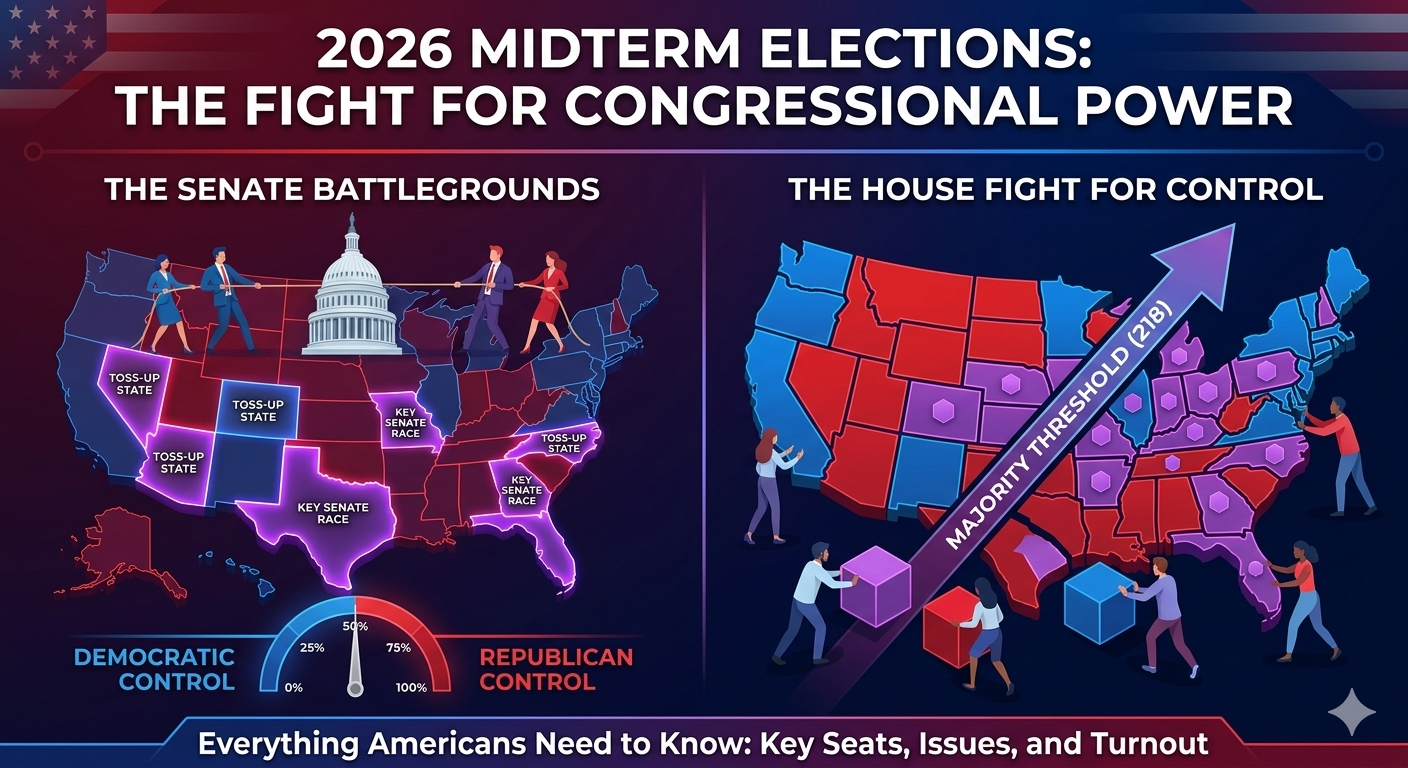
The 2026 midterm elections are fast approaching, and the political stakes could not be higher. On November 3, 2026, tens of millions of Americans will head to the polls to decide the balance of power in Congress — and in doing so, they will effectively render a verdict on President Donald Trump’s second term. With all 435 House seats and 35 Senate seats on the line, this election cycle is shaping up to be one of the most consequential in recent American history.
What Is at Stake in the 2026 Midterm Elections?
The House of Representatives
Every single one of the 435 seats in the U.S. House of Representatives will be contested this November. Republicans currently hold a razor-thin 220-215 majority, and Democrats need a net gain of just three seats to flip control of the chamber. For Republicans, the math is equally sobering — they can afford to lose no more than two seats without surrendering the majority.
As of April 2026, a staggering 57 representatives — including 22 Democrats and 36 Republicans — have announced they will not seek re-election. Political analysts have identified at least 42 battleground House districts, with Democrats holding 22 of them and Republicans holding 20. The redistricting battles sweeping the country have added another layer of unpredictability to an already volatile map.
The Senate
In the Senate, Republicans enter the cycle with a commanding 53-47 advantage, counting two independents who caucus with Democrats. For Democrats to reclaim the Senate majority, they would need to flip a net of four seats — a tall order given the current map.
Democrats are defending 13 Senate seats, while Republicans are defending 22 — a numerical distribution that, on the surface, appears to favor the GOP. However, political headwinds, historically unfavorable trends for the party in power during midterms, and a challenging national environment have kept multiple Republican-held seats firmly in play.
The Key Senate Races to Watch in 2026
North Carolina: An Open-Seat Showdown
Perhaps no Senate race has attracted more early attention than North Carolina, where veteran Republican Sen. Thom Tillis announced his retirement after facing internal party pressure over his vote against the “One Big Beautiful Bill Act.” The open seat immediately became a premier battleground.
Former Democratic Governor Roy Cooper and former Republican National Committee Chairman Michael Whatley — who was personally endorsed by President Trump — locked up their respective nominations in the March 3 primary. Both candidates are considered strong fundraisers with deep establishment ties. Whatley alone reported raising $5 million in the first quarter of 2026, signaling a ferociously expensive general election contest ahead.
Maine: Susan Collins Under the Microscope
Republican Sen. Susan Collins of Maine represents the only Republican-held Senate seat in a state that Kamala Harris won in 2024, making her race one of the most closely monitored in the country. Collins has survived multiple blue-wave election cycles before — including 2008 and 2020 — but Democrats are determined to make this race different.
The Democratic primary field in Maine includes incumbent Governor Janet Mills, former deputy secretary David Costello, and military veteran Graham Platner. Regardless of who emerges from the primary, the Collins race is expected to be a marquee contest all the way through November.
Georgia: Jon Ossoff Fights to Hold On
Democratic Sen. Jon Ossoff is widely regarded by Republican strategists as the most vulnerable Democratic incumbent on the map. He is the only Democratic senator seeking re-election in a state that Donald Trump carried in 2024. Despite his strong fundraising operation and a well-built war chest, Republicans have aggressively targeted him, painting him as a progressive out of step with Georgia’s shifting electorate.
Michigan: A Wide-Open Democratic Primary
With retiring Sen. Gary Peters stepping aside, Michigan has become a critical pickup opportunity — for both parties. The Democratic primary alone features a three-way contest between Rep. Haley Stevens, state Sen. Mallory McMorrow, and progressive physician Abdul El-Sayed, who has earned the backing of Sen. Bernie Sanders. Deep divisions over Israel policy and the future of Michigan’s manufacturing sector have already surfaced in the campaign. Republicans, for their part, have fielded Mike Rogers — who narrowly lost the 2024 Michigan Senate race — for a rematch.
Ohio: The Sherrod Brown Factor
Ohio’s special election to fill the seat vacated by Vice President JD Vance adds a unique wrinkle to the 2026 cycle. Appointed Sen. Jon Husted is running as the Republican, while Democrats received a major boost when former Sen. Sherrod Brown — a beloved figure among Ohio Democrats — announced his candidacy. Trump carried Ohio by 11 points in 2024, making any Democratic win an uphill climb, though Brown’s personal brand has historically outperformed the party in the state.
Alaska: A Surprise Democratic Challenge
Democrats received an unexpected boost in deep-red Alaska when former Rep. Mary Peltola announced she would challenge Republican Sen. Dan Sullivan. Peltola, who previously won Alaska’s at-large House seat only to lose it 15 months ago by three points, has proven she can compete in a state Trump carried by 11 points. Her entry makes Alaska a race to watch in what could be a wave environment.
The Money War: Super PACs and Fundraising
The financial arms race ahead of November is already staggering in its scale.
Senate Leadership Fund (SLF), the super PAC aligned with Senate Majority Leader John Thune, entered 2026 with roughly $100 million in cash on hand and has since unveiled a $342 million investment across eight key states. The group has earmarked $236 million specifically to defend five Republican-held Senate seats: Ohio, North Carolina, Maine, Iowa, and Alaska.
On the Democratic side, Senate Majority PAC, which supports Senate Democrats, closed 2025 with $36 million on hand — a significant gap relative to the GOP’s outside spending apparatus, though Democratic operatives note the group has yet to reveal its full spending blueprint.
Looming over both parties is MAGA Inc., the leading pro-Trump super PAC, which is sitting on more than $300 millionheading into the general election stretch.
Redistricting: The Invisible Battle Reshaping the Map
Behind the headlines and the Senate horse races, a sweeping redistricting battle is quietly reshaping the House battlefield. As of early 2026, at least four states — California, Missouri, North Carolina, and Texas — will use newly redrawn congressional maps, a direct result of aggressive mid-decade redistricting efforts undertaken by both parties.

The Trump administration reportedly pressured GOP-led states to redraw congressional maps mid-cycle in an effort to protect Republican incumbents and potentially pad the party’s narrow House majority. Democratic-run states retaliated in kind. California’s legislature, for instance, drafted and enacted a new map that eliminates five Republican-held districts — a direct countermove to redistricting actions taken in Texas.
In Virginia, state legislators announced plans in late 2025 to redraw the state’s congressional districts ahead of the 2026 elections. Legal challenges to district maps in Arkansas and Florida have already been decided by the courts, while Colorado, New Jersey, and New York are among the states where redistricting remains a live political debate.
The National Mood: Economy, Iran, and Trump’s Approval
The backdrop against which all of these races are unfolding is a national political environment that, at present, appears to favor Democrats.
President Trump’s approval rating on the economy — the signature issue that powered his 2024 victory — has fallen to a career low of 31%, according to recent polling conducted by CNN and SSRS. Inflation concerns, tariff-related economic uncertainty, and rising energy costs have contributed to voter anxiety. Average gasoline prices across the United States have climbed to $4.16 per gallon — nearly a 40% increase since early in the year — driven in large part by economic disruptions tied to the U.S.-Iran conflict.
On the Iran front, public disapproval of the ongoing conflict has reached 66%, with only one-third of Americans saying they believe Trump has a clear plan for handling the situation. Democrats have moved swiftly to capitalize on voter discontent, with House and Senate Democrats jointly planning to force votes on war powers resolutions.
Historically, the party that holds the White House nearly always loses seats in the midterms. During Trump’s first term in 2018, Democrats gained 41 House seats. Whether 2026 produces a similar wave — or whether Republicans can defy the trend — remains the defining question of the election cycle.
Governor’s Races: The 2028 Presidential Preview
Beyond Congress, 36 governorships are on the ballot in November, making the 2026 gubernatorial map a crucial testing ground for the political talent that could dominate the 2028 presidential race — the first national election in 16 years that will not feature Donald Trump on the ballot.
Currently, Republicans hold 27 governorships and Democrats hold 23. Democrats already showed strength in off-year 2025 elections, when Abigail Spanberger won Virginia’s governorship by a larger-than-expected margin and Mikie Sherrill won in New Jersey. Both victories were widely interpreted as early warning signs for Republicans heading into the midterm cycle.
Special Elections Already Underway in 2026
The 2026 election cycle did not wait for November to produce results. Several special elections have already taken place to fill vacant congressional seats.
In Georgia’s 14th congressional district, Republican Clay Fuller defeated Democrat Shawn Harris in a March runoff to succeed Rep. Marjorie Taylor Greene, who resigned in January 2026. The district carried a strong Republican lean.
In Texas’s 18th congressional district, Democrat Christian Menefee won a runoff race in a solidly Democratic Houston-area district following the death of Rep. Sylvester Turner.
An upcoming special election in New Jersey’s 11th congressional district — vacated when Rep. Mikie Sherrill resigned to become governor — is scheduled for April 16, 2026, and will be closely watched as a political bellwether.
How to Follow the 2026 Midterm Primaries
The primary calendar stretches from early spring through late summer, with key contests continuing through September. Several major primary dates remaining in 2026 include:
- May 5 — Indiana and Ohio
- May 12 — Nebraska and West Virginia
- June 2 — California, Iowa, Mississippi, Montana, New Jersey, New Mexico, and South Dakota
- August — Michigan (key Democratic Senate primary)
Election Day for the general election is set for Tuesday, November 3, 2026. Following the vote, states will certify results and the 120th United States Congress is set to be sworn in during January 2027.
Bottom Line: What November Could Mean for America
The 2026 midterm elections are not merely a referendum on any one policy or personality. They represent a pivotal inflection point for American democracy itself — a moment when voters will weigh in on tariffs and trade, war and diplomacy, economic pain and political accountability.

If Democrats succeed in flipping either the House or the Senate, the final two years of President Trump’s term will look dramatically different — defined by divided government, aggressive congressional oversight, and the opening shots of the 2028 presidential campaign. If Republicans hold both chambers, Trump will retain the legislative firepower to continue reshaping the federal government and American policy at home and abroad.
Either way, November 3, 2026 promises to be one of the most closely watched election nights in a generation.
Stay tuned for continued coverage of the 2026 midterm elections, including primary results, polling updates, and in-depth analysis of every major battleground race.
Related News :
America’s AI Crisis: 16000 Jobs Lost Every Month And It’s Just Getting Started
Social Connect :

