

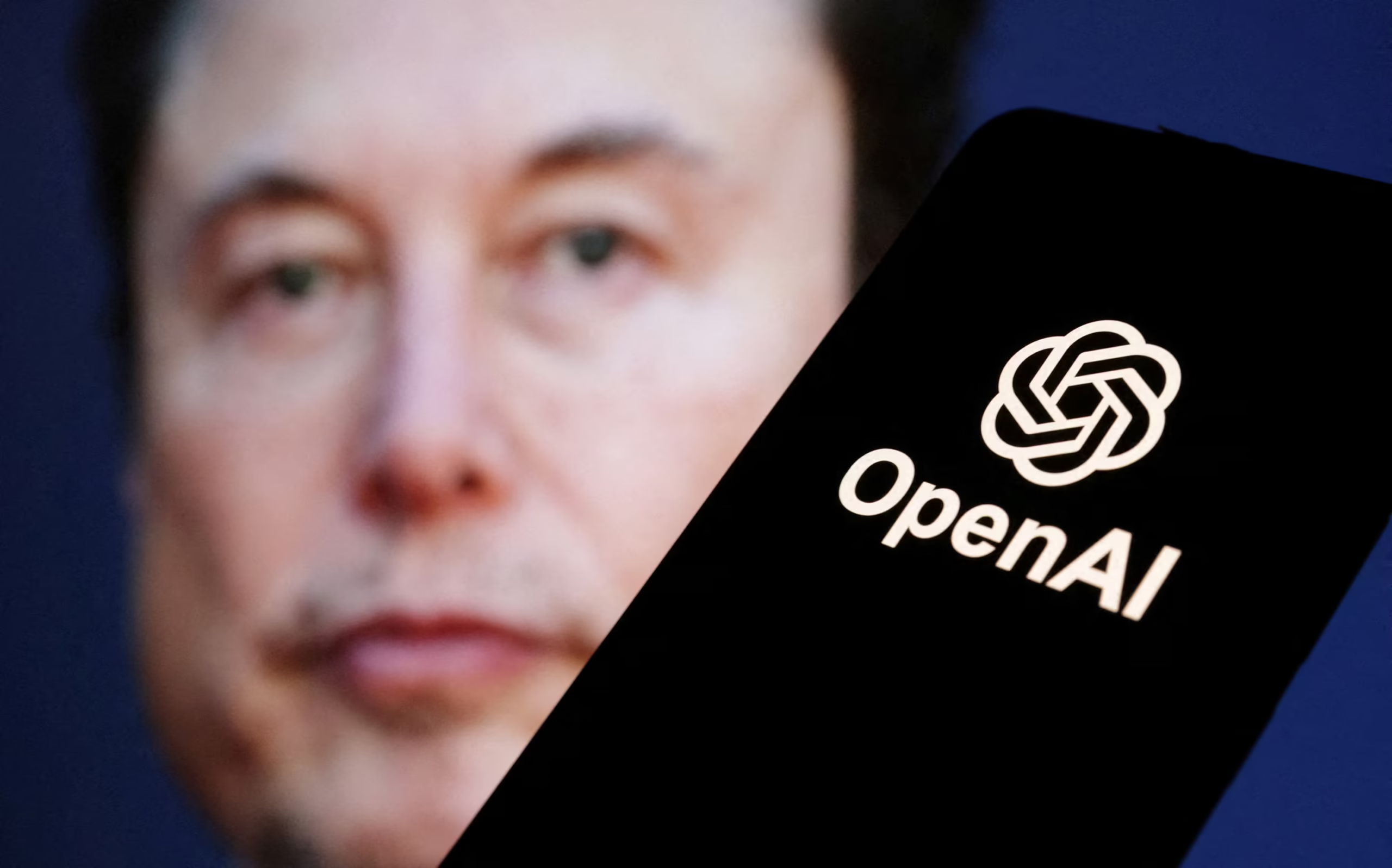
The Accountability Gap: How the Dismissal of the Elon Musk Lawsuit Against OpenAI Exposes Tech’s Fragile Governance and Rising Macroeconomic Strains
OAKLAND, CA — The global technology ecosystem has entered an era of deep regulatory and structural scrutiny following a historic courtroom decision in Northern California. A nine-person federal jury in Oakland delivered a unanimous verdict in favor of Sam Altman and his artificial intelligence enterprise, effectively dismantling the high-profile Elon Musk lawsuit against OpenAI. For three weeks, legal analysts debated whether the creators of ChatGPT had compromised their foundational altruistic mission to build safe artificial general intelligence (AGI) for the benefit of humanity.
Yet, the final ruling did not touch on the philosophical ethics of open-source software or corporate fidelity. Instead, the multi-billion-dollar confrontational dispute collapsed under a strict procedural technicality. The jury concluded that the plaintiff waited far too long to act, giving OpenAI a sweeping victory.
This dramatic conclusion to the Elon Musk lawsuit against OpenAI occurs at a moment of broader economic transition. As tech executives review the trial transcripts, global financial markets are reacting to a completely separate set of structural pressures. Accelerating geopolitical friction in the Middle East has pushed crude oil prices higher, driving global inflation anxieties to a prominent one-year peak. On Wall Street, major equity indices closed sharply lower yesterday as the benchmark 10-year U.S. Treasury yield climbed to an unexpected high.
The cascading impact of these macroeconomic surges is hitting emerging consumer economies with remarkable speed. In India, state-run oil marketing enterprises just implemented their second fuel price hike in less than a week, raising petrol and diesel costs by 90 paise per litre.
Whether analyzing the fallout of the Elon Musk lawsuit against OpenAI or tracing the trajectory of international energy inflation, a clear theme emerges: delayed structural responses—whether in filing a critical lawsuit or adapting to macro shifts—ultimately dictate who wins and who loses in the modern global economy.
Part I: The Inside Story of the $150 Billion Courtroom Collapse
The legal showdown that culminated in the dismissal of the Elon Musk lawsuit against OpenAI was watched closely by Silicon Valley. Musk initially filed his civil complaint in February 2024, accusing Altman and OpenAI President Greg Brockman of “stealing a charity.” His legal team argued that the pair violated an unwritten founding agreement by steering a non-profit AI research lab into a heavily capitalized commercial powerhouse.
The financial stakes behind the Elon Musk lawsuit against OpenAI were staggering. Court filings from earlier this year revealed that Musk was seeking up to $150 billion in financial damages to be paid back into OpenAI’s charitable arm, along with the immediate removal of Altman from the corporate board.
+------------------------------------------------------------------------+
|                     OAKLAND FEDERAL COURT VERDICT MATRIX               |
+========================================================================+
|  Case Focus                --> Elon Musk lawsuit against OpenAI        |
|  Jury Deliberation Time    --> Under Two Hours (Unanimous Verdict)      |
|  Defense Core Evidence     --> September 2020 Public Tweets by Musk    |
|  Primary Legal Finding     --> Time Limits Exceeded Under CA Law       |
+------------------------------------------------------------------------+
|  CURRENT TRIAL STATUS      --> DISMISSED ON THE SPOT (APPEAL PENDING)  |
+------------------------------------------------------------------------+
To counter these claims, OpenAI’s defense team centered their argument on a single social media post written by Musk on September 24, 2020. In that post, Musk publicly declared that OpenAI seemed “like the opposite of open” and appeared “essentially captured by Microsoft.“
Defense attorneys argued that this post proved the plaintiff was fully aware of the organization’s commercial shift years before he decided to file a claim.
Under California law, plaintiffs have a strict three-year window to file a claim for breach of a charitable trust and a two-year limit for unjust enrichment. Because the timeline showed he sat on this information, the jury dismissed the Elon Musk lawsuit against OpenAI as untimely. This outcome demonstrates that even the world’s wealthiest individual cannot bypass statutory deadlines, rendering the highly publicized Elon Musk lawsuit against OpenAI legally invalid due to the passage of time.
Part II: Inside the Month-Long Trial of Altruism vs. Greed
The three-week trial in Oakland exposed deep rifts and internal tensions at the top of the tech industry. Throughout the proceedings, the Elon Musk lawsuit against OpenAI was framed by the plaintiff’s attorneys as a direct battle between altruism and greed. Musk’s legal team characterized Sam Altman as a calculated corporate operator who used a charitable shield to build an entity now valued at an estimated $852 billion.
Witnesses, including former board members, were questioned extensively about Altman’s transparency during the corporate restructuring, spotlighting the internal friction that briefly led to his firing in late 2023.
However, OpenAI’s legal team consistently countered that the Elon Musk lawsuit against OpenAI was not a principled defense of open-source technology. Instead, they argued the litigation was a strategic effort to slow down a direct competitor. Attorneys pointed out that Musk’s own artificial intelligence venture, xAI, was launched explicitly as a for-profit corporation, despite his claims that advanced AI should only be developed by non-profit organizations.
By presenting emails from 2017 showing that Musk himself had proposed a for-profit structure that he would control, the defense weakened the core narrative of the Elon Musk lawsuit against OpenAI.
The trial ultimately showed that the early days of AI development relied on loose, informal agreements rather than airtight legal contracts. When the jury returned its quick verdict, it underscored a hard reality: courts prioritize documented timelines over shifting personal recollections. The formal dismissal of the Elon Musk lawsuit against OpenAI removes a major legal cloud, allowing the company to move forward with its planned initial public offering (IPO) later this year.
Part III: Bond Market Volatility and Tech Stocks Under Pressure
While the tech sector processes the swift conclusion of the Elon Musk lawsuit against OpenAI, broader macroeconomic pressures are creating new headwinds for the industry. On Wall Street, equity markets pulled back sharply as investors reacted to shifts in the bond market. The benchmark 10-year U.S. Treasury yield surged to a one-year nominal high, signaling that market participants are pricing in long-term inflationary pressures.
This shift in fixed-income markets has a direct impact on corporate valuations across the technology sector.
                 THE CAPITAL COST RIPPLE EFFECT

     [ Global Energy Surge ] --------------------------------+
                         Crude costs rise, driving baseline  |
                         global inflation expectations up.   |
                                                             |
     [ Treasury Yield Spike ] <------------------------------+
                         10-Year yields hit 1-year highs,
                         raising the risk-free rate of return.

     [ Tech Stock Compression ] -----------------------------+
                         Higher cost of capital pressures     |
                         speculative long-term valuations.   |
When government bond yields rise, the cost of capital increases for corporate borrowers. For capital-intensive technology companies, higher borrowing costs make it more expensive to build the massive data centers required to train and run frontier AI models.
This financial dynamic creates a challenging environment for high-growth firms, independent of their legal status.
The market’s reaction highlights a broader reality: the tech sector cannot remain completely insulated from global macroeconomic conditions. Even as companies secure key legal victories, like the dismissal of the Elon Musk lawsuit against OpenAI, they must still navigate an environment defined by higher interest rates and volatile energy prices. Financial analysts are adjusting their growth models to reflect these shifting realities, noting that sustained inflation could pressure profit margins across the digital economy.
Part IV: India’s Domestic Energy Strain and the Inflation Challenge
The real-world impact of global energy volatility is visible in emerging markets, particularly in India. Driven by rising crude oil costs on international markets, state-run oil marketing enterprises—including Indian Oil Corporation and Bharat Petroleum—implemented their second retail fuel price hike in less than a week. The adjustment added 90 paise per litre to the price of both petrol and diesel, showing how quickly geopolitical issues can affect domestic consumer prices.
| Economic Indicator | Market Metric (May 2026) | Domestic Policy Impact |
| Global Crude Oil | Brent over $110/barrel | Expanded trade deficit for importing nations. |
| US 10-Year Treasury | One-Year Nominal High | Pressures international capital allocations. |
| Indian Retail Fuel | +90 Paise/Litre (2nd hike) | Drives up logistics costs for consumer goods. |
| OpenAI Corporate Valuation | Estimated at $852 Billion | Legal path cleared for potential public listing. |
For an economy that imports more than 85% of its crude oil requirements, rising energy prices present a clear challenge for monetary policy. A 90 paise per litre increase might seem small on its own, but when scaled across a national logistics network, it creates upward pressure on wholesale prices.
Diesel is the primary fuel for commercial trucking and agricultural production in India.
Higher fuel costs quickly transfer to the transport of food and manufactured products, complicating efforts to keep retail inflation within target ranges. This connection between international commodity markets and domestic retail prices is a reminder that structural shifts in energy markets can quickly alter corporate operating costs worldwide.
Part V: The Strategic Impact of the Legal Resolution
The conclusion of the Elon Musk lawsuit against OpenAI marks a clear turning point for the artificial intelligence industry. By securing a dismissal based on statutory timelines, OpenAI avoids a complex judicial review of its corporate structure. A different outcome in the Elon Musk lawsuit against OpenAI could have jeopardized its commercial partnerships and complicated its corporate framework.
With the trial level case resolved, the organization can focus on scaling its infrastructure and expanding its enterprise services.
             THE EVOLUTION OF TECH ENTERPRISE GOVERNANCE

     [ Early Stage Ideology ] -------------------------------+
                         Labs rely on shared vision and      |
                         open-source research models.        |
                                                             |
     [ Capital Scaling Realities ] <-------------------------+
                         Massive infrastructure costs require
                         private capital and corporate partners.

     [ Enforcing Legal Boundaries ] -------------------------+
                         Courts rely on strict timelines;    |
                         untimely challenges are dismissed.  |
However, the broader discussion sparked by the Elon Musk lawsuit against OpenAI is likely to continue. The case highlighted the challenges of balancing a public-benefit mission with the massive capital required to develop advanced technologies. While the court dismissed the case on procedural grounds, it underscored the need for clear governance structures in early-stage tech ventures.
As artificial intelligence becomes more integrated into the global economy, the balance between commercial growth and public accountability will remain a central focus for the industry.
Ultimately, the developments of the past week show that the technology sector operates within a complex web of legal, financial, and macroeconomic realities. Winning a major court battle, like the dismissal of the Elon Musk lawsuit against OpenAI, provides stability, but companies must still manage broader economic trends like rising energy costs and shifting capital markets. Success will depend on an organization’s ability to navigate both intricate legal frameworks and volatile macroeconomic environments, ensuring long-term sustainability as the digital economy matures.
Part VI: The Upcoming Appellate Battle and Beyond
While the district court’s ruling ends the trial phase, the issues raised by the Elon Musk lawsuit against OpenAI are moving toward the next legal stage. Shortly after the verdict was announced, Musk posted on social media that he intends to appeal the decision to the U.S. Ninth Circuit Court of Appeals. He argued that dismissing a challenge to a non-profit’s restructuring based on a “calendar technicality” sets a challenging precedent for the oversight of charitable entities.
This ensures that the Elon Musk lawsuit against OpenAI will remain a point of discussion for corporate and non-profit legal experts.
Legal analysts note that overturning a jury’s factual finding regarding a timeline is a significant hurdle on appeal. U.S. District Judge Yvonne Gonzalez Rogers stated on the record that there was substantial evidence supporting the jury’s conclusion, indicating that the initial dismissal rests on solid legal ground.
As the Elon Musk lawsuit against OpenAI transitions to the appellate phase, it serves as a case study in the importance of timely legal action in fast-moving industries.
At the same time, the broader AI market continues to move forward. Competitors are scaling their models, enterprise adoption is growing, and the capital requirements for advanced computing show no signs of slowing down. The lesson of the Elon Musk lawsuit against OpenAI is clear: in both technology and law, speed and precision are critical, and those who delay risk losing their opportunity to shape the outcome.
For more:- Subscribe to read
Social Connect:

