

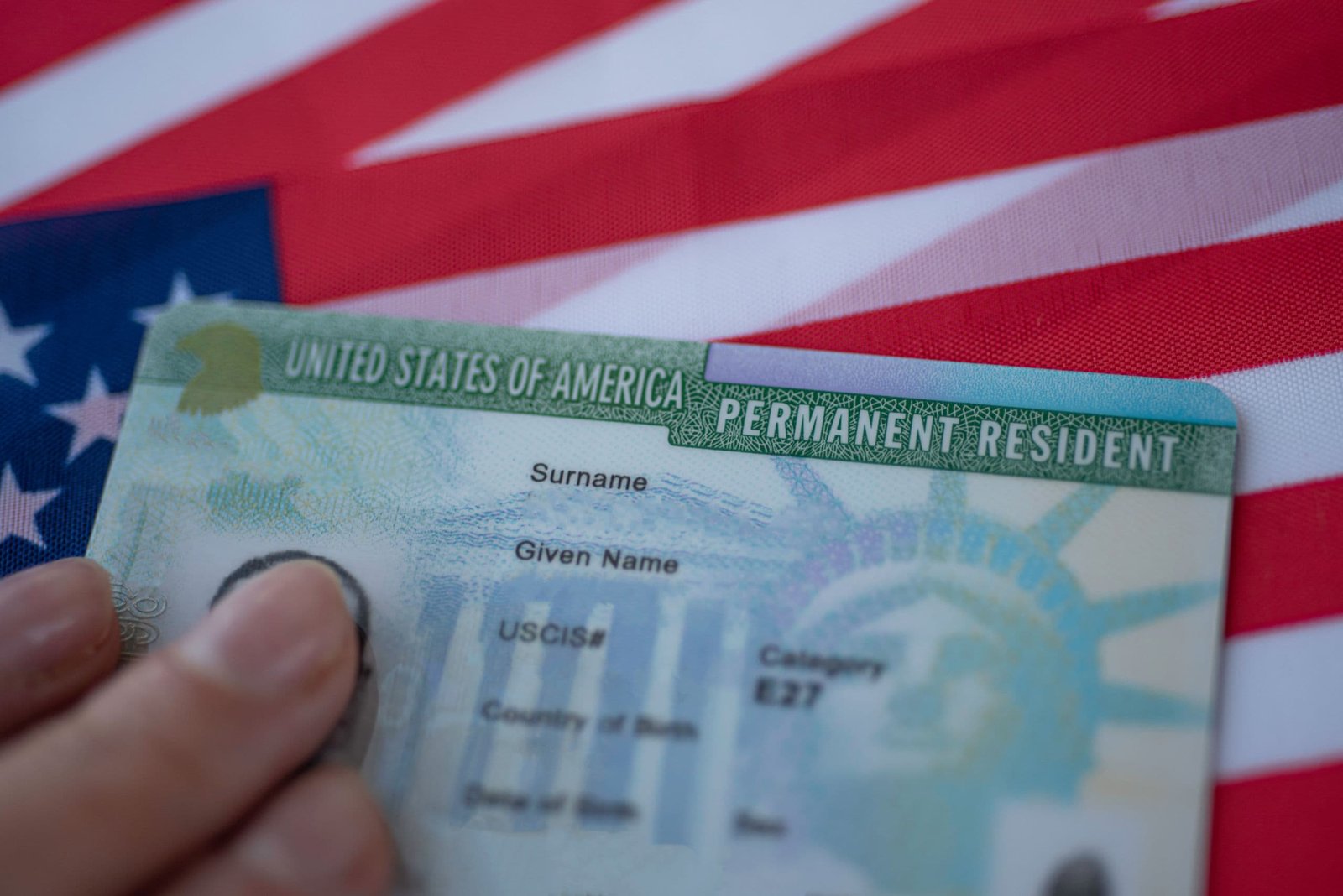
Trump Administration Ends Internal Adjustment Loophole; Demands Return Mandate for High-Skilled Green Card Applicants
WASHINGTON, D.C. — In what is being described as the most radical structural shift to the American immigration system in over three decades, the United States government has officially dismantled the long-standing regulatory mechanism that permitted temporary visa holders to transition directly into permanent residency while residing within the country.
Under the sweeping new administrative directive issued by the Department of Homeland Security (DHS) in coordination with U.S. Citizenship and Immigration Services (USCIS), nonimmigrant professionals holding temporary employment authorizations—such as H-1B, L-1, and O-1 visas—will no longer be allowed to automatically adjust their status from inside the United States when applying for a Green Card. Instead, hundreds of thousands of high-skilled foreign workers are now being instructed to liquidate their domestic arrangements, exit the country, and undergo rigorous consular processing at American embassies and consulates within their respective home countries to secure their permanent legal status.
The policy shift effectively brings an abrupt end to the traditional administrative procedure known as the “Adjustment of Status” ($I-485$ process), which for decades functioned as a secure internal bridge for corporate employees, academic researchers, and specialized experts to transition into permanent residency without disrupting their careers, families, or corporate operations. By forcing applicants to seek a Green Card via international consular offices, the administration has introduced an unprecedented level of operational uncertainty, systemic delay, and personal upheaval into the high-skilled immigrant community.
The End of the Internal Administrative Bridge
For generations, the path to a Green Card for an international professional recruited by an American corporation followed a highly predictable, multi-stage legal trajectory. A worker typically entered the country on a temporary, nonimmigrant work visa, after which their employer would sponsor them for permanent residency by completing a labor market verification process (PERM) and obtaining an approved immigrant petition ($I-140$). The final step—the actual issuance of the Green Card—was almost universally executed via an internal domestic application for adjustment of status. This mechanism allowed the applicant, their spouse, and their dependent children to maintain their daily lives, continue their employment, and retain valid residency status on American soil while immigration officers reviewed their background checks and finalized their paperwork.
[OLD SYSTEM: INTERNAL BRIDGE]
Temporary Visa (H-1B/L-1) ──> I-140 Petition ──> I-485 Adjustment of Status ──> Green Card Issued (All inside US)

[NEW SYSTEM: THE RETURN MANDATE]
Temporary Visa (H-1B/L-1) ──> I-140 Petition ──> MANDATORY DEPARTURE ──> Consular Interview Abroad ──> Green Card / Re-entry
The new regulatory framework completely shatters this internal bridge. Under the updated mandate, the approval of an immigrant petition no longer grants the beneficiary the right to file for a domestic adjustment of status. The administration’s revised doctrine asserts that a temporary visa is, by its legal definition, strictly bounded by time and specific intent, and that the ultimate transition to a Green Card must undergo external diplomatic vetting.
Consequently, once an applicant’s priority date becomes current under the visa bulletin, they are issued an official instruction to repatriate to their country of origin. The domestic processing channels that previously handled these adjustments are being systematically wound down, leaving foreign nationals with no choice but to navigate the external consular pathway if they wish to successfully secure their Green Card.
Operational Chaos Across Silicon Valley and Corporate America
The immediate fallout of this policy change has sent shockwaves through the American technology sector, healthcare networks, and elite research institutions. Silicon Valley, which relies heavily on high-skilled international talent to sustain its engineering pipelines, is facing immediate operational disruptions. Corporate legal departments and external immigration counsel have spent the last forty-eight hours scrambling to assess the status of thousands of senior software engineers, system architects, and executive leaders who are suddenly subject to mandatory departure orders in order to finish processing their Green Card applications.
The fundamental crisis for corporate employers is the unpredictable nature of foreign consular timelines. While an internal adjustment of status allowed an employee to remain productive at their desk or laboratory while their Green Card was pending, the mandatory return requirement means crucial corporate assets will be physically displaced for unknown periods.
American consulates in major talent-exporting nations, particularly India, China, and parts of Western Europe, already suffer from severe backlogs and extended wait times for standard visa appointments. Forcing hundreds of thousands of permanent residency applicants into these same consular queues is expected to create massive administrative bottlenecks. A corporate executive or principal research scientist traveling abroad for a Green Card interview could find themselves stranded outside the United States for months due to administrative processing delays, biometric backlogs, or unexpected security reviews, leaving critical domestic projects without leadership.
Furthermore, this disruption severely undermines the continuity of high-value corporate operations. Companies face the difficult choice of either establishing temporary remote international work arrangements for displaced employees or placing critical personnel on extended, unpaid leaves of absence while they wait for their Green Card approvals abroad. For sectors like defense contracting, advanced aerospace, biotechnology, and financial infrastructure—where data security regulations and export control laws often strictly prohibit remote work from foreign soil—the policy acts as a functional exile of vital human capital.
Human and Financial Toll on Immigrant Families
Beyond the corporate ledger, the human cost of the new Green Card rules is hitting high-skilled immigrant families hard. Over the past two decades, lengthy country-specific visa backlogs have forced many temporary visa holders to live in the United States for ten, fifteen, or even twenty years while waiting for their permanent residency numbers to become available. During this prolonged period of structural limbo, these individuals have built deep roots in American communities: they have purchased homes, paid local property taxes, established businesses, and raised children, many of whom are American citizens by birth.
For these long-term residents, the instruction to return to their home countries to secure a Green Card is not a simple administrative trip; it is a disruptive displacement. Families are faced with the grim prospect of breaking residential leases, putting their homes on the market in compressed timeframes, and pulling their children out of American schools to travel overseas into uncertain administrative conditions.
+-------------------------------------------------------------------------+
|                  IMPACT RADAR: THE NEW GREEN CARD RULES                 |
+-------------------------------------------------------------------------+
|  [CORPORATE]   • Unpredictable consular delays for key personnel        |
|                • Strict export/data laws prevent remote work abroad     |
|                                                                         |
|  [FAMILIES]    • Deep local roots disrupted (mortgages, schools)        |
|                • Risk of split families if dependents face delays       |
|                                                                         |
|  [SYSTEMIC]    • Massive new backlogs shifted to overseas consulates     |
|                • Rising legal friction over "dual intent" changes       |
+-------------------------------------------------------------------------+
Because consular processing requires every member of the household seeking a derivative Green Card to appear in person at the foreign diplomatic post, entire family units must relocate across the globe simultaneously.
The financial burden of this forced repatriation is immense. Applicants are solely responsible for the costs of international airfare, long-term temporary lodging in their home countries, and local medical examinations mandated by consular guidelines.
The psychological toll is amplified by the ever-present risk of visa denial or prolonged administrative holdups at the consulate. If a consular officer raises an objection or issues a request for additional evidence during the overseas interview, the applicant has no right to re-enter the United States. Their temporary nonimmigrant visa is frequently invalidated upon the initiation of the permanent residency interview, meaning a single administrative complication can permanently bar a family from returning to the home they built in America, leaving them effectively stranded abroad without their belongings or domestic livelihoods.
The Legal and Philosophical Rationale from Washington
In defense of the radical policy change, administrative officials from the Department of Homeland Security argue that the new framework restores the original legislative intent of the nation’s immigration laws. According to senior policy advisers within the administration, nonimmigrant visas such as the H-1B or L-1 were never intended by Congress to serve as an unexamined, entirely domestic pathway to permanent citizenship. The administration contends that the domestic adjustment of status process had evolved into an overused administrative loophole that bypassed the rigorous external consular screening mechanisms designed to safeguard the nation’s borders and labor markets.
The government’s new legal position emphasizes that an individual residing in the United States on a temporary visa remains, by law, a guest worker whose status is contingent upon the ongoing validity of their nonimmigrant classification. When that individual transitions to a permanent immigrant track via a Green Card, the administration argues that the final adjudication should take place through the Department of State’s international consular network. This ensures that the applicant undergoes a fresh, comprehensive evaluation on foreign soil, free from the domestic legal protections and protracted appellate structures that complicate deportations or denials handled within United States borders.
                    +-----------------------------+
                    |    ADMINISTRATION VIEW      |
                    +-----------------------------+
                                   |
         +-------------------------+-------------------------+
         |                                                   |
         v                                                   v
[Consular Supremacy]                                [Intent Realignment]
Adjudications should occur                          Temporary visas are guests;
abroad under Dept of State                          permanent status needs external
vetting, not domestic loop.                         diplomatic review.
Furthermore, proponents of the new rules assert that shifting the administrative burden away from domestic field offices will help alleviate the domestic backlogs that have crippled USCIS for years. By transferring the final interview and verification stages of the Green Card process to overseas diplomatic posts, the administration claims it can free up domestic personnel to focus on processing backlogged asylum claims, naturalization applications, and standard temporary visa extensions. The policy is being framed by Washington as a structural optimization designed to enforce absolute compliance with the letter of immigration law, regardless of the transactional costs imposed on corporations or foreign nationals.
Economic Counter-Currents and the Threat of Brain Drain
Economists and immigration policy experts are sounding the alarm over the potential long-term damage these new rules could inflict on America’s global economic competitiveness. For decades, the primary competitive advantage of the United States economy has been its unmatched ability to attract and retain the world’s most talented students, engineers, and entrepreneurs. The promise of a reliable, predictable path to a Green Card has been the cornerstone of this talent attraction strategy, convincing elite minds from around the world to bring their innovations, patents, and startups to American shores.
By making the acquisition of a Green Card an intentionally difficult, disruptive, and legally risky endeavor, the United States risks losing its edge to global economic competitors. Nations like Canada, the United Kingdom, Australia, and various member states of the European Union have spent recent years actively reforming their immigration frameworks to fast-track high-skilled tech workers into permanent residency. Canada’s Express Entry system and its specialized tech talent streams, for example, allow foreign professionals to secure permanent legal status within months, entirely avoiding the multi-year wait times and sudden policy shifts characteristic of the American system.
+--------------------------------------------------------------------------+
|                 GLOBAL HIGH-SKILLED RESIDENCY COMPARISON                 |
+--------------------------------------------------------------------------+
|  UNITED STATES   • Multi-year/decade backlog based on country of origin. |
|                  • NEW: Forced departure for final consular processing.  |
|                                                                          |
|  CANADA          • Express Entry points system; processed in months.     |
|                  • Seamless internal transition to Permanent Residency.  |
|                                                                          |
|  UNITED KINGDOM  • Global Talent Visa with clear, fast-tracked route     |
|                  • Minimal domestic disruption for corporate hires.      |
+--------------------------------------------------------------------------+
The new U.S. policy is expected to trigger a significant “brain drain,” as highly skilled workers currently in the United States look for opportunities elsewhere rather than face the risk of forced repatriation. Senior engineers and researchers who are close to their visa limits or whose priority dates are approaching may choose to relocate their families to country environments that offer greater stability and respect for human capital.
Simultaneously, the next generation of international talent—such as doctoral students graduating from elite American research universities—may choose to bypass the United States entirely, taking their skills to nations where their path to a Green Card is not treated as an administrative hurdle designed to force them out of their adopted homes.
Legal Challenges and the Battle Ahead in Federal Courts
The implementation of these strict rules has already sparked intense pushback from a broad coalition of business advocacy groups, civil rights organizations, and immigration defense attorneys. A consortium of high-tech trade associations, representing some of the largest employers in the Fortune 500, has announced its intention to file immediate lawsuits in federal district courts seeking an emergency injunction to halt the implementation of the Department of Homeland Security’s directive.
The upcoming legal battles are expected to center on whether the administration exceeded its statutory authority under the Immigration and Nationality Act (INA) and violated the Administrative Procedure Act (APA). Plaintiffs will argue that by abruptly ending the option for an internal adjustment of status for qualified temporary visa holders, the government has bypassed the mandatory notice-and-comment rulemaking procedures required for significant regulatory changes.
Legal experts point out that Congress explicitly created the domestic adjustment of status mechanism ($I-485$) via legislation precisely to prevent the unnecessary disruption of domestic commerce and the separation of families. They will argue that the administration’s new policy attempts to rewrite federal law through executive overreach.
                  +----------------------------------+
                  |   ANTICIPATED LEGAL CHALLENGES   |
                  +----------------------------------+
                                   |
         +-------------------------+-------------------------+
         |                                                   |
         v                                                   v
[APA Violations]                                   [Statutory Overreach]
Argues DHS skipped mandatory                       Argues Congress made Section 245
notice-and-comment windows                         specifically to prevent unnecessary
for major policy shifts.                           forced travel for eligible workers.
Litigants will also argue that the policy violates the established principle of “dual intent,” which is explicitly granted by law to H-1B and L-1 visa holders. The dual intent doctrine legally allows a foreign worker to enter the United States on a temporary nonimmigrant visa while simultaneously pursuing a permanent Green Card.
By forcing these individuals out of the country under the threat of status termination, the new rules fundamentally undermine the legal protections that dual intent status was meant to provide. As these cases work their way through the federal court system, thousands of high-skilled workers remain in a state of anxious limbo, caught between the clear wording of prior immigration practices and the strict new enforcement actions of an unpredictable administration.
Looking Ahead to an Uncertain Landscape
As the reality of the return mandate sets in, the landscape of American professional immigration is entering an era of intense volatility. For the individual worker, the path to a Green Card is no longer a bureaucratic routine, but a high-stakes gamble requiring careful strategy, financial risk-taking, and the resilience to face potential long-term displacement from their career and community. For corporate America, the rule represents a structural barrier to talent acquisition that will force companies to rethink their global workforce strategies, potentially accelerating the offshoring of engineering hubs to countries with more welcoming immigration policies.
What remains clear is that the administration’s focus on tightening the borders has fundamentally altered the terms of engagement for international talent. The coming months will reveal whether the U.S. economy can absorb the shock of this human capital disruption, or if the strict new rules for obtaining a Green Card will mark the moment the United States voluntarily relinquished its status as the world’s premier destination for high-skilled innovation.
To apply:- How Do I Apply for a Green Card ? – USA Visa Counsel
Social Connect:

