



THE MOBILIZATION MATRIX: GLOBAL HEALTH SECURITY THREATENED AS CRISIS ACCELERATES IN EASTERN CONGO DUE TO EBOLA OUTBREAK
KINSHASA, DEMOCRATIC REPUBLIC OF THE CONGO — A highly aggressive and rapidly expanding epidemic of the Ebola virus in the eastern regions of the Democratic Republic of the Congo (DRC) has sent international public health networks into an unprecedented state of emergency mobilization.
Faced with a dramatic surge in transmission velocities across multiple provinces, United Nations agencies, in tandem with the World Health Organization (WHO), have initiated an immediate, large-scale escalation of their field assets. The intervention comes amid explicit warnings from epidemiological specialists that the current global community is committing a “big mistake” by severely underestimating the catastrophic potential of this latest viral flare-up.
As health authorities struggle to contain the pathogen within volatile geographic corridors, the consequences of the outbreak are rippling far beyond the sphere of conventional medicine. In an extraordinary convergence of global sport and international biosecurity protocols, the DRC national football team has been placed under a mandatory, high-security medical isolation framework. This strict intervention is designed to ensure absolute safety before the delegation is permitted to land on American soil for their highly anticipated debut match against Portugal at the FIFA World Cup 2026 inside NRG Stadium in Houston, Texas, on June 17.
Part I: The Anatomy of an Accelerating Crisis
The current crisis represents the 17th documented occurrence of Ebola within the borders of the Democratic Republic of the Congo, yet its specific biological blueprint has sent shockwaves through the global scientific establishment. Unlike the previous major outbreaks that were driven by the Zaire strain of the virus, the current epidemic has been molecularly identified as the Bundibugyo ebolavirus species. This critical distinction multiplies the difficulty of the containment effort; while modern medicine possesses licensed therapeutics and highly effective vaccines designed specifically to neutralize the Zaire variant, there are currently no approved vaccines or targeted antiviral regimens available to combat the Bundibugyo strain of Ebola.
[OUTBREAK VARIANT PROFILES]
┌───────────────────────┬──────────────────────────────────┐
│ Zaire Ebolavirus      │ Licensed Vaccines (Ervebo) Available; Approved Monoclonal Antibodies. │
├───────────────────────┼──────────────────────────────────┤
│ Bundibugyo Ebolavirus │ NO Approved Vaccines; NO Licensed Therapies; Requires Strict Isolation. │
└───────────────────────┴──────────────────────────────────┘
The initial index cases of this Ebola wave began manifesting symptoms—including acute high fevers, systemic hemorrhaging, gastrointestinal failure, and profound physical malaise—in late April within the deeply troubled Ituri Province. By the middle of May, the Congolese Ministry of Public Health officially declared a state of epidemic emergency as laboratory confirmation validated the rapid spread of Ebola across the major regional health zones of Bunia, Mongwalu, and Rwampara.
Alarmingly, due to deep-seated infrastructural damage, civil unrest, and delayed surveillance mechanisms, the Ebola virus had already established deep chains of transmission through dense civilian populations before centralized diagnostic operations could even be deployed. Recognizing the cross-border risk, the WHO took the decisive step of designating the situation a Public Health Emergency of International Concern (PHEIC), triggering an emergency framework for international assistance.
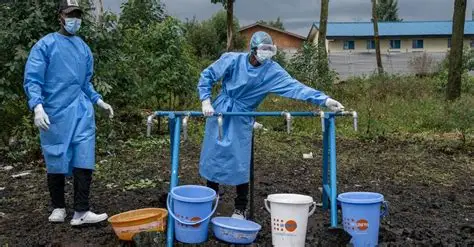
The epidemiological data underscores the terrifying speed of the contagion. Within weeks of the initial declaration, official tallies jumped to hundreds of suspected cases and a rapidly climbing death toll. Field clinics operated by Médecins Sans Frontières (MSF) report that local hospital infrastructures in the provincial capital of Bunia have become completely overwhelmed, forcing humanitarian teams to establish primitive canvas field hospitals to isolate those fighting active Ebola infections.
Compounding the crisis is the physical movement of people; confirmed cases of Ebola have already skipped across domestic borders into Uganda’s capital city of Kampala, and have also taken root within the DRC’s densely packed metropolis of Kinshasa, transforming a rural health crisis into a major urban biosecurity emergency.
Part II: The Global Health Apparatus Mobilizes
In response to the deteriorating situation, the United Nations has unlocked emergency financial reserves and deployed a coordinated multi-agency task force. The European Commission has redirected millions in aid toward enhanced wastewater pathogen sequencing and localized diagnostic infrastructure, while the U.S. Centers for Disease Control and Prevention (CDC) has issued immediate travel advisories and strict borders restrictions.
The primary hurdle facing these international teams on the ground is the total absence of a specialized pharmaceutical defense against this type of Ebola. In past years, the deployment of the Ervebo vaccine allowed medical teams to implement “ring vaccination” tactics—immunizing every contact of an infected individual to create a human firewall against Ebola. With the Bundibugyo strain, doctors are forced to rely strictly on foundational barrier nursing, rigorous tracking of fluid contacts, and aggressive supportive hydration therapy.
                  +----------------------------------+
                  |  WHO EMERGENCY RISK EVALUATION  |
                  +----------------------------------+
                                   |
         +-------------------------+-------------------------+
         |                                                   |
         v                                                   v
[DRC Domestic Risk: VERY HIGH]                    [Regional Risk: HIGH]
Urban centers (Kinshasa) and                      Cross-border transit into Uganda
conflict zones compromise tracking.                 (Kampala) creates regional danger.
The WHO’s upgrade of the regional risk level to “very high” reflects the logistical nightmare of tracking an invisible virus in an active conflict zone. The eastern DRC remains home to numerous armed militias, creating a perilous environment where medical teams seeking to control Ebola transmission must travel under armed UN escorts.
Public health experts warn that if the virus establishes permanent transmission chains within large displacement camps or unmonitored border communities, containing the spread of Ebola will become practically impossible. The international community’s historical tendency to treat these outbreaks as self-limiting local tragedies is what the WHO has directly characterized as a catastrophic error, emphasizing that an uncontained virus anywhere on earth is a direct threat to global stability everywhere.
Part III: The World Cup Intersection and the Houston Protocol
As the medical battle rages in Central Africa, the global sports calendar has collided head-on with international quarantine enforcement. The DRC national football team, affectionately known as the Leopards, recently secured an emotional and historic qualification for the FIFA World Cup 2026, marking their first appearance at the global tournament since 1974. However, their triumphant athletic narrative has been completely overshadowed by the shifting realities of the Ebola epidemic.
The team is scheduled to play their opening Group K match against international heavyweight Portugal in Houston, Texas, on June 17, a marquee sporting event expected to draw over 70,000 spectators to NRG Stadium. With millions of international fans preparing to travel to North America for the competition, the potential introduction of Ebola into a major transport and economic hub like Houston has forced sports governing bodies and federal agencies into a defensive posture.
               [THE WORLD CUP BIOSECURITY PIPELINE]

   DRC National Team  ───>  Mandatory 21-Day Medical Quarantine
                                      │
                                      ▼
   Daily PCR Testing & Thermal Screening (Monitored by WHO/CDC)
                                      │
                                      ▼
   Authorized Charter Travel Directly to Houston, Texas
                                      │
                                      ▼
   NRG Stadium Matchday: Portugal vs. Congo DR (June 17, 2026)
To preserve both the integrity of the tournament and the safety of the host nation, FIFA, in strict coordination with the CDC and the WHO, has instituted an absolute mandate: the entire Congolese football delegation must undergo a rigorous 21-day medical isolation protocol before they are granted entry clearance into the United States.
This unprecedented sports-health crossover requires the players, coaching staff, and athletic trainers to live inside a sealed, sterile environment completely cut off from public interaction. The length of the isolation period is not an arbitrary figure; 21 days represents the absolute maximum incubation window for the Ebola virus inside a human host.
During this pre-travel quarantine, the athletes are subjected to daily clinical checkups, automated thermal monitoring, and frequent blood-based polymerase chain reaction (PCR) screenings to confirm the total absence of Ebola genetic material. Any single individual within the delegation who exhibits an elevated body temperature or any symptom associated with Ebola will be immediately removed to an isolated medical facility, an event that would trigger a complete restart of the 21-day quarantine clock for the entire team and potentially forfeit their participation in the World Cup.
Part IV: The Logistics of a High-Stakes Quarantine
Executing a elite athletic preparation program while confined within a high-security biosecurity bubble presents intense logistical challenges for the Congolese football federation. Football at the World Cup level demands absolute physical conditioning, meticulous tactical training, and intense team cohesion. Forcing athletes into a rigid isolation framework fundamentally alters their training environment just weeks before facing a world-class competitor like Portugal.
To mitigate these disruptions, international health agencies have collaborated with sporting authorities to construct a specialized, secure training sanctuary outside the primary zones of active Ebola transmission. Within this sealed compound, the pitch, the training gyms, and the dining facilities are managed under strict medical guidelines. Every piece of equipment, from the footballs to the resistance bands, undergoes constant sanitization to eliminate any theoretical path for viral contamination.
+--------------------------------------------------------------------------+
|                  THE IN-BUBBLE QUARANTINE ARCHITECTURE                  |
+--------------------------------------------------------------------------+
|  • PERIMETER SECURITY   | Controlled by UN/WHO monitors; no outside      |
|                         | visitors, journalists, or family members.      |
|                                                                          |
|  • DIETARY SANITATION  | All food and fluids sourced from verified,     |
|                         | pathogen-free logistics lines.                 |
|                                                                          |
|  • CLINICAL TRACKING    | Constant monitoring for fever, fatigue, and    |
|                         | early-stage biomarkers of the virus.           |
+--------------------------------------------------------------------------+
The kitchen staff, medical trainers, and maintenance crews are subjected to the exact same quarantine restrictions as the players, ensuring that no unvetted individual breaches the perimeter of the bubble.
The psychological burden on the players is immense. Instead of celebrating their historic return to football’s grandest stage alongside their families and fans, they are living under the constant shadow of a lethal disease, surrounded by medical staff in personal protective equipment. The fear of contracting Ebola is paired with the professional anxiety of losing their dream of playing in the World Cup.
If an outbreak of Ebola were to infiltrate the training squad, it would not only end their athletic aspirations but could devastate the hearts of a nation that looks to the team as a source of hope amid a national health disaster. The team’s management has had to bring in specialized sports psychologists to help the players manage the dual stress of elite athletic expectation and high-stakes biosecurity isolation.
Part V: The Host Nation’s Defensive Posture
In the United States, federal agencies are taking no chances with the potential cross-continental transit of Ebola. The CDC has activated its emergency travel response operations, deploying specialized personnel to entry points across the country. A 30-day strict prohibition has been enacted barring any non-U.S. citizens who have traveled through the DRC, Uganda, or surrounding high-risk territories within the preceding 21 days from entering American territory, with the World Cup delegation serving as the sole, highly regulated exception.
In Houston, local public health officials and hospital systems are working in lockstep with federal coordinators to prepare for every possible contingency. NRG Stadium, which will host seven matches during the month-long tournament, is being equipped with advanced thermal imaging arrays at all player entry tunnels and spectator gates. While the chances of an active Ebola case reaching the stadium are low due to the strict pre-travel bubble, the city’s medical infrastructure is maintaining a state of high alert.
+-------------------------------------------------------------------------+
|                  HOUSTON AREA BIOSECURITY PREPARATIONS                  |
+-------------------------------------------------------------------------+
|  • THERMAL IMAGING     | Automated scanning arrays deployed at all      |
|                        | player and VIP entry points at NRG Stadium.    |
|                                                                          |
|  • CONTAINMENT UNITS   | Specialized isolation rooms prepared at local  |
|                        | tier-one medical facilities near the venue.    |
|                                                                          |
|  • RE-ROUTE PROTOCOLS  | Dedicated emergency transit paths mapped for   |
|                        | immediate quarantine of any suspect individual. |
+-------------------------------------------------------------------------+
Specialized containment units at nearby world-class medical centers have been placed on standby, and emergency medical personnel have undergone advanced training on how to handle potential hemorrhagic fever symptoms without causing public panic.
The political and economic pressure surrounding the match is substantial. A single misstep in the containment of Ebola could lead to calls to cancel or relocate matches, threatening hundreds of millions of dollars in tourism revenue and broadcasting contracts.
However, the consensus among global health officials is that sports cannot take precedence over biosecurity. The strict isolation of the Congolese team is being watched closely as a model for how international mega-events can continue to function in an era defined by emerging, unpredictable global health crises. The goal is to prove that through meticulous planning, international cooperation, and absolute adherence to medical protocols, the global community can celebrate human athletic achievement without compromising the defense against infectious disease.
Part VI: The Structural Lessons of the 2026 Outbreak
As the mid-June deadline approaches, the twin narratives of the Ebola surge and the World Cup countdown continue to develop in parallel. The crisis in the eastern provinces of the Democratic Republic of the Congo serves as a stark reminder of the fragile state of global health security. The international community’s initial slow response to the Bundibugyo strain highlights a dangerous gap in our collective pandemic preparedness—a systemic vulnerability where the absence of a profitable vaccine market often leads to administrative inertia until a virus threatens to step onto the international stage.
The UN’s current emergency push is making strides in expanding field hospitals, delivering personal protective gear, and setting up contact tracing networks across Ituri and North Kivu. Yet, the persistent spread of Ebola toward major population centers proves that traditional containment strategies are facing unprecedented strain in our highly interconnected world.
The strict quarantine of the DRC national football team shows how health considerations now impact every facet of modern society. Whether the Leopards step onto the pitch in Houston on June 17 depends entirely on the success of a medical bubble designed to hold back one of the world’s most dangerous pathogens. As scientists, humanitarian workers, and athletes push forward, the message from health authorities remains clear: treating Ebola as a localized issue is a dangerous error that the world cannot afford to repeat.
For more:- World Health Organization (WHO)
Social Connect:


