

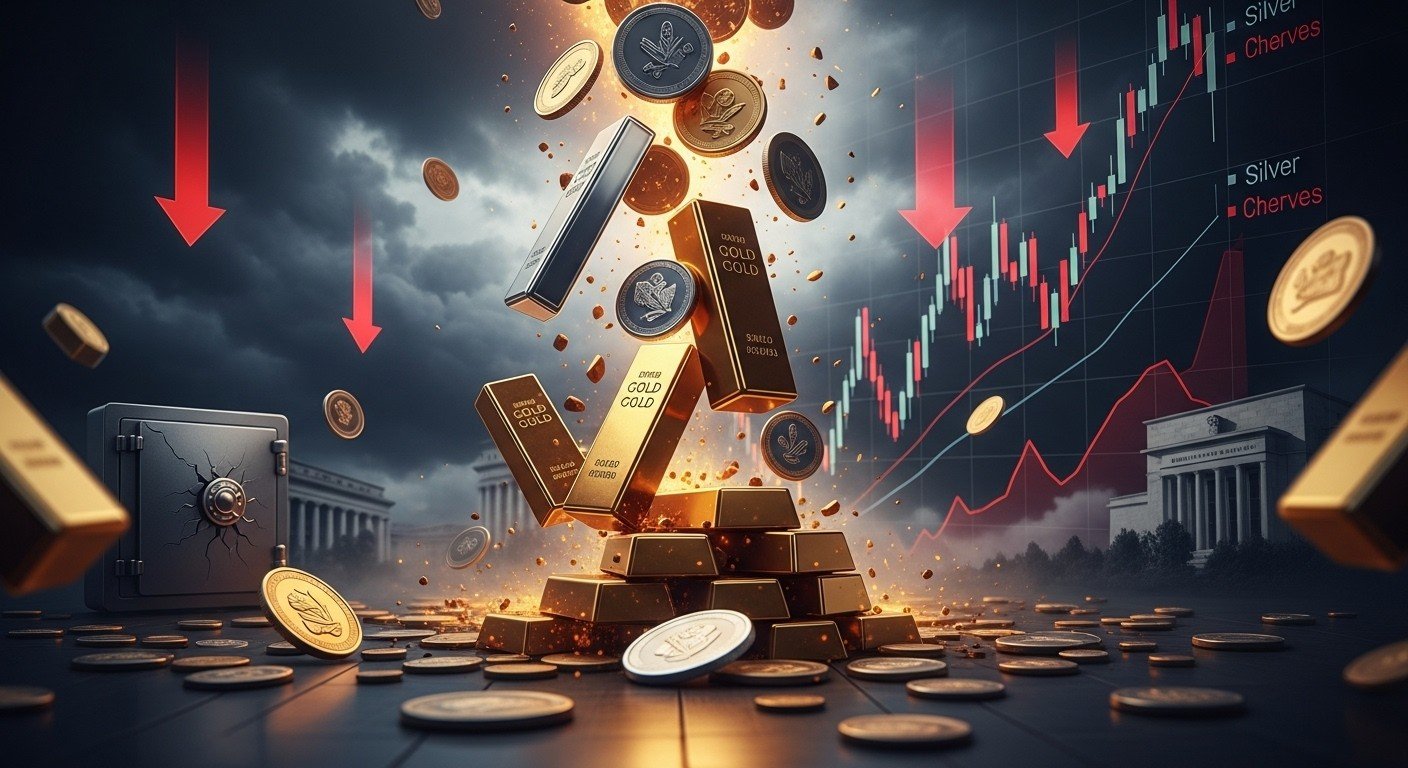
Metal Meltdown: Global Uncertainty Triggers Sharp Correction in Gold and Silver Prices
CHICAGO, IL — The global commodities landscape witnessed a dramatic reversal on Friday as a sudden wave of deleveraging swept through the pits of the COMEX. In a session defined by extreme precious metals market volatility, gold and silver prices tumbled from their recent highs, catching many investors off guard as geopolitical headlines shifted the risk-premium landscape.
By the close of the New York session, spot gold had plummeted by $52 per ounce, while silver prices slipped by $1.60 per ounce. This sharp correction marks one of the most significant single-day declines in the second quarter of 2026, serving as a stark reminder that even the most resilient “safe-haven” assets are not immune to the forces of precious metals market volatility.
The Geopolitical Seesaw: Why Safes Aren’t Always Haven
The primary driver behind this sudden sell-off appears to be a shifting narrative regarding geopolitical flashpoints. For the past several weeks, bullion prices have been bolstered by a “fear premium” tied to escalating tensions in the Middle East and Eastern Europe. However, Friday brought reports of potential diplomatic breakthroughs, leading to a rapid unwinding of long positions.
When geopolitical tensions appear to thaw, the immediate reaction in the precious metals market volatility index is a sharp move toward liquidity. Traders who had hedged against a total market collapse found themselves over-exposed as “peace talk” rumors gained traction. The result was a classic “risk-on” rotation that saw capital flow out of non-yielding assets like gold and back into equities and higher-yielding currencies.
COMEX Gold: A $52 Retraction
Gold, often considered the ultimate anchor in times of trouble, failed to hold its ground at the $2,400 psychological level. The $52 drop pushed the yellow metal toward critical support zones, triggering automated sell orders and further intensifying the precious metals market volatility.
Market analysts point out that this decline was not merely a reaction to peace rumors, but also a response to a strengthening U.S. dollar. As the Federal Reserve maintains a hawkish stance to combat persistent service-sector inflation, the “real yield” on U.S. Treasuries has become increasingly attractive compared to gold. In an environment of high precious metals market volatility, the opportunity cost of holding a non-interest-bearing asset becomes a primary focus for institutional fund managers.
Silver’s Slippage: The Industrial and Monetary Dual-Hit
Silver faced an even more aggressive percentage decline, dropping $1.60 per ounce. Unlike gold, which is primarily a monetary asset, silver’s value is split between its roles as a store of value and an industrial metal. The current precious metals market volatility is hitting silver from both sides.
On the monetary front, the stronger dollar is weighing on silver just as it is on gold. On the industrial front, concerns over a cooling manufacturing sector in Western Europe have raised questions about future demand for silver in solar panels and high-end electronics. When industrial sentiment turns bearish at the same time that the “safe-haven” premium is evaporating, silver often experiences the most violent swings in the precious metals market volatility spectrum.
Technical Indicators: Support and Resistance in Turmoil
From a technical perspective, the Friday session has damaged the short-term bullish structure of the metals. Analysts are now closely watching the 50-day moving average to see if this is a temporary correction or the beginning of a deeper bear phase. The current precious metals market volatility has pushed the Relative Strength Index (RSI) for silver into “oversold” territory, while gold remains in a neutral, albeit fragile, position.
“We are seeing a massive flush of ‘weak hands’ from the market,” says David Reynolds, a senior commodities strategist. “The precious metals market volatility we are witnessing today is the market’s way of resetting expectations. We had become too one-sided in our bullishness, and this correction is a healthy, albeit painful, rebalancing of the books.”
The Dollar Factor: A Headwind for Bullion
One cannot discuss precious metals market volatility without mentioning the U.S. Dollar Index (DXY). On Friday, the dollar gained strength against a basket of major currencies, making gold and silver more expensive for buyers using other currencies like the Euro or the Yen.
This inverse relationship between the greenback and metals is a cornerstone of global finance. As long as the U.S. economy continues to show relative outperformance compared to its G7 peers, the dollar will likely remain a significant headwind for gold and silver. Investors must navigate this currency-driven precious metals market volatility with extreme caution, as even positive news for the metals can be neutralized by a surging dollar.
Central Bank Demand: The Long-Term Floor?
While short-term precious metals market volatility is dominated by speculative traders and geopolitical headlines, the long-term outlook is often anchored by central bank activity. Over the last two years, central banks in emerging markets have been record buyers of gold to diversify away from the dollar.
There is no evidence yet that this institutional buying has ceased. In fact, many analysts believe that central banks view periods of high precious metals market volatility as an opportunity to “buy the dip” and increase their reserves at more favorable prices. This institutional support provides a “floor” for gold that prevents it from entering a freefall, even when retail and speculative sentiment turns sour.
Impact on Mining Stocks and ETFs
The ripple effects of Friday’s sell-off were felt immediately in the equity markets. Major gold and silver mining companies saw their share prices decline by 4% to 7%, as their profit margins are directly tied to the spot prices of the metals they extract.
Exchange-Traded Funds (ETFs) backed by physical gold and silver also saw significant outflows. This exit of “passive” capital further fueled the precious metals market volatility, as the funds were forced to liquidate physical holdings to meet redemption requests. For the individual investor, the volatility in mining stocks often acts as a leveraged version of the spot market, leading to even more dramatic portfolio swings.
The “Ostrich” Effect: Ignoring the Signs
Some market participants argue that the recent rally was a bubble waiting to burst and that the current precious metals market volatility was inevitable. These skeptics point to the fact that gold had been hitting record highs even as real interest rates rose—a historical anomaly that suggested the market was ignoring fundamental gravity.
Friday’s $52 drop in gold suggests that gravity has finally caught up. When the market stops “ignoring” the rising cost of capital, the adjustment period is usually swift and violent. This re-alignment of fundamentals is the primary engine behind the current state of precious metals market volatility.
Future Outlook: Navigating the Choppy Waters of Q2
As we look toward the remainder of the quarter, the precious metals market volatility is expected to remain high. Investors will be hanging on every word from the Federal Reserve and every headline from global conflict zones.
If a formal peace treaty or ceasefire is signed, we could see gold test the $2,250 level. Conversely, if diplomatic efforts fail and the dollar softens, the current precious metals market volatility could pivot back into a buying frenzy. The “all-clear” signal is nowhere to be seen, and the only certainty is that the road ahead for gold and silver will be far from smooth.
Conclusion: A Lesson in Risk Management
The “Metal Meltdown” of Friday, April 24, 2026, serves as a masterclass in market dynamics. The $52 fall in gold and the $1.60 slide in silver are not just numbers on a screen; they represent the sudden evaporation of the “fear trade” and the brutal efficiency of the precious metals market volatility cycle.
For the disciplined investor, this correction is a reminder of the importance of stop-loss orders and diversification. While precious metals will always have a place in a balanced portfolio, they are not a one-way street to wealth. As the geopolitical landscape continues to shift, the precious metals market volatility will continue to test the nerves of even the most seasoned traders. In the world of gold and silver, the only thing that shines brighter than the metal itself is the need for a solid exit strategy.
Kitco – Gold & Silver Price Charts: kitco.com/charts
Social Connect :

