

The Drone Inversion: How Unregulated Autonomous Systems and the Rise of Militarized UAV Technology Have Escalated the Global Risk of Nuclear Terrorism
UNITED NATIONS, NY — The international security architecture is facing its most volatile paradigm shift since the height of the Cold War. In a scathing, unclassified briefing delivered to the United Nations Security Council on Monday, May 18, 2026, an independent panel of geopolitical and technology experts issued a stark warning to the international community. The rapid proliferation of commercially available artificial intelligence, combined with an exponential increase in automated battlefield infrastructure, has pushed the threat of sub-state atomic sabotage to an unprecedented flashpoint. According to the panel’s exhaustive report, the intersection of unchecked commercial technology and state-level engineering has pushed the global risk of nuclear terrorism to its highest level in modern history.
The UN panel’s warning comes amid a sharp, catastrophic escalation in long-range autonomous warfare across Eastern Europe. Over the past seventy-two hours, both Russian and Ukrainian forces have unleashed unprecedented waves of coordinated, AI-driven swarm strikes targeting dense civilian industrial centers and energy infrastructure grids.
While the immediate fallout of these actions has resulted in mounting civilian casualties and widespread blackouts, the international community’s primary concern has shifted toward a far more terrifying systemic threat.
The widespread, uncontrolled availability of dual-use consumer AI software and cheap, militarized drone kits has effectively lowered the technical and financial barriers required for non-state actors, rogue elements, and insurgent groups to orchestrate an act of catastrophic nuclear terrorism.
Part I: The Eastern European Drone Surge — Anatomy of a Swarm Escalation
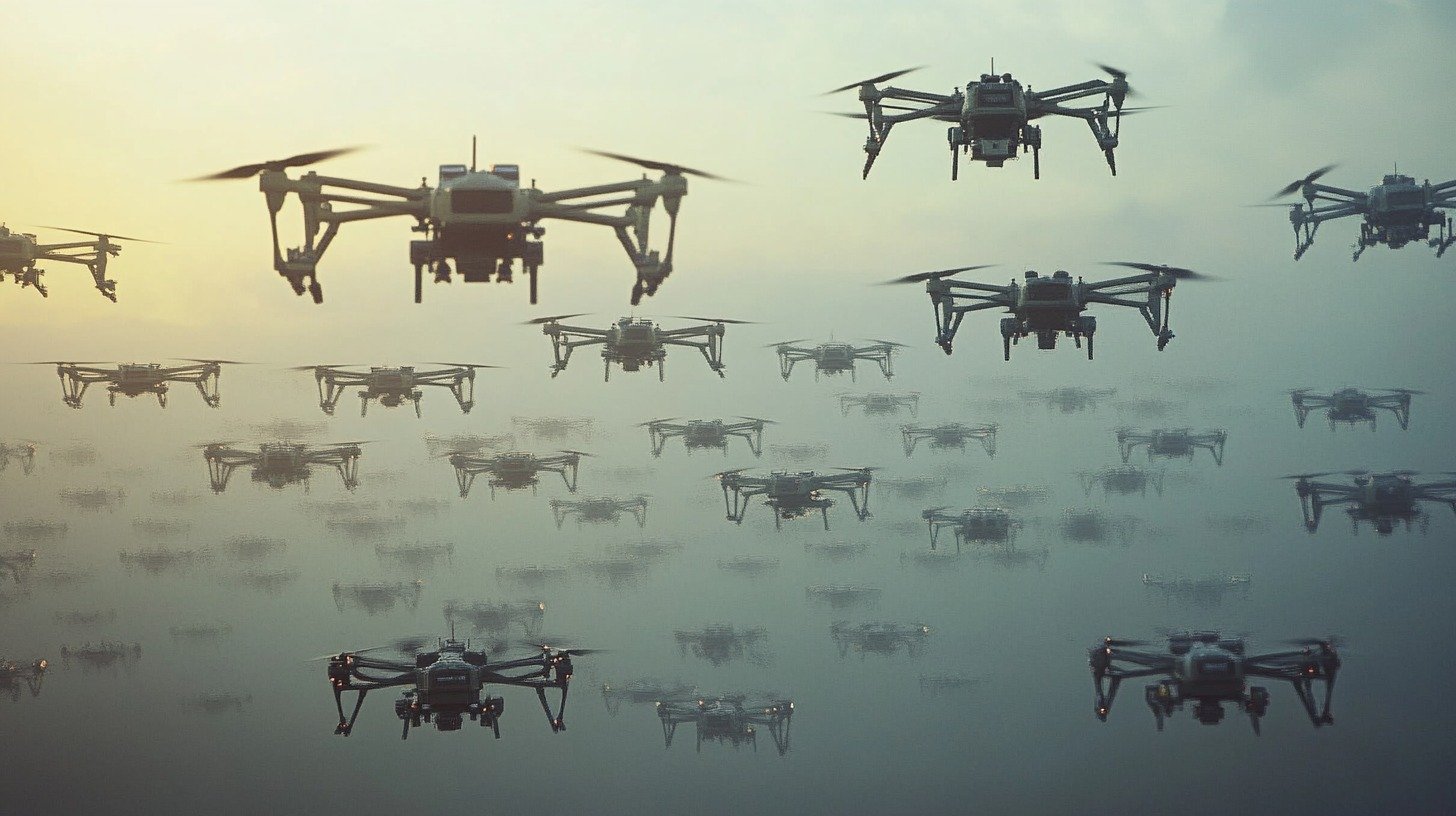
To understand the mechanics of this newly accelerated global emergency, one must observe the reality of modern automated warfare on the front lines. The weekend of May 16-17, 2026, witnessed the largest synchronized deployment of autonomous aerial systems in human history. Ukrainian defense networks reported intercepting over 450 Russian long-range strike drones across twelve distinct oblasts, while Russian defense officials confirmed that a massive, multi-directional swarm of over 380 Ukrainian autonomous vehicles penetrated deep into domestic airspace, targeting critical oil refineries, railway junctions, and electrical substations.
+------------------------------------------------------------------------+
|                     MAY 2026 UN SECURITY ALERT MATRIX                  |
+========================================================================+
|  1. Primary Threat Driver  --> COMMERCIALLY SOURCED AI SWARM KITS      |
|                                Lowering technical barriers to entry.   |
|  2. Conflict Proliferation --> 830+ SYNCHRONIZED STRIKES (48 Hours)     |
|                                Drastic expansion of strike envelopes. |
|  3. Primary Security Risk  --> SUB-STATE NUCLEAR TERRORISM CATALYST    |
|                                Targeting of atomic holding facilities. |
+------------------------------------------------------------------------+
|  SYSTEMIC BARRIER STATUS  --> COMPLETELY COLLAPSED                     |
+------------------------------------------------------------------------+
The human cost of this automated campaign has triggered widespread international condemnation. Because these weapon systems increasingly rely on decentralized, edge-computed AI algorithms to navigate active electronic warfare jamming environments, their onboard target recognition systems are prone to catastrophic algorithmic drift.
Strikes originally routed toward peripheral military depots have repeatedly impacted multi-story residential blocks and civilian medical installations in cities like Kharkiv, Belgorod, Odessa, and Rostov-on-Don. The result is a sharp, accelerating spike in civilian casualties that highlights the dangers of deploying unvalidated, autonomous decision-making loops in active combat zones.
However, the UN panel explicitly noted that the immediate battlefield statistics are merely a prelude to a much larger threat vector. The conflict in Eastern Europe has turned into a massive, real-world development lab for cheap, highly lethal autonomous technologies.
Technologies that once required billions of dollars in state-sponsored research and development are now being engineered, tested, and optimized using open-source code repositories and cheap consumer components. This rapid development loop has created a dangerous situation where the tools needed to execute an act of nuclear terrorism are now available on the open market.
Part II: The Commercial AI Loophole — Demilitarizing Mass Destruction
The core mechanism driving the threat of nuclear terrorism to historic levels is the commercialization of advanced technology. For decades, the primary defense against non-state groups acquiring weapons of mass destruction was the sheer difficulty of delivery. Even if a rogue group managed to steal or synthesize radioactive isotopes or dirty bomb materials, they lacked the heavy bombers, ballistic missiles, or specialized military logistics chains required to breach state-level security perimeters and deposit a payload onto a high-value target.
Modern drone tech and commercial AI frameworks have completely broken those historical barriers, changing the nature of how a group could plan an act of nuclear terrorism.
-
The Accessibility of Open-Source Codebases: Advanced computer vision algorithms, autonomous flight-path mapping, and multi-agent swarm synchronization tools are now widely shared across public software platforms like GitHub.
-
The Proliferation of Dual-Use Hardware: High-performance brushless motors, long-range carbon-fiber airframes, and highly sensitive GPS-denied navigation chips are mass-produced globally for consumer agricultural and photography industries.
               THE COLLAPSE OF THE HISTORICAL DEFENSE BOUNDARY

     [ Legacy Threat Profile ] ------------------------------+
                         Heavy state barriers; requires      |
                         ballistic missiles and vast budgets.|
                                                             |
     [ The Commercial Tech Inversion ] <---------------------+
                         Open-source AI and consumer kits
                         demilitarize advanced flight tech.

     [ Decentralized Terror Vector ] ------------------------+
                         Rogue actors gain cheap, automated   |
                         delivery paths for nuclear payloads.|
By pairing an unguided commercial drone with an open-source, edge-computed computer vision script, any sub-state actor can create a highly precise, automated strike asset for a few hundred dollars. These systems do not require active communication links with a human operator, making them completely immune to traditional radio-frequency jamming systems.
This technological leap enables small, underfunded groups to build independent air wings, presenting a severe threat to internal state security and increasing the likelihood of localized nuclear terrorism.
The UN report emphasizes that this democratization of high-precision delivery platforms is what makes the current era so dangerous. A terrorist cell no longer needs an army or a multi-million dollar budget to challenge state defenses.
With a small fleet of customized agricultural drones running open-source navigation models, a non-state actor can plan an attack on a high-security facility, transforming the theoretical threat of nuclear terrorism into an imminent operational challenge.
Part III: Vulnerability Profiles — Targeting the Atomic Infrastructure Grid
The most terrifying chapter of the UN briefing details the vulnerability of global atomic infrastructure to low-cost, automated aerial attack. While world governments have spent billions of dollars fortifying nuclear power plants, processing facilities, and waste storage depots against land-based assaults or heavy artillery bombardment, many of these facilities remain highly vulnerable to low-altitude, synchronized aerial swarm attacks designed to trigger localized nuclear terrorism.
The expert panel identified three critical vulnerability vectors within the global nuclear infrastructure grid that could be exploited by rogue actors seeking to cause an incident of nuclear terrorism:
1. The Vulnerability of External Cooling Arrays
Modern nuclear reactors rely completely on a continuous, uninterrupted flow of water to prevent catastrophic core meltdowns. The pumping stations, backup diesel generators, and electrical switching stations that power these cooling arrays are frequently positioned outside the main containment dome. A coordinated strike by a swarm of low-cost explosives-laden drones could systematically disable these external backup systems, initiating a station blackout scenario that could trigger a localized core meltdown, fulfilling a major goal of nuclear terrorism.
2. Spent Fuel Pool Vulnerabilities
While active reactor cores are housed inside thick, reinforced concrete containment structures, spent fuel rods are frequently stored in secondary cooling pools that lack the same heavy structural armor. These pools contain massive concentrations of highly radioactive isotopes. A successful strike that breaches the walls of a storage pool or drains its cooling liquid could spark a massive zirconium fire, releasing a huge cloud of radioactive fallout across vast geographical areas without needing to crack the main reactor dome.
3. Intermediate Transit Disruptions
Every year, thousands of tons of enriched uranium, medical isotopes, and weapons-grade nuclear waste are transported across global highway and rail networks. These transit convoys are significantly more vulnerable than fortified storage depots. A rogue organization utilizing synchronized, automated drone strikes could easily disable a transport convoy’s security escort in a remote area, allowing them to seize radioactive materials to build a dirty bomb, providing a direct path to an act of nuclear terrorism.
| Atomic Security Vector | Legacy Defensive Paradigm | Automated Swarm Threat Profile |
| Containment Integrity | Fortified concrete domes built to withstand direct aviation impacts. | Precision external strikes targeting external backup power, cooling water lines, and pumps. |
| Transit Escort Protocols | Armored transport convoys supported by heavily armed human security forces. | Coordinated, multi-angle aerial ambushes designed to overwhelm and isolate security details. |
| Early Warning Arrays | Radar networks optimized to detect high-altitude aircraft and incoming missiles. | Low-altitude, radar-evading swarm signatures that blend with local terrain and bird flocks. |
The UN panel warned that the conflict in Ukraine has already seen dangerous close calls that prove these risks are real. Strategic installations, such as the Zaporizhzhia Nuclear Power Plant and the Kursk atomic generation facility, have repeatedly recorded unauthorized drone activity near their perimeters.
While these instances have not yet triggered a major disaster, they provide a terrifying proof-of-concept for non-state actors watching from afar, showing that the global infrastructure grid is vulnerable to calculated nuclear terrorism.
Part IV: The Global Non-State Proliferation Pipeline
The geopolitical danger is intensified by the existence of a highly organized, international gray market that moves advanced weapon components from active combat zones into the hands of global insurgent networks. The sheer volume of drone manufacturing happening across Europe and Asia has made it impossible for international regulators to track the lifecycle of dual-use technologies, creating a direct supply chain that feeds the threat of nuclear terrorism.
Inspectors have documented multiple instances where advanced, mil-spec drone components recovered from raids on extremist cells in North Africa, the Middle East, and Southeast Asia contained tracking markers tracing back to industrial production facilities in Eastern Europe.
+-------------------------------------------------------------------------+
|                  THE GRAY-MARKET WEAPONS TRANSIT NETWORK                |
+=========================================================================+
|   [Industrial Mass Production] --> Mass output of components in Europe. |
|   [Active Combat Testing]      --> Algorithmic optimization in field.   |
|   [Gray-Market Redirection]    --> Smuggling via loose maritime routes. |
|   [Non-State Acquisition]      --> Materials bought to build terror kits|
+-------------------------------------------------------------------------+
This fluid technology pipeline means that an algorithmic breakthrough developed on the battlefields of Ukraine can be copied, uploaded to an open encrypted cloud server, and downloaded by an insurgent group anywhere on earth within days. This rapid proliferation loop strips away the geographic buffers that once protected vulnerable nations from advanced threats, raising the global risk of nuclear terrorism across every continent simultaneously.
When a non-state group gains the ability to launch precision long-range strikes without needing expensive military hardware, traditional deterrence strategies stop working. Rogue actors who operate outside international legal frameworks cannot be deterred by standard diplomatic or economic threats.
If such an organization manages to combine an automated drone delivery platform with illicit radioactive isotopes obtained through gray-market smuggling networks, the threat of nuclear terrorism shifts from a distant security concern into an active global disaster scenario.
Part V: Building the Counter-UAS Defense Grid — A Race Against Time
As the international community grapples with the warnings delivered at the United Nations, security agencies are racing to build next-generation defense grids capable of neutralizing autonomous threats before they can be used to execute an act of nuclear terrorism. The era of relying entirely on surface-to-air missiles and kinetic anti-aircraft guns is drawing to a close, as these traditional defensive systems are economically unsustainable against massive, low-cost drone swarms.
Using a million-dollar interceptor missile to down a five-hundred-dollar consumer drone running an open-source navigation loop is a losing mathematical equation that leaves critical infrastructure open to eventual saturation attacks.
To counter this vulnerability, international defense consortiums are pivoting toward developing and deploying advanced directed-energy weapons, high-power microwave (HPM) arrays, and automated counter-drone networks. These systems are designed to disrupt the internal electronic components of incoming craft instantly, creating a reliable defensive shield around vulnerable facilities.
Concurrently, international nuclear regulators are demanding that all atomic power stations rapidly implement mandatory, low-altitude airspace defense shields, including heavy physical netting, automated automated interceptor nests, and advanced acoustic tracking arrays.
               THE INVERSION OF THE RECOVERY PIPELINE

     [ Historical Anti-Air Arrays ] -------------------------+
                         Expensive, slow missile systems     |
                         easily overwhelmed by cheap swarms. |
                                                             |
     [ The Defensive Technology Void ] <---------------------+
                         Traditional radar networks fail to
                         detect low-flying autonomous craft.

     [ Next-Gen Defense Inversion ] -------------------------+
                         Directed-energy weapons and microwave|
                         arrays build an instant shield grid.|
However, the expert panel emphasized that physical defense networks represent only one piece of a comprehensive containment strategy. Stopping the spread of nuclear terrorism requires an unprecedented level of global diplomatic cooperation and international regulatory oversight.
Nations must work together to build strict tracking frameworks for dual-use artificial intelligence software, implement rigid export controls on critical drone components, and enhance intelligence-sharing networks targeting black-market fissile material smuggling operations.
The findings presented at the United Nations show that the international community is running out of time to get ahead of this technology curve. The ongoing conflict in Eastern Europe continues to push the limits of what automated weapon systems can do, while the tools needed to harness this power are becoming easier to access worldwide.
If world governments fail to look past immediate geopolitical rivalries and establish a binding global framework to secure vulnerable facilities and restrict autonomous technologies, they may find that the democratization of flight has delivered the tools of nuclear terrorism straight to the world’s doorstep, permanently altering global security forever.
Nuclear Security Framework: IAEA Division of Nuclear Security | International Atomic Energy Agency
Social Connect :

