

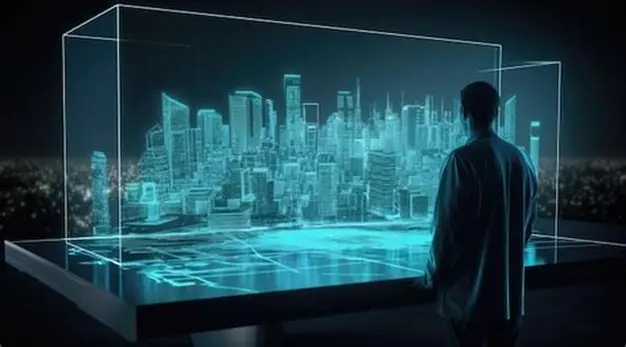
Beyond the Screen: How Holographic AI Models are Redefining the Human-Machine Interface in 2026
SILICON VALLEY – For decades, the primary way we interacted with computers was through flat surfaces—first glowing monitors, then handheld glass rectangles. However, today marks the official beginning of a new epoch in digital communication. Major technology titans, led by the quiet but rapid rollout of “Project Glasswing,” have unveiled Holographic AI Models. This breakthrough allows artificial intelligence to step out of the chat box and into three-dimensional space, transforming static data into interactive, high-fidelity visual projections during real-time voice conversations.
As we navigate the complexities of the mid-2020s, the emergence of Holographic AI Models represents more than just a flashy upgrade; it is a fundamental shift in how we perceive and manipulate information. By bridging the gap between auditory instruction and spatial visualization, these models are solving the “communication deficit” that has plagued remote collaboration since the dawn of the internet.
The Glasswing Breakthrough: Visualizing the Invisible
The centerpiece of this technological surge is Project Glasswing. While multimodal AI has been around for years—allowing systems to “see” images and “hear” voices—Holographic AI Models take this a step further by generating 3D spatial data on the fly. When a user engages in a voice call with an AI assistant, the interface is no longer limited to text or 2D images. Instead, the AI utilizes advanced light-field rendering and AR (Augmented Reality) integration to project rotatable, scalable objects directly onto the user’s workspace or mobile screen.
For example, if an aerospace engineer is discussing a structural flaw in a turbine blade, Holographic AI Models can instantly generate a detailed 3D schematic of that specific component. The engineer can rotate the blade, zoom into microscopic stress fractures, and watch real-time simulations of thermal expansion, all while maintaining a natural conversation with the AI. This seamless integration of sight and sound is the hallmark of the Holographic AI Models era.
Revolutionizing Medical Diagnostics and Education
Perhaps no field stands to benefit more from Holographic AI Models than healthcare. Traditionally, medical scans like MRIs and CTs are viewed as 2D “slices” on a monitor, requiring years of training to interpret accurately. With the advent of Holographic AI Models, these scans are being transformed into interactive anatomical projections.
Surgeons can now consult their AI assistants during pre-operative planning. The AI projects a holographic representation of the patient’s specific organ, allowing the medical team to “walk through” the surgical path. The ability of Holographic AI Models to render complex biological systems in 3D—and react to verbal queries like “show me the vascular structure behind this tumor”—is saving lives by increasing precision and reducing the time spent in the operating room.
In the realm of education, Holographic AI Models are dismantling the traditional classroom walls. Students studying ancient history can sit around a projected 3D model of the Roman Colosseum, while the AI narrates its construction history. This immersive learning experience ensures that the Holographic AI Models are not just tools for professionals, but a gateway for the next generation of thinkers to visualize the world in ways their predecessors never could.
The Engineering Frontier: Prototyping at the Speed of Thought
In industrial design and architecture, the “design-to-prototype” cycle has always been the most significant bottleneck. Holographic AI Models are effectively eliminating this delay. Instead of waiting hours for a 3D render to compile or days for a physical model to be 3D printed, designers can now use “Spatial Prompting.”
By simply describing a change—such as “adjust the roof pitch by five degrees and change the material to brushed aluminum”—the Holographic AI Models update the projection in real-time. This allows for an iterative process that happens at the speed of thought. The spatial accuracy of Holographic AI Models is so precise that these projections can be used for light-study simulations, helping architects understand how natural light will move through a building at different times of the year before a single brick is laid.
Technical Support and the Death of the Instruction Manual
We have all experienced the frustration of trying to follow a flat, 2D diagram while attempting to repair a household appliance or set up a complex piece of hardware. Holographic AI Models are making the paper instruction manual obsolete. Remote technical support is being transformed into an interactive “over-the-shoulder” experience.
When a technician—or even a DIY homeowner—encounters a problem, they can point their device at the machinery. The Holographic AI Models analyze the visual feed and project “digital twins” of the internal components over the physical object. The AI then highlights exactly which bolt to turn or which wire to reconnect. This application of Holographic AI Models reduces human error significantly and ensures that complex technical knowledge is accessible to anyone, anywhere, regardless of their prior training.
The Underlying Tech: How It Works
The magic behind Holographic AI Models lies in the massive increase in computational efficiency seen over the last year. These models rely on “Neural Radiance Fields” (NeRFs) and real-time ray tracing, powered by the latest generation of localized AI chips. Unlike early AI, which relied solely on cloud processing, modern Holographic AI Models use a “hybrid-edge” approach.
The heavy linguistic and logical processing happens in the cloud, while the intense 3D rendering is handled by the user’s local hardware. This ensures that the Holographic AI Models remain responsive and lag-free, which is essential for a convincing holographic experience. Furthermore, the integration of 5G and 6G networks provides the low-latency bandwidth required to stream the complex data packets that make Holographic AI Models possible.
Privacy, Ethics, and the “Uncanny Valley”
As with any transformative technology, Holographic AI Models bring a new set of ethical considerations. The ability of an AI to generate hyper-realistic 3D representations of people or environments raises concerns about “Deep-Spatial Fakes.” If Holographic AI Models can project a convincing 3D version of a human being, the potential for sophisticated social engineering and misinformation becomes a critical security risk.
To address this, developers of Holographic AI Models are implementing “Spatial Watermarking.” Every 3D object generated by these models contains a microscopic, cryptographically signed metadata tag that identifies it as AI-generated. This ensures that even as Holographic AI Models become more lifelike, there remains a clear distinction between the digital and the physical.
Furthermore, there is the psychological hurdle of the “Uncanny Valley.” As Holographic AI Models become more realistic, they can sometimes elicit a sense of unease in users. Developers are currently experimenting with “Stylized Projections”—where the AI takes on a slightly holographic, translucent aesthetic—to maintain a clear boundary between the machine and reality, ensuring a comfortable user experience.
The Economic Impact: A New Market for 3D Assets
The rise of Holographic AI Models is creating a massive secondary market for digital assets. Just as the web created a demand for stock photos and videos, the Holographic AI Models economy is driving a surge in the creation of high-quality 3D models. Companies are now racing to digitize their entire product catalogs so they can be easily “called up” by Holographic AI Models during sales calls or support sessions.
From fashion brands projecting virtual garments that users can “walk around” to furniture retailers letting you see a 3D couch in your actual living room, Holographic AI Models are the new storefront. This shift in commerce is a direct result of the high engagement rates associated with 3D interaction. Consumers are 70% more likely to purchase a product if they have interacted with it via Holographic AI Models compared to traditional 2D advertising.
Conclusion: A 3D Future
As we look toward the horizon of 2027 and beyond, it is clear that the flat-screen era is drawing to a close. Holographic AI Models have unlocked a new dimension of human productivity and creativity. By turning the air around us into a canvas for information, these models are fulfilling the long-standing promise of ubiquitous computing.
The journey of Holographic AI Models is just beginning. As the hardware becomes smaller—transitioning from smartphones to lightweight AR glasses—the integration of these models into our daily lives will become even more seamless. We are moving toward a world where the answer to any question isn’t just spoken or written, but visualized in three dimensions right before our eyes.
Whether it’s a surgeon performing a complex procedure, an engineer designing the next clean-energy vehicle, or a student exploring the stars, Holographic AI Models are providing the visual language for a more connected and informed world. The “Glasswing” has taken flight, and the digital world will never be flat again.
OpenAI – GPT-4o and Vision Capabilities: openai.com/index/hello-gpt-4o/
Social Connect :

