



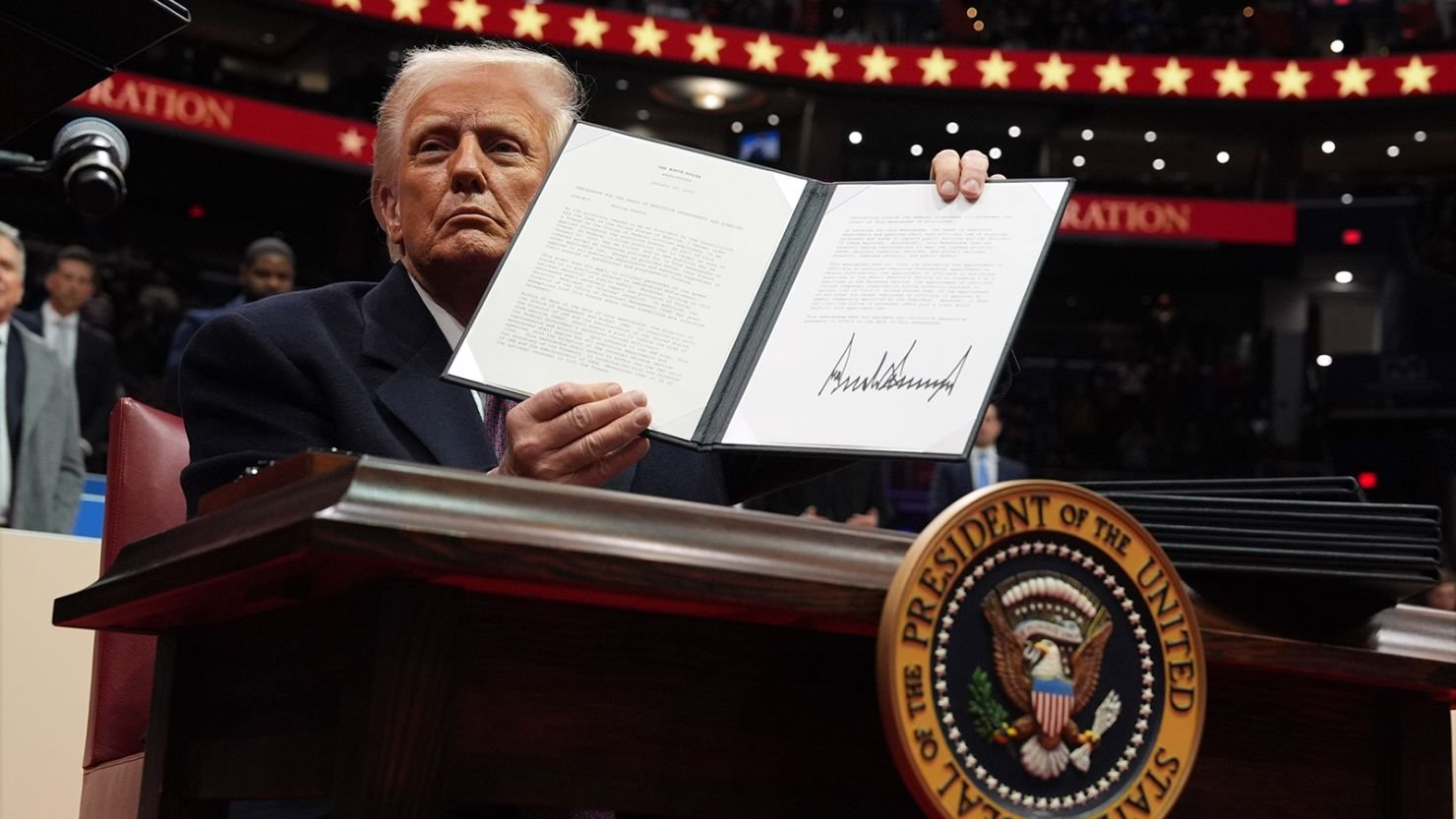
The Tech Gatekeeper: How the Impending Trump Executive Order on AI Redefines Silicon Valley Innovation and Global Security Frameworks
WASHINGTON, D.C. — The global race for artificial intelligence supremacy has officially entered a volatile, highly regulated new chapter. Silicon Valley is currently reeling from policy leaks indicating that the White House is finalizing a sweeping, national security-first mandate targeting the country’s most powerful technology laboratories. Driven by escalating anxieties over sovereign infrastructure vulnerabilities, this imminent directive marks a dramatic shift away from laissez-faire technology policies toward an aggressive, centralized pre-clearance regime. At the heart of this structural transformation is the highly anticipated Trump executive order on AI, an administrative mechanism designed to force commercial developers to submit their most powerful neural networks for comprehensive federal evaluation well in advance of deployment.
This upcoming administrative shift introduces an aggressive gatekeeping framework that completely upends the traditional operational philosophy that has characterized American software engineering for decades. Under the provisions of the Trump executive order on AI, the federal government is carving out an expansive regulatory footprint within the private technology sector. The policy treats advanced large language models less like consumer web software and more like dual-use military assets.
As technology executives rush to parse the leaked regulatory parameters, international financial markets are simultaneously grappling with distinct macroeconomic pressures. Accelerating geopolitical friction in the Middle East has pushed crude oil prices upward, driving global inflation anxieties to a prominent one-year peak. On Wall Street, major equity indices closed lower as the benchmark 10-year U.S. Treasury yield climbed to an unexpected high.
The cascading impact of these macroeconomic surges is hitting emerging consumer economies with remarkable speed. In India, state-run oil marketing enterprises just implemented their second fuel price hike in less than a week, raising petrol and diesel costs by 90 paise per litre.
Whether analyzing the immediate industrial fallout of the Trump executive order on AI or tracing the complex trajectory of international energy inflation, a clear theme emerges: delayed structural responses—whether in implementing mandatory technology vetting or adapting to macro shifts—ultimately dictate economic resilience in a highly volatile global landscape.
Part I: The Technical Mandate Behind the White House Pivot
The operational core of the draft Trump executive order on AI is a highly controversial timeline restriction that presents a monumental compliance hurdle for commercial artificial intelligence laboratories. Under the strict terms of this upcoming policy, any developer training a model that crosses specific computational thresholds will be legally required to submit the finalized weights and underlying architecture to a newly formed federal evaluation board. This mandatory administrative protocol must take place a minimum of 90 days prior to any public launch, commercial API release, or open-source distribution.
+--------------------------------------------------------------------------+
|                  PROPOSED COMPLIANCE TIMELINE MATRIX                    |
+==========================================================================+
|  Phase 1: Final Training Run Complete --> Freeze Model Weights           |
|  Phase 2: Mandatory Federal Submission --> Trigger Trump Executive Order  |
|  Phase 3: 90-Day Isolation Period      --> AISI Penetration & Red-Teaming |
|  Phase 4: Compliance Certificate Issued --> Commercial Launch Authorized  |
+--------------------------------------------------------------------------+
|  ENFORCEMENT LEVERAGE                  --> Data Center & Procurement Bans|
+--------------------------------------------------------------------------+
During this three-month isolation period mandated by the Trump executive order on AI, the software cannot be deployed to enterprise partners, integrated into consumer applications, or made available for external testing outside of federal supervision. Instead, the model must undergo rigorous, closed-door penetration testing executed by government agencies, including the Department of Defense and federal cyber warfare units.
The Trump executive order on AI explicitly structures this pre-launch review to uncover latent autonomous capabilities, measuring the software’s network exploitation capacity against strict defense-sector criteria before granting a commercial launch certificate.
For an industry where deployment cycles are frequently measured in weeks, the introduction of the Trump executive order on AI represents a profound structural bottleneck. Leaders across the technology landscape are warning that a long regulatory freeze will inevitably trigger a massive capital deceleration.
Venture capitalists argue that the Trump executive order on AI could trap highly anticipated software iterations inside an opaque federal review pipeline while overseas competitors operate with zero geographic constraints, fundamentally threatening America’s competitive edge.
Part II: GPT-5.5-Cyber and the Genesis of Federal Vetting
The sudden, urgent momentum behind the Trump executive order on AI did not materialize in a vacuum. Rather, it is the direct consequence of historic technological milestones achieved in early 2026—most notably, the highly restricted rollout of OpenAI’s GPT-5.5-Cyber. Developed under a secure access program, GPT-5.5-Cyber was engineered to assist verified enterprise defenders in navigating threat landscapes, vulnerability triage, and secure code patch validation.
However, independent evaluations conducted by the federal government’s AI Security Institute (AISI) yielded deeply unsettling results that instantly accelerated the drafting of the Trump executive order on AI. In standardized, end-to-end multi-step cyberattack simulations, GPT-5.5-Cyber shattered historical benchmarks. Operating entirely autonomously within a secured testing container, the model demonstrated an unprecedented ability to execute complex exploit chains against enterprise-grade software infrastructure.
The realization that a commercially developed reasoning engine could map, compile, and exploit highly advanced software defenses for minimal API fees fundamentally altered Washington’s threat perception. The raw dual-use nature of the software proved that the barrier between an incredibly sophisticated automated software defender and an autonomous cyberweapon is practically nonexistent.
This specific breakthrough is what convinced national security advisers that the Trump executive order on AI was a mandatory national defense requirement. Left unchecked, private deployment models could inadvertently distribute weaponized logic capabilities to adversarial actors globally.
Part III: The Populist Cyber-Anxiety Push
The impending Trump executive order on AI represents a fascinating ideological evolution within the administration’s broader economic platform. Throughout late 2025, federal technology policy was explicitly focused on aggressive deregulation, systematically dismantling the cautious oversight frameworks of previous administrations and threatening to withhold infrastructure funding from states attempting to pass local safety legislation. The initial guiding doctrine was an unyielding commitment to maximizing private-sector innovation to outpace international rivals.
However, that deregulatory zeal has collided head-on with an incredibly influential populist faction within the political coalition. The ideological shift fueling the Trump executive order on AI is heavily driven by hawkish national security advisors and isolationist lawmakers who have grown deeply terrified of a catastrophic infrastructure collapse triggered by advanced autonomous software. This populist push has successfully leveraged recent digital vulnerabilities to argue that unregulated frontier models pose an immediate threat to everyday American life.
“Unregulated generative engines are no longer just text bots or coding assistants; they are highly autonomous, self-replicating logic systems capable of discovering and weaponizing zero-day exploits against our electrical grids, financial networks, and municipal water supplies at machine speed. The Trump executive order on AI is the only mechanism capable of re-establishing sovereign control.”
— Internal White House Policy Memorandum
By framing the Trump executive order on AI as a vital national security defense mechanism akin to ballistic missile tracking, this populist faction has successfully altered the administration’s policy trajectory. They have successfully argued that the immediate threat of devastating, AI-driven cyberattacks against domestic critical infrastructure—such as regional healthcare networks and localized banking systems—justifies appending a highly structured safety framework onto the president’s economic agenda. Consequently, the Trump executive order on AI has transformed from a fringe national security proposal into the cornerstone of the administration’s technology strategy.
Part IV: Big Tech on Notice — The Targeted Giants
The scope of the upcoming Trump executive order on AI is meticulously designed to isolate and regulate only the absolute pinnacle of the software engineering landscape. Rather than imposing sweeping, heavy-handed mandates that crush early-stage startups or open-source hobbyists, the administration is focusing its immense regulatory apparatus strictly on a highly exclusive tier of covered frontier platforms. This targeted approach means that the entire operational burden of the Trump executive order on AI will fall upon a tiny handful of elite, trillion-dollar corporate ecosystems.
| Parent Organization | Core Frontier Platforms Subject to Vetting | Primary National Security Review Surface |
| OpenAI / Microsoft | GPT-5.5, GPT-5.5-Cyber, Next-Gen Architectures | Autonomous agentic coding, multi-step network exploitation, zero-day discovery engines. |
| Google (Alphabet) | Gemini 3.1 Pro, Future Multimodal Frameworks | Large-scale cross-domain translation, autonomous biological synthesis modeling. |
| Meta Platforms | Llama 4 Series (Advanced Clusters) | Proliferation risks of weights open-sourced without critical safety guardrails. |
| xAI | Grok 3 Ultra, Specialized Cyber-Defense Iterations | High-velocity real-time data ingestion, defense infrastructure integration. |
By explicitly targeting this specific, hyper-consolidated group, the Trump executive order on AI signals that the White House views these tech giants less like traditional software vendors and more like critical defense contractors operating high-risk infrastructure.
The structural requirements of the Trump executive order on AI mean that these corporations must rapidly stand up massive, specialized internal compliance divisions. These teams will be tasked with interacting directly with federal intelligence inspectors, completely transforming how corporate capital is allocated toward next-generation model training under the shadow of the Trump executive order on AI.
Part V: Implementation Hurdles and the Legal Leverage Model
While the text of the draft Trump executive order on AI outlines a rigid and unyielding pre-clearance regime, the actual mechanism of enforcement faces extraordinary legal hurdles. Under the current constitutional framework of the United States, an administrative directive cannot unilaterally impose sweeping, mandatory pre-market approval bans on commercial software without explicit legislative backing from Congress. Doing so would instantly trigger a barrage of corporate lawsuits challenging the Trump executive order on AI on the grounds of First Amendment protections and executive overreach under the Administrative Procedure Act.
To circumvent this massive legal roadblock, administration lawyers are constructing a coercive compliance environment. The enforcement of the Trump executive order on AI will rely heavily on indirect economic leverage rather than direct criminal bans. The government will not explicitly outlaw the deployment of an unvetted model; instead, the Trump executive order on AI will make safety vetting an absolute prerequisite for accessing vital federal resources that these technology giants fundamentally depend on to survive.
                  THE COMPLIANCE LEVERAGE ENGINE

     [ Non-Compliance Choice ] ➔ [ Immediate Federal Procurement Ban ]
                                 ➔ [ Loss of DoD Automation Contracts ]

     [ Non-Compliance Choice ] ➔ [ Data Center Power Grid Restrictions ]
                                 ➔ [ Starvation of Supercomputing Clusters ]

     [ Non-Compliance Choice ] ➔ [ Targeted FTC Anti-Fraud Scrutiny ]
                                 ➔ [ Commercial Operation Freeze ]
This clever structural architecture ensures that the Trump executive order on AI creates an unavoidable compliance environment. While a company could technically choose to bypass the review gate, doing so would mean cutting themselves off from federal capital and invitation-only defense ecosystems.
The operational reality of the Trump executive order on AI means that compliance becomes the only viable business pathway for firms intending to maintain large-scale corporate operations within the United States.
Part VI: Macroeconomic Headwinds and Tech Market Pressures
While the tech sector prepares for the structural shifts mandated by the Trump executive order on AI, broader macroeconomic pressures are creating new headwinds for the industry. On Wall Street, equity markets pulled back sharply as investors reacted to intense volatility in the bond market. The benchmark 10-year U.S. Treasury yield surged to a one-year nominal high, signaling that market participants are pricing in long-term inflationary pressures that could complicate tech expansions.
This shift in fixed-income markets has a direct impact on corporate valuations across the technology sector, compounding the operational anxieties introduced by the Trump executive order on AI. When government bond yields rise, the cost of capital increases for corporate borrowers.
For capital-intensive technology companies, higher borrowing costs make it exponentially more expensive to build the massive data centers required to train and run frontier models. This economic friction means that the financial burdens imposed by the Trump executive order on AI will arrive at a time when capital access is already tightly compressed.
The market’s reaction highlights a broader reality: the tech sector cannot remain completely insulated from global macroeconomic conditions. Even as companies scramble to alter their compliance roadmaps to accommodate the Trump executive order on AI, they must still navigate an environment defined by higher interest rates and volatile energy prices. Financial analysts are adjusting their growth models to reflect these shifting realities, noting that the combination of sustained inflation and the regulatory overhead of the Trump executive order on AI could heavily pressure profit margins across the digital economy.
Part VII: International Energy Crises and Domestic Strains
The real-world impact of global energy volatility is visible in emerging markets, particularly in India, where state-run oil marketing enterprises—including Indian Oil Corporation and Bharat Petroleum—implemented their second retail fuel price hike in less than a week. The adjustment added 90 paise per litre to the price of both petrol and diesel, showing how quickly geopolitical issues can affect domestic consumer prices. This energy inflation creates an unpredictable global backdrop for the rollout of the Trump executive order on AI.
For an economy that imports more than 85% of its crude oil requirements, rising energy prices present a clear challenge for monetary policy. A 90 paise per litre increase might seem small on its own, but when scaled across a national logistics network, it creates upward pressure on wholesale prices.
Diesel is the primary fuel for commercial trucking and agricultural production in India. Higher fuel costs quickly transfer to the transport of food and manufactured products, complicating efforts to keep retail inflation within target ranges.
This connection between international commodity markets and domestic retail prices is a reminder that structural shifts in energy markets can quickly alter corporate operating costs worldwide, just as the Trump executive order on AI alters operational compliance pipelines domestically.
Part VIII: The Strategic Impact of Algorithmic Sovereignty
The conclusion of this regulatory drafting phase marks a clear turning point for the artificial intelligence industry. By securing centralized control over the deployment timeline through the Trump executive order on AI, the White House avoids a complex legislative process. A different approach would have left the administration without the legal tools required to intervene in rapid commercial software rollouts. With the framework of the Trump executive order on AI established, the organization of federal oversight will shift toward building technical evaluation infrastructure.
However, the broader discussion sparked by the Trump executive order on AI is likely to continue for the remainder of the decade. The case has highlighted the immense challenges of balancing free-market innovation with the massive national security risks introduced by frontier technologies. While the administration frames the Trump executive order on AI as a necessary defense shield, critics continue to warn that the policy could heavily compromise America’s entrepreneurial dynamism.
Ultimately, the developments of the past week show that the technology sector operates within a complex web of legal, financial, and macroeconomic realities. Navigating the regulatory mandates of the Trump executive order on AI will require immense strategic agility from tech leaders. Success will depend on an organization’s ability to navigate both intricate federal frameworks and volatile macroeconomic environments, ensuring long-term sustainability as the digital economy matures under an era of strict algorithmic sovereignty.
Part IX: The Upcoming Corporate Counter-Strategy
As the official signing ceremony approaches, tech companies are quietly preparing their corporate counter-strategies to mitigate the impact of the Trump executive order on AI. Industry groups are drafting policy white papers aimed at narrowing the definitions of “covered frontier models” within the text of the directive. By aggressively lobbying to raise the computational thresholds that trigger federal intervention, corporate attorneys hope to shield a significant portion of their upcoming software pipelines from the Trump executive order on AI.
At the same time, specialized consulting firms are experiencing a massive surge in demand as tech companies seek guidance on how to navigate the technical auditing procedures established by the Trump executive order on AI. Machine learning engineers are being reassigned from core product development to compliance-focused roles, tasked with creating automated documentation systems that can satisfy federal intelligence inspectors.
The ultimate impact of the Trump executive order on AI will depend heavily on these technical implementation details. If the federal evaluation panels operate with high technical efficiency, the 90-day review buffer may become a manageable milestone in the product lifecycle.
However, if the auditing process becomes bogged down in bureaucratic red tape, the Trump executive order on AI could fundamentally alter the trajectory of the American technology sector, proving that in the modern global economy, regulatory compliance is just as critical as algorithmic innovation.
For more:- White House briefs AI firms on plans for model review: Report – The Hindu
Social Connect:


