



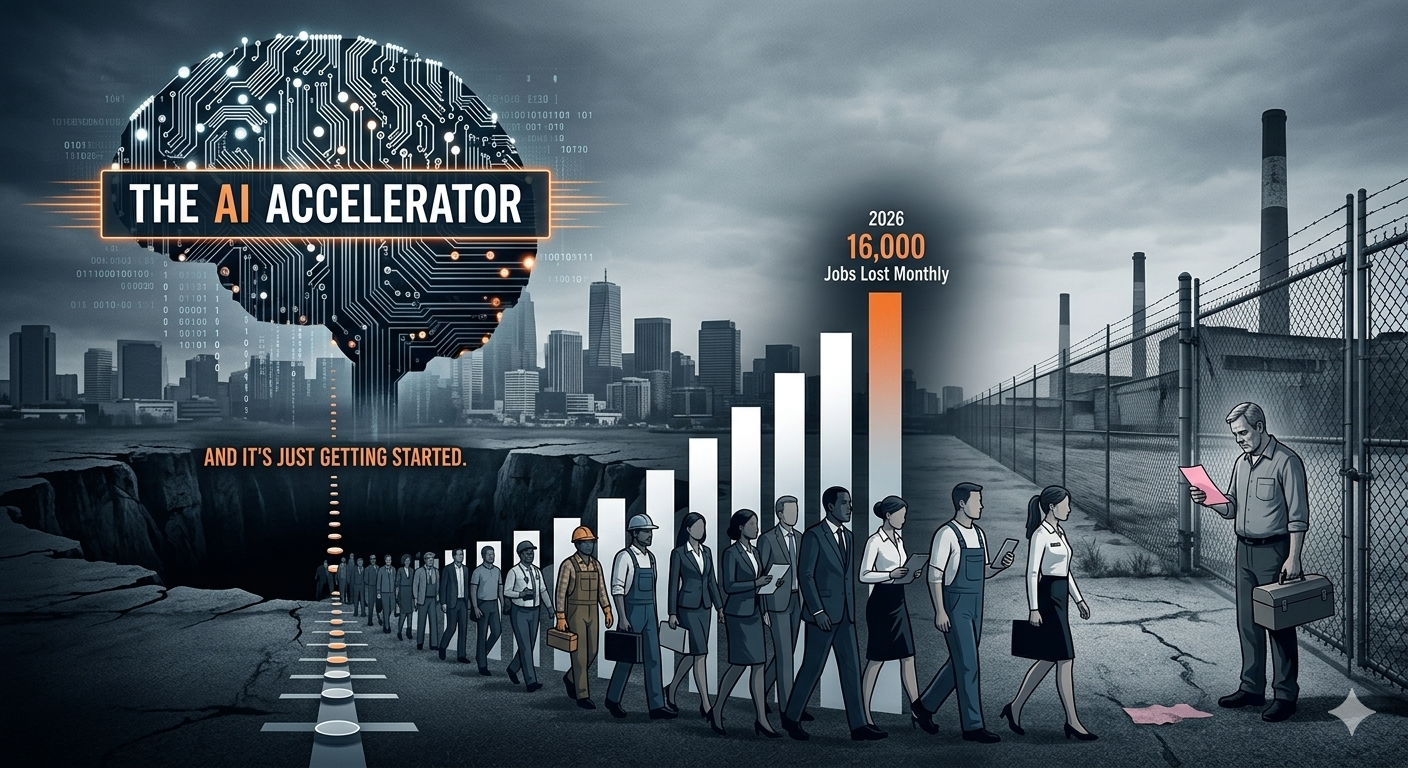
America’s AI Crisis: 16000 Jobs Lost Every Month And It’s Just Getting Started

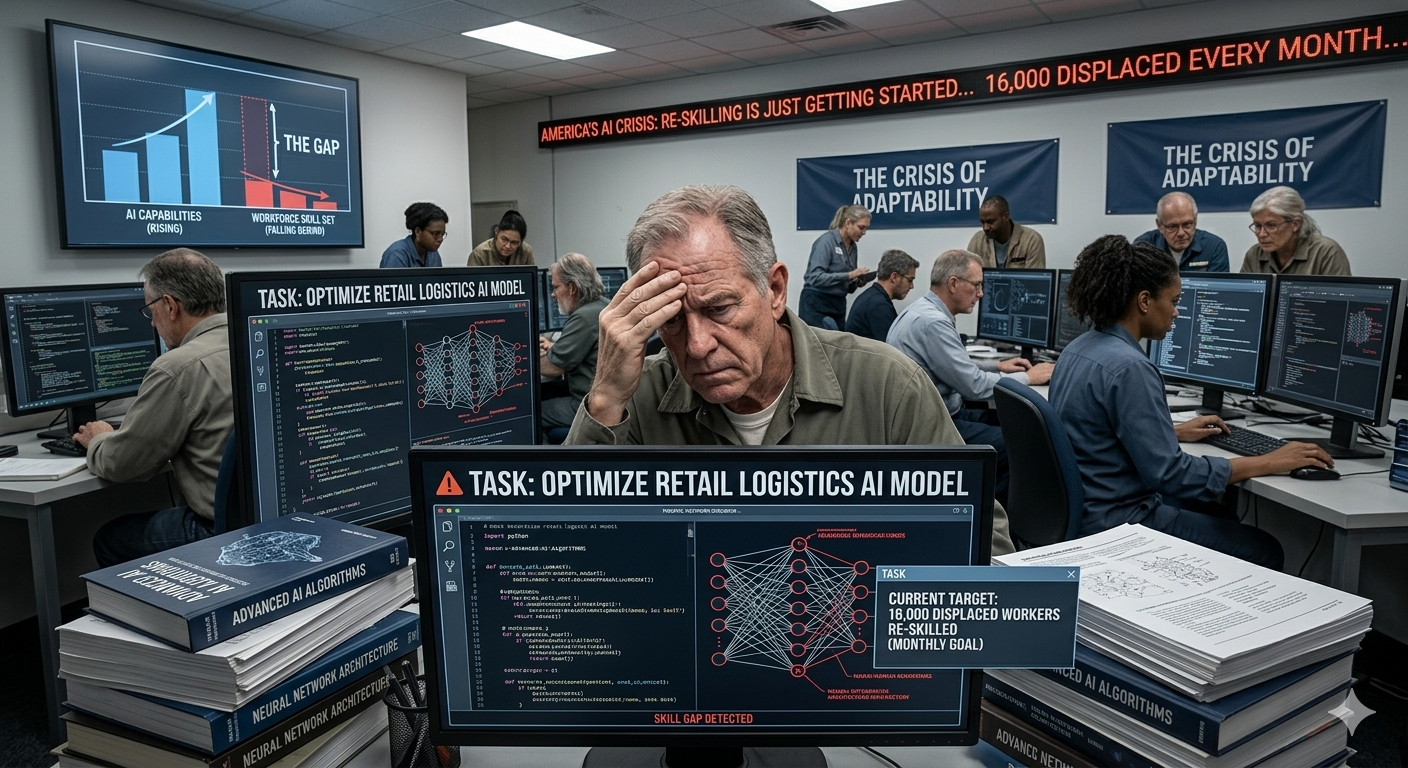
From Silicon Valley layoffs to entry-level roles vanishing overnight, artificial intelligence is dismantling decades of American workforce stability at a pace economists never predicted. New data reveals the full, alarming scope of what’s really happening.
The numbers are no longer hypothetical. Artificial intelligence is cutting roughly 16,000 American jobs every single month, according to new research by Goldman Sachs economists — and the wave is accelerating far faster than Washington, corporate boardrooms, or the workers themselves were prepared to handle. What began as a distant threat debated in academic journals has become a lived reality for hundreds of thousands of Americans in 2026.
The disruption isn’t hitting everyone equally. Young professionals, entry-level workers, and those in highly structured, routine-heavy roles are absorbing the sharpest blows. Meanwhile, senior employees and those in leadership positions are, paradoxically, often becoming more productive — and more valuable — precisely because of the same tools displacing their junior colleagues.
“AI is destroying some jobs, creating others, and making many workers more valuable — all at the same time. The problem is that the destruction is hitting first, faster, and harder.”
— GOLDMAN SACHS RESEARCH, APRIL 2026
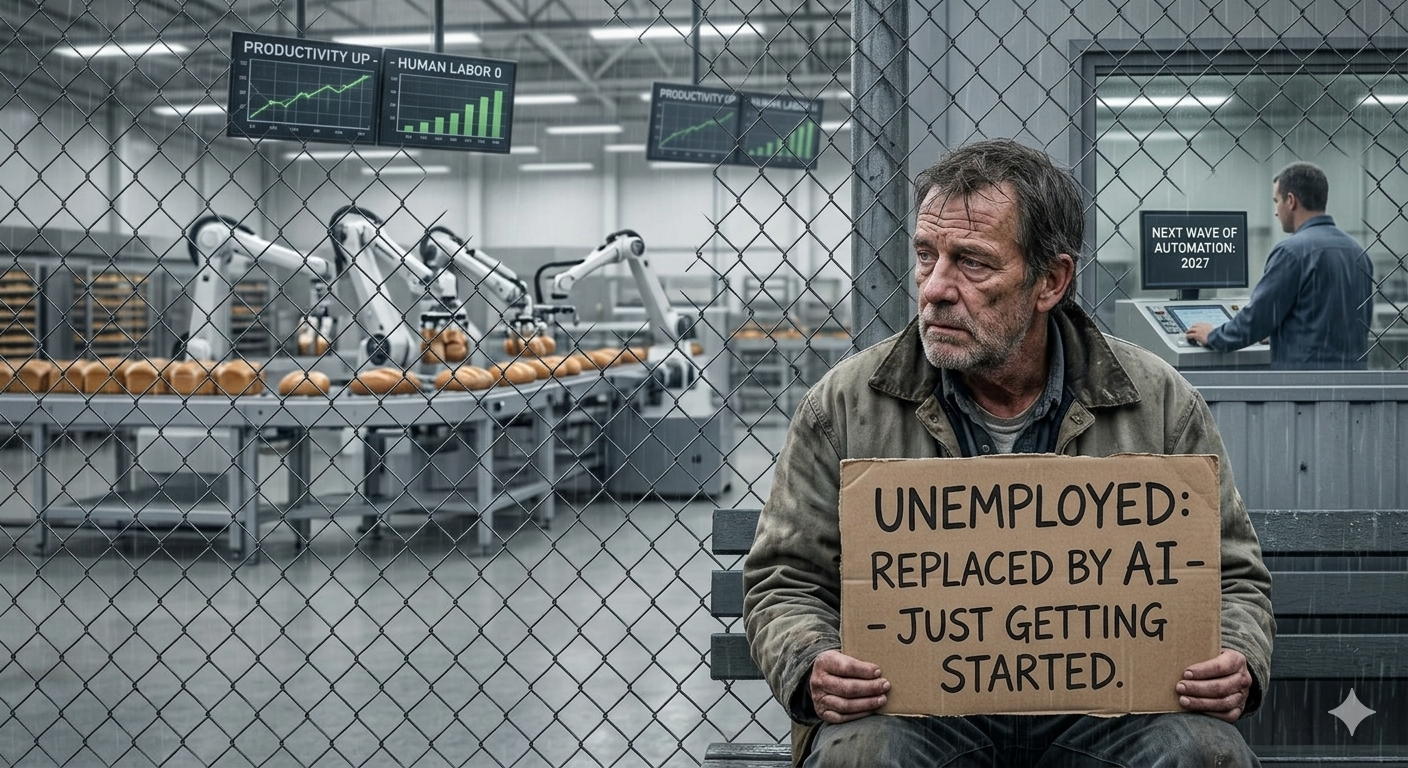
The Scale of Disruption: What the Data Actually Says
By the close of Q1 2026, more than 78,500 workers in the tech industry alone had been handed pink slips — with over 76% of those positions located right here in the United States, according to industry tracking data. Nearly half of those cuts, approximately 47.9%, were directly attributed to AI-driven automation and workflow restructuring.
Boston Consulting Group delivered one of the starkest projections yet: over the next three years, AI will reshape between 50% and 55% of all US jobs. And for those hoping their position simply “adapts,” BCG’s researchers add a cold caveat — 10% to 15% of American jobs could be fully replaced by AI within five years.
“There’s almost a knee-jerk reaction — we’ll cut jobs and have layoffs. It’s indiscriminate, and that’s harmful for society because we need people to have jobs,” BCG Managing Director Matthew Kropp told reporters. “Yes, some will go away, but many jobs you’ll be re-skilling people to work in a different way.”
THE LAYOFFS MAKING HEADLINES
In early March 2026, Block — the payments company led by Jack Dorsey — eliminated 4,000 positions, representing roughly 40% of its entire global workforce. Dorsey cited the “growing capability of AI tools to perform a wider range of tasks” as the driving force. It was the single largest AI-attributed layoff event in tech history — until Oracle reportedly followed suit weeks later, cutting an estimated 20,000 to 30,000 employees in what insiders described as a sweeping, AI-driven organizational overhaul.
These aren’t isolated incidents. They are the sharpest edge of a trend already reshaping nearly every sector of the American economy.
Gen Z Is Taking the Brunt — And the Irony Is Brutal
Perhaps no group illustrates the paradox of the AI era more painfully than Generation Z. This is the cohort most natively fluent in AI tools — the same young Americans who are building side projects with large language models, entering the workforce with AI literacy their 45-year-old managers lack, and who championed the very technologies now being used to eliminate their job categories.
Stanford University’s 2026 AI Index reveals a trend that should alarm policymakers: employment among software developers aged 22 to 25 has plummeted nearly 20% since 2024 — even as headcount among their older counterparts continues to grow. The same pattern is repeating in customer service, content creation, data entry, and other roles dominated by young workers just entering the professional world.
“The adaptation is already happening among Gen Z — but it isn’t showing up yet in the job numbers. The creation of new opportunities, if history is any guide, will take longer to materialize.”
— STANFORD HUMAN-CENTERED AI INSTITUTE, 2026
The brutal irony: the generation absorbing the most displacement is also the generation most likely to adapt. But adaptation takes time — and for young Americans entering a job market contracting at this speed, time may be the one resource they don’t have.
Who’s Most at Risk? A Sector-by-Sector Breakdown
Not every American worker faces the same level of exposure. The risk is concentrated, targeted, and in many cases already underway. Here’s how AI is hitting the major sectors of the US workforce:
| SECTOR | AI RISK LEVEL | KEY THREAT | RISK SCORE |
|---|---|---|---|
| Software Development | Very High | AI coding assistants (Copilot, Cursor) | |
| Customer Service | Very High | AI chatbots & voice agents | |
| Content & Copywriting | High | Generative AI text tools | |
| Data Entry & Admin | High | Automation & AI workflow tools | |
| Legal & Paralegal | Moderate–High | AI document analysis & research | |
| Healthcare | Moderate | AI clinical notes; diagnostic tools | |
| Skilled Trades | Low | Minimal near-term automation risk |
THE DEVELOPER PRODUCTIVITY TRAP
One of the most consequential — and least discussed — dynamics of 2026’s AI wave is what’s happening inside software teams. AI coding assistants like GitHub Copilot and Cursor have fundamentally redefined what a single developer can produce. Industry data shows developers using these tools are generating 40% to 55% more code per sprint while maintaining comparable quality.
The math is brutally simple: a team of ten developers with AI tools can now produce the output of fifteen without them. New software engineering job postings dropped 15% in just the first two months of 2026 compared to the same period in 2025, according to LinkedIn labor market data. The message from corporate America is clear — fewer humans, same output.
Washington Is Falling Behind — And Americans Know It
Perhaps the most sobering finding of the 2026 Stanford AI Index isn’t about jobs at all. It’s about trust. Only 31% of Americans trust their government to regulate artificial intelligence effectively — the lowest figure among all surveyed nations. In a separate poll, more than half of all Americans said they believe AI will do more harm than good.
Just 33% of American workers expect AI to make their jobs better — well below the global average of 40%. This deep-seated skepticism has become a defining feature of the national mood around technology, even as consumers continue adopting AI tools at record speed.
The share of Americans who trust their government to regulate AI — the lowest figure of any country surveyed in the 2026 Stanford AI Index. For context, the global average is nearly twice as high.
Meanwhile, a recent Gallup survey of more than 23,700 US employees found that 41% now work in an organization that has integrated AI tools — up three points in a single quarter. Among workers in AI-adopting firms, 27% say their workplace has changed in deeply disruptive ways over the past year alone. The pace of change is overwhelming institutional capacity to manage it.
Is This Time Really Different? The Debate Raging Among Economists
Not every labor economist is sounding the alarm. A vocal contingent argues that what we’re seeing today mirrors every major technology transition in American history — steam power, electrification, the internet — all of which ultimately created more jobs than they destroyed. In their view, AI will similarly birth entirely new industries, roles, and economic activities that we cannot yet fully envision.
Even OpenAI CEO Sam Altman weighed in, acknowledging a phenomenon economists are now calling “AI washing” — where companies use AI as justification for layoffs that would have happened anyway due to weak business performance. “There’s some AI washing where people are blaming AI for layoffs that they would otherwise do,” Altman admitted publicly, “and then there’s some real displacement.”
IBM is bucking the trend entirely, reportedly tripling its entry-level hiring in 2026, with company leadership arguing that while AI can perform many entry-level tasks, it still requires human oversight, domain expertise, and contextual judgment. The message: companies that invest in human-AI collaboration — rather than simple replacement — may find themselves better positioned in the long run.
What This Means for the Average American Worker in 2026
The picture that emerges from the data is neither a dystopian collapse nor a painless transition. It is something messier, more unequal, and more urgent than either narrative allows. AI is simultaneously a productivity engine, a job destroyer, and — for those with the skills and access to harness it — a career accelerator.
THE SKILLS THAT STILL MATTER
Across industries, workers who are thriving in the AI era share a common profile: they use AI tools actively, apply human judgment to AI outputs, and specialize in areas requiring creativity, empathy, complex reasoning, and physical presence. Healthcare workers and employees in technical roles lead in reported productivity gains. Workers in service and administrative support roles are struggling most to find value in the new paradigm.
McKinsey’s Global Institute projects that AI could automate 30% of all work activities across the global economy by 2030 — with knowledge work and white-collar professions experiencing the fastest transformation. Goldman Sachs puts the long-term exposure figure at 300 million full-time jobs globally, with the United States as the leading edge of that disruption.
THE POLICY GAP NO ONE IS FILLING
What is conspicuously absent from this picture is a coherent national response. There is no federal AI workforce transition program of scale. There is no bipartisan consensus on retraining policy. There is no safety net purpose-built for workers displaced by algorithmic automation rather than traditional economic downturns. The workers losing their livelihoods to AI tools are not losing them to a recession — they’re losing them to a shift that is permanent, structural, and accelerating.
As corporate America races to capture AI’s productivity gains, and as Washington scrambles to even define the regulatory boundaries of the technology, it is ordinary American workers — the software developer in their late twenties, the customer service rep in Ohio, the paralegal in Atlanta — who are left to navigate this transformation largely alone.
“Those who fail to dramatically rethink work will see their competitors grow faster and more profitably. But those who cut their workforce beyond AI’s ability to replace it will see productivity drop and critical talent walk away.”
— BOSTON CONSULTING GROUP, APRIL 2026
The AI revolution is not coming. It is here. It is measurable. It is monthly. And for 16,000 Americans every single month, it is personal. The question facing the nation is not whether to adapt — it is whether America will build the systems, the policies, and the cultural will to ensure that adaptation is a shared opportunity rather than a shared catastrophe.
Related News :
Major Workers’ Compensation and Employment Law Changes Take Effect Across the United States in 2026
Social Connect :


